 Add to Chrome
 Add to Firefox
 Add to Edge
You Only Align Once: Propagating Cooperative Behaviors in Multi-Agent Systems through Seed Agents
May 26, 2026
Ensuring agent behaviors in distributed open multi-agent systems remains challenging, especially as populations grow and unaligned agents may exist. We show that a single aligned agent can propagate cooperative behaviors to untrained agents purely through natural language interaction, a phenomenon we term Alignment Propagation. We study this in the Red-Black Game, a team-based iterated Prisoner's Dilemma in which teammates deliberate and vote to determine their team's collective action. By distilling the cooperative reasoning and persuasive dialogues of a teacher model into a Qwen-3-14B, we obtain a seed agent that, when placed among four untrained teammates, doubles the cooperation rate from 24.8% to 62.2%, outperforming the teacher model and a vanilla Gemini-3.1-Pro. Remarkably, a seed trained exclusively on the RedBlack Game transfers zero-shot to Sugarscape, a spatially grounded survival simulation with pairwise trading, achieving a 91.5% trade success rate versus a 21.6% baseline. Our results reframe multi-agent alignment from an exhaustive per-agent training problem to a scalable social capability that can be engineered through strategic seed placement.

VisFactor: Benchmarking Fundamental Visual Cognition in Multimodal Large Language Models
Feb 23, 2025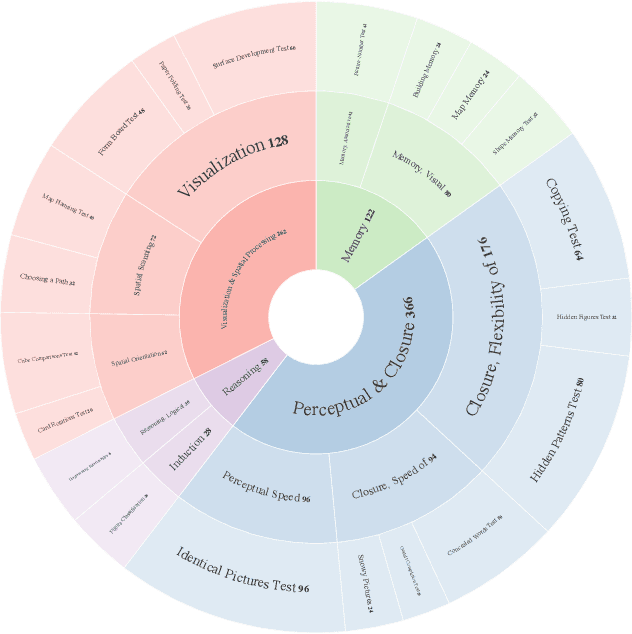
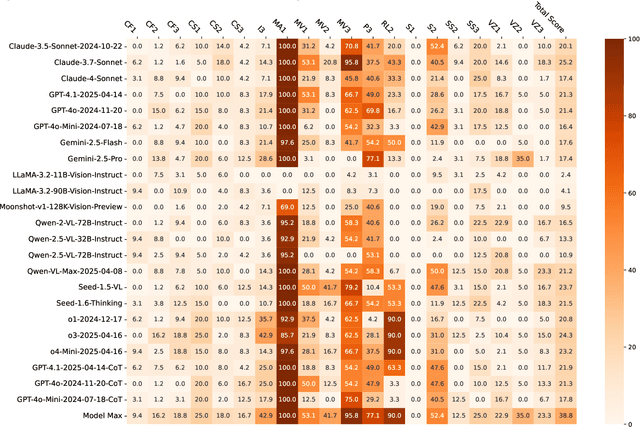
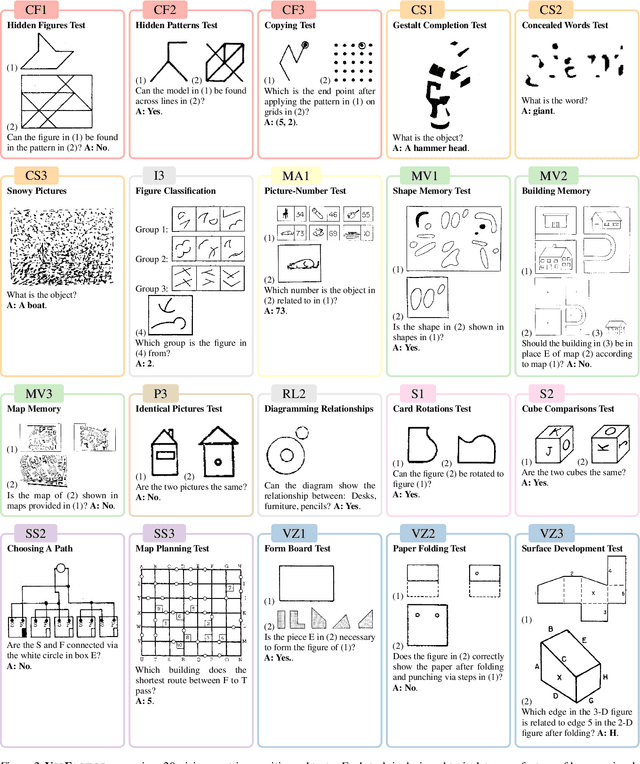

Multimodal Large Language Models (MLLMs) have demonstrated remarkable advancements in multimodal understanding; however, their fundamental visual cognitive abilities remain largely underexplored. To bridge this gap, we introduce VisFactor, a novel benchmark derived from the Factor-Referenced Cognitive Test (FRCT), a well-established psychometric assessment of human cognition. VisFactor digitalizes vision-related FRCT subtests to systematically evaluate MLLMs across essential visual cognitive tasks including spatial reasoning, perceptual speed, and pattern recognition. We present a comprehensive evaluation of state-of-the-art MLLMs, such as GPT-4o, Gemini-Pro, and Qwen-VL, using VisFactor under diverse prompting strategies like Chain-of-Thought and Multi-Agent Debate. Our findings reveal a concerning deficiency in current MLLMs' fundamental visual cognition, with performance frequently approaching random guessing and showing only marginal improvements even with advanced prompting techniques. These results underscore the critical need for focused research to enhance the core visual reasoning capabilities of MLLMs. To foster further investigation in this area, we release our VisFactor benchmark at https://github.com/CUHK-ARISE/VisFactor.
InstantIR: Blind Image Restoration with Instant Generative Reference
Oct 09, 2024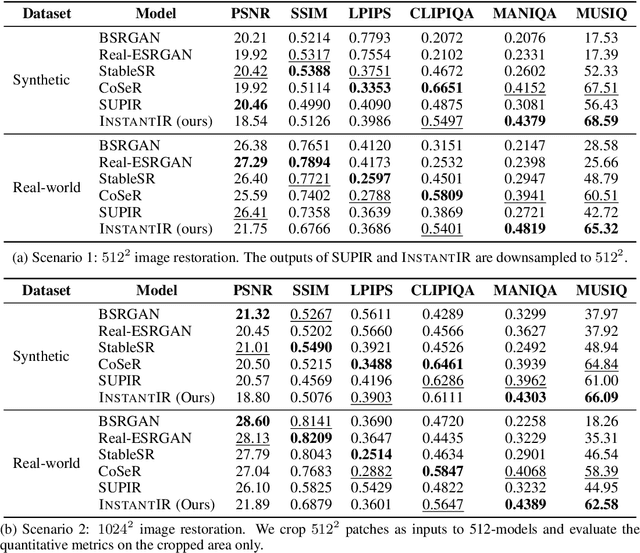

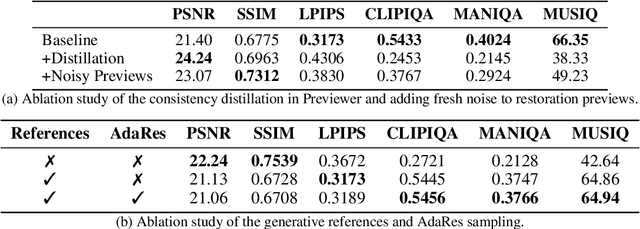

Handling test-time unknown degradation is the major challenge in Blind Image Restoration (BIR), necessitating high model generalization. An effective strategy is to incorporate prior knowledge, either from human input or generative model. In this paper, we introduce Instant-reference Image Restoration (InstantIR), a novel diffusion-based BIR method which dynamically adjusts generation condition during inference. We first extract a compact representation of the input via a pre-trained vision encoder. At each generation step, this representation is used to decode current diffusion latent and instantiate it in the generative prior. The degraded image is then encoded with this reference, providing robust generation condition. We observe the variance of generative references fluctuate with degradation intensity, which we further leverage as an indicator for developing a sampling algorithm adaptive to input quality. Extensive experiments demonstrate InstantIR achieves state-of-the-art performance and offering outstanding visual quality. Through modulating generative references with textual description, InstantIR can restore extreme degradation and additionally feature creative restoration.