 Add to Chrome
 Add to Firefox
 Add to Edge
The Latin Substrate: How Language Models Represent and Mediate Script Choice
May 29, 2026
Many languages are written in multiple scripts, requiring large language models (LLMs) to generate equivalent linguistic content in distinct orthographic forms. While prior work suggests that LLMs route information through shared latent representations, how they internally mediate script variation remains poorly understood. We study this question by first examining per-layer output distributions with the logit lens, which reveals consistent latent romanization during transliteration, and then through representational and mechanistic analyses of script generation. At the representational level, we show that scripts of the same language become increasingly separable across layers and that a simple linear steering direction can flip a model's output script while largely maintaining semantic content. The vector generalizes asymmetrically to writing systems unseen during construction, flipping non-Latin output to Latin reliably, but mapping Latin output into varied non-Latin scripts. At the mechanistic level, we localize a small set of late-layer attention heads that causally mediate script choice. These heads transfer across unrelated languages and writing systems, suggesting that script routing is implemented by language-agnostic components. Across both analyses, we observe a consistent directional asymmetry: non-Latin output is produced by a compact, identifiable gate, while Latin-script output emerges from diffuse contributions across the network. Collectively, our findings hint that LLMs organize script variation around shared latent representations while exhibiting a privileged substrate toward Latin script.

Multilingual Steering by Design: Multilingual Sparse Autoencoders and Principled Layer Selection
May 21, 2026Sparse autoencoders (SAEs) enable feature-level mechanistic interpretability and activation steering in large language models (LLMs), but SAE-based language control remains unreliable in multilingual settings: most SAEs are trained on English-only data, and steering layers are chosen heuristically. We address these limitations by advancing a principled, mechanistic account of multilingual language steering with SAEs. First, we show that training SAEs on multilingual data consistently strengthens cross-lingual representations and yields more reliable, quality-preserving language control across layers and model families. Second, we introduce an \emph{a priori} steering layer-selection rule based on the intersection of multilingual alignment and language separability, which predicts effective intervention depths without exhaustive layerwise search. We evaluate our approach on LLaMA-3.1-8B and Gemma-2-9B across machine translation and cross-lingual summarization (CrossSumm), using SpBLEU, ROUGE-L, COMET, and LaSE. Our results show that multilingual SAEs combined with intersection-selected layers stabilize the trade-off between language identification accuracy and generation quality, providing a principled, predictive, representation-level account of multilingual SAE steering.
DFKI-MLT at SemEval-2026 TASK 7: Steering Multilingual Models Towards Cultural Knowledge
May 21, 2026Large language models (LLMs) are increasingly used across diverse linguistic and cultural contexts, yet their cultural knowledge remains uneven across regions and languages. We present the DFKI-MLT system for SemEval-2026 Task 7 on cultural awareness, where we apply activation steering to multilingual LLMs using language vectors extracted from parallel FLORES data. Our method performs inference-time adaptation by adding language-specific steering vectors to the residual stream at a selected transformer layer, without any parameter updates. We participated in both the short-answer (SAQ) and multiple-choice (MCQ) tracks; however, only our MCQ submission received an official score. In the official MCQ track, we achieved 86.96% accuracy, ranking 7th out of 17 teams. To better understand system behavior, we conduct post-hoc analyses on the shared-task MCQ and SAQ settings. These analyses show that activation steering yields modest and heterogeneous improvements on cultural reasoning: gains are strongly layer-sensitive, vary substantially across language-region pairs, with some configurations even degrading performance, and interact with prompt formulation, comparing generic and culturally conditioned prompts. Our findings suggest that prompt design and activation steering should be jointly optimized for culturally aware multilingual inference.
From Weights to Activations: Is Steering the Next Frontier of Adaptation?
Apr 15, 2026Post-training adaptation of language models is commonly achieved through parameter updates or input-based methods such as fine-tuning, parameter-efficient adaptation, and prompting. In parallel, a growing body of work modifies internal activations at inference time to influence model behavior, an approach known as steering. Despite increasing use, steering is rarely analyzed within the same conceptual framework as established adaptation methods. In this work, we argue that steering should be regarded as a form of model adaptation. We introduce a set of functional criteria for adaptation methods and use them to compare steering approaches with classical alternatives. This analysis positions steering as a distinct adaptation paradigm based on targeted interventions in activation space, enabling local and reversible behavioral change without parameter updates. The resulting framing clarifies how steering relates to existing methods, motivating a unified taxonomy for model adaptation.
ReasonXL: Shifting LLM Reasoning Language Without Sacrificing Performance
Apr 14, 2026Despite advances in multilingual capabilities, most large language models (LLMs) remain English-centric in their training and, crucially, in their production of reasoning traces. Even when tasked with non-English problems, these models predominantly reason in English, creating a fundamental mismatch for non-English usage scenarios. We address this disparity directly with three contributions. (i) We introduce ReasonXL, the first large-scale parallel corpus of cross-domain reasoning traces spanning five European languages (English, German, French, Italian, and Spanish), with over two million aligned samples per language, each comprising prompts, reasoning traces, and final outputs, enabling direct supervision of language-specific reasoning. (ii) Using ReasonXL, we demonstrate that LLMs can be adapted to reason entirely in a desired target language, using a simple two-stage pipeline of supervised fine-tuning (SFT) followed by reinforcement learning with verifiable rewards (RLVR). The resulting models match or exceed baseline performance, with minimal loss in general knowledge and broadly preserved cross-lingual transfer. (iii) We conduct an extensive representational analysis of the adaptation and find a clear functional division across model depth: early layers contain an activation bottleneck that causally determines language identity, while upper layers concentrate the weight and activation changes driven by adaptation. We further find that RLVR achieves greater behavioral divergence from the base model with smaller parameter updates than SFT, suggesting a more efficient representational rerouting despite much smaller weight updates.
CLaS-Bench: A Cross-Lingual Alignment and Steering Benchmark
Jan 13, 2026Understanding and controlling the behavior of large language models (LLMs) is an increasingly important topic in multilingual NLP. Beyond prompting or fine-tuning, , i.e.,~manipulating internal representations during inference, has emerged as a more efficient and interpretable technique for adapting models to a target language. Yet, no dedicated benchmarks or evaluation protocols exist to quantify the effectiveness of steering techniques. We introduce CLaS-Bench, a lightweight parallel-question benchmark for evaluating language-forcing behavior in LLMs across 32 languages, enabling systematic evaluation of multilingual steering methods. We evaluate a broad array of steering techniques, including residual-stream DiffMean interventions, probe-derived directions, language-specific neurons, PCA/LDA vectors, Sparse Autoencoders, and prompting baselines. Steering performance is measured along two axes: language control and semantic relevance, combined into a single harmonic-mean steering score. We find that across languages simple residual-based DiffMean method consistently outperforms all other methods. Moreover, a layer-wise analysis reveals that language-specific structure emerges predominantly in later layers and steering directions cluster based on language family. CLaS-Bench is the first standardized benchmark for multilingual steering, enabling both rigorous scientific analysis of language representations and practical evaluation of steering as a low-cost adaptation alternative.
Multilingual Political Views of Large Language Models: Identification and Steering
Jul 30, 2025Large language models (LLMs) are increasingly used in everyday tools and applications, raising concerns about their potential influence on political views. While prior research has shown that LLMs often exhibit measurable political biases--frequently skewing toward liberal or progressive positions--key gaps remain. Most existing studies evaluate only a narrow set of models and languages, leaving open questions about the generalizability of political biases across architectures, scales, and multilingual settings. Moreover, few works examine whether these biases can be actively controlled. In this work, we address these gaps through a large-scale study of political orientation in modern open-source instruction-tuned LLMs. We evaluate seven models, including LLaMA-3.1, Qwen-3, and Aya-Expanse, across 14 languages using the Political Compass Test with 11 semantically equivalent paraphrases per statement to ensure robust measurement. Our results reveal that larger models consistently shift toward libertarian-left positions, with significant variations across languages and model families. To test the manipulability of political stances, we utilize a simple center-of-mass activation intervention technique and show that it reliably steers model responses toward alternative ideological positions across multiple languages. Our code is publicly available at https://github.com/d-gurgurov/Political-Ideologies-LLMs.
Language Arithmetics: Towards Systematic Language Neuron Identification and Manipulation
Jul 30, 2025Large language models (LLMs) exhibit strong multilingual abilities, yet the neural mechanisms behind language-specific processing remain unclear. We analyze language-specific neurons in Llama-3.1-8B, Mistral-Nemo-12B, and Aya-Expanse-8B & 32B across 21 typologically diverse languages, identifying neurons that control language behavior. Using the Language Activation Probability Entropy (LAPE) method, we show that these neurons cluster in deeper layers, with non-Latin scripts showing greater specialization. Related languages share overlapping neurons, reflecting internal representations of linguistic proximity. Through language arithmetics, i.e. systematic activation addition and multiplication, we steer models to deactivate unwanted languages and activate desired ones, outperforming simpler replacement approaches. These interventions effectively guide behavior across five multilingual tasks: language forcing, translation, QA, comprehension, and NLI. Manipulation is more successful for high-resource languages, while typological similarity improves effectiveness. We also demonstrate that cross-lingual neuron steering enhances downstream performance and reveal internal "fallback" mechanisms for language selection when neurons are progressively deactivated. Our code is made publicly available at https://github.com/d-gurgurov/Language-Neurons-Manipulation.
On Multilingual Encoder Language Model Compression for Low-Resource Languages
May 22, 2025In this paper, we combine two-step knowledge distillation, structured pruning, truncation, and vocabulary trimming for extremely compressing multilingual encoder-only language models for low-resource languages. Our novel approach systematically combines existing techniques and takes them to the extreme, reducing layer depth, feed-forward hidden size, and intermediate layer embedding size to create significantly smaller monolingual models while retaining essential language-specific knowledge. We achieve compression rates of up to 92% with only a marginal performance drop of 2-10% in four downstream tasks, including sentiment analysis, topic classification, named entity recognition, and part-of-speech tagging, across three low-resource languages. Notably, the performance degradation correlates with the amount of language-specific data in the teacher model, with larger datasets resulting in smaller performance losses. Additionally, we conduct extensive ablation studies to identify best practices for multilingual model compression using these techniques.
LowREm: A Repository of Word Embeddings for 87 Low-Resource Languages Enhanced with Multilingual Graph Knowledge
Sep 26, 2024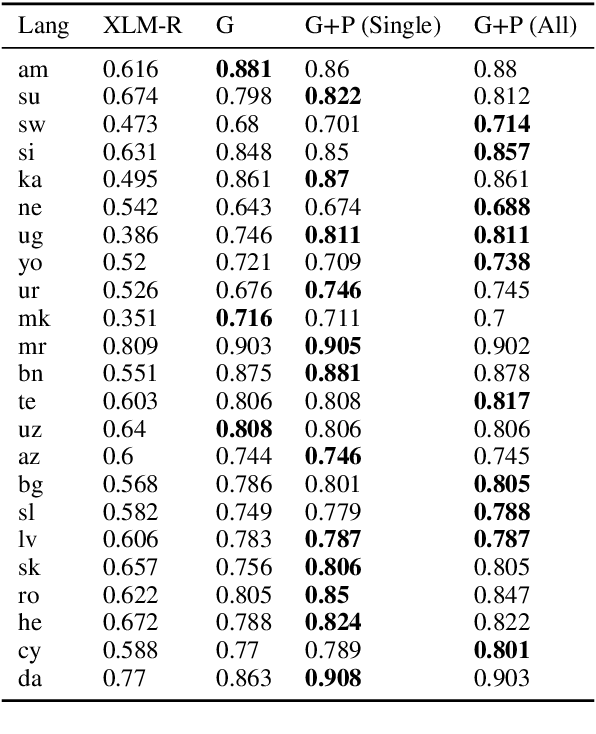
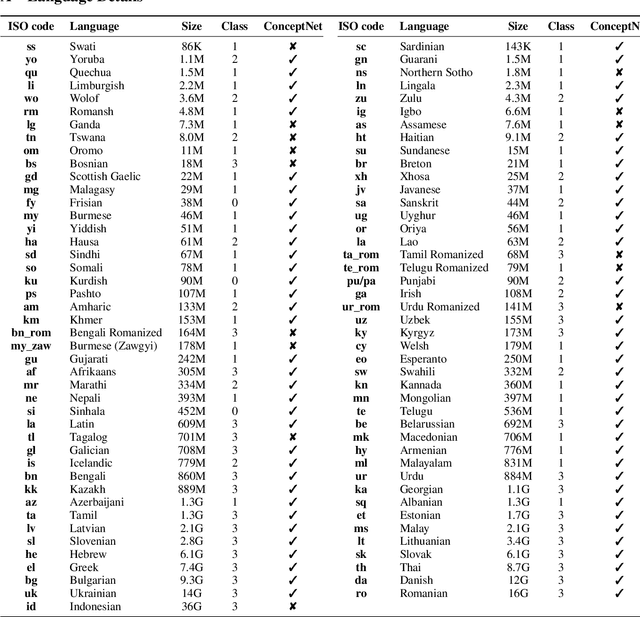
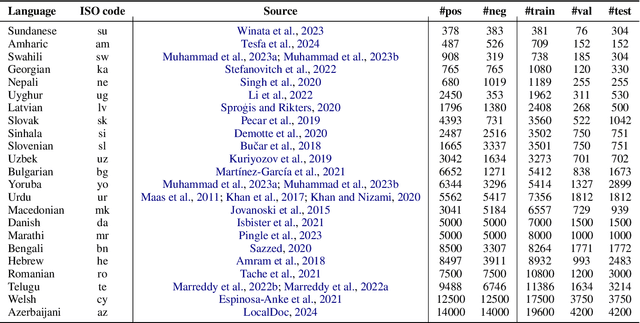
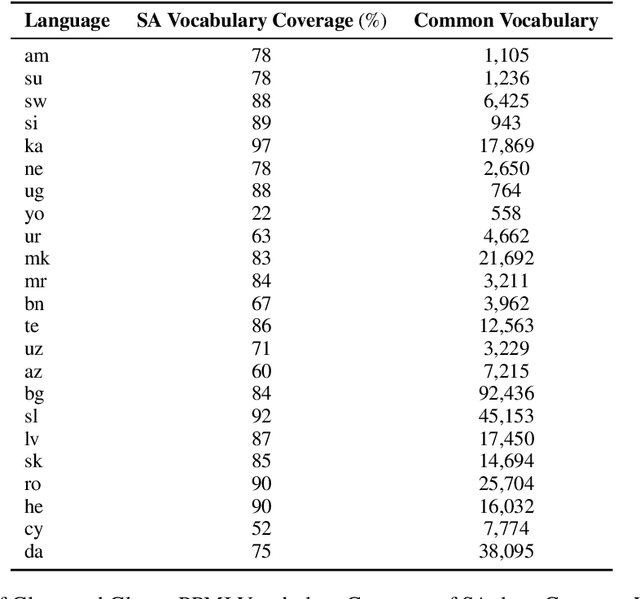
Contextualized embeddings based on large language models (LLMs) are available for various languages, but their coverage is often limited for lower resourced languages. Training LLMs for such languages is often difficult due to insufficient data and high computational cost. Especially for very low resource languages, static word embeddings thus still offer a viable alternative. There is, however, a notable lack of comprehensive repositories with such embeddings for diverse languages. To address this, we present LowREm, a centralized repository of static embeddings for 87 low-resource languages. We also propose a novel method to enhance GloVe-based embeddings by integrating multilingual graph knowledge, utilizing another source of knowledge. We demonstrate the superior performance of our enhanced embeddings as compared to contextualized embeddings extracted from XLM-R on sentiment analysis. Our code and data are publicly available under https://huggingface.co/DFKI.