 Add to Chrome
 Add to Firefox
 Add to Edge
Redakto - The Incognito Tab for LLMs
Aug 18, 2026
Large Language Models (LLMs) are being increasingly used in everyday applications. A major challenge in the context of LLMs or Artificial Intelligence (AI) in general is to ensure privacy when using them, meaning that personally identifiable information (PII) is removed from any text that enters an LLM. These challenges have become more urgent with novel EU legislation. Uncertainty around LLM usage with respect to privacy concerns in EU countries can be a major blocker for the speed of innovation and transfer from research to applications. Here we present \textbf{Redakto}, a tool that can be used for anonymizing text prior to feeding it to an LLM or other downstream text processing. We provide state-of-the-art functionalities for both redaction of PII but also when used for pseudonymization. These functionalities are exposed such that they can easily be used by end-users, through the Redakto web application, and by developers and researchers, via REST APIs and model context protocol (MCP) hooks. The implementation is fully open source, requires modest compute resources, and can be readily deployed on local hardware. In contrast to prior work and in order to better assess the quality of the anonymized texts, we conduct extensive empirical evaluations on textual data from legal and medical domain with respect to both privacy and utility of the redacted texts. Our empirical results demonstrate that the texts anonymized with different redaction strategies achieve utility scores on par with the original texts, suggesting that anonymization with Redakto can be used for LLM tasks without substantial negative impact for the tasks we explored.

A Sovereign, Open-Source Foundation Model for German and English
Jul 13, 2026We present Soofi S 30B-A3B, a sovereign, open-source Mixture-of-Experts (MoE) hybrid Mamba Transformer foundation model for German and English. Its hybrid design activates only 3B of 30B parameters per token and keeps the inference cache near-constant as context grows, giving it a decisive throughput advantage over dense models for long-context, high-concurrency deployment. Pretrained on roughly 27 trillion tokens with deliberately up-weighted German, Soofi S matches dense 14 to 27B models on aggregate English and German benchmarks while achieving the best code aggregates in both languages among 17 open base models, and outperforms every European sovereign baseline in our comparison, including ones far larger in active parameters. Among fully open models, Soofi S obtains the highest English and German evaluation scores, ahead of Olmo 3 32B and Apertus 70B. Soofi S was built end-to-end on the German Industrial AI Cloud, a sovereign HPC scale AI infrastructure operated by Deutsche Telekom in Munich. Soofi S will be released under highly permissive, open-access terms: weights, selected intermediate checkpoints, full per-source data accounting, hyperparameters, and training and evaluation code. Where source licenses permit, data-construction artifacts are released under permissive licenses; commercially licensed sources are documented with aggregate statistics and exact mixture accounting.
ReasonXL: Shifting LLM Reasoning Language Without Sacrificing Performance
Apr 14, 2026Despite advances in multilingual capabilities, most large language models (LLMs) remain English-centric in their training and, crucially, in their production of reasoning traces. Even when tasked with non-English problems, these models predominantly reason in English, creating a fundamental mismatch for non-English usage scenarios. We address this disparity directly with three contributions. (i) We introduce ReasonXL, the first large-scale parallel corpus of cross-domain reasoning traces spanning five European languages (English, German, French, Italian, and Spanish), with over two million aligned samples per language, each comprising prompts, reasoning traces, and final outputs, enabling direct supervision of language-specific reasoning. (ii) Using ReasonXL, we demonstrate that LLMs can be adapted to reason entirely in a desired target language, using a simple two-stage pipeline of supervised fine-tuning (SFT) followed by reinforcement learning with verifiable rewards (RLVR). The resulting models match or exceed baseline performance, with minimal loss in general knowledge and broadly preserved cross-lingual transfer. (iii) We conduct an extensive representational analysis of the adaptation and find a clear functional division across model depth: early layers contain an activation bottleneck that causally determines language identity, while upper layers concentrate the weight and activation changes driven by adaptation. We further find that RLVR achieves greater behavioral divergence from the base model with smaller parameter updates than SFT, suggesting a more efficient representational rerouting despite much smaller weight updates.
"Where does it hurt?" -- Dataset and Study on Physician Intent Trajectories in Doctor Patient Dialogues
Aug 26, 2025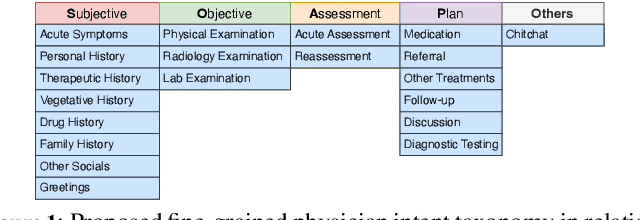
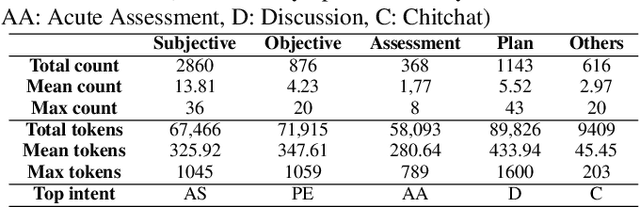
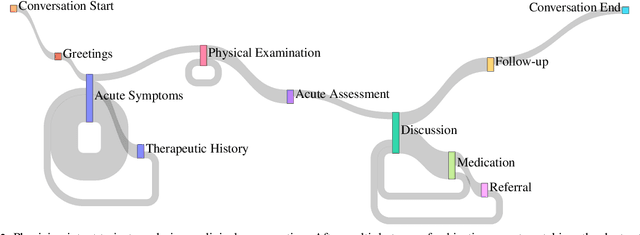
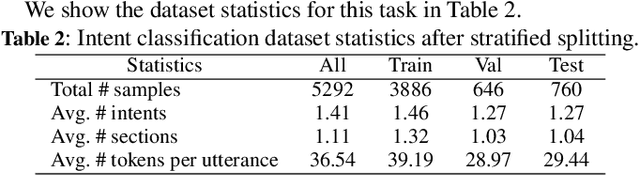
In a doctor-patient dialogue, the primary objective of physicians is to diagnose patients and propose a treatment plan. Medical doctors guide these conversations through targeted questioning to efficiently gather the information required to provide the best possible outcomes for patients. To the best of our knowledge, this is the first work that studies physician intent trajectories in doctor-patient dialogues. We use the `Ambient Clinical Intelligence Benchmark' (Aci-bench) dataset for our study. We collaborate with medical professionals to develop a fine-grained taxonomy of physician intents based on the SOAP framework (Subjective, Objective, Assessment, and Plan). We then conduct a large-scale annotation effort to label over 5000 doctor-patient turns with the help of a large number of medical experts recruited using Prolific, a popular crowd-sourcing platform. This large labeled dataset is an important resource contribution that we use for benchmarking the state-of-the-art generative and encoder models for medical intent classification tasks. Our findings show that our models understand the general structure of medical dialogues with high accuracy, but often fail to identify transitions between SOAP categories. We also report for the first time common trajectories in medical dialogue structures that provide valuable insights for designing `differential diagnosis' systems. Finally, we extensively study the impact of intent filtering for medical dialogue summarization and observe a significant boost in performance. We make the codes and data, including annotation guidelines, publicly available at https://github.com/DATEXIS/medical-intent-classification.