 Add to Chrome
 Add to Firefox
 Add to Edge
TRACE-CTI: Auditable Post-Extraction Governance of TTP Claims with Knowledge Graphs
Jul 27, 2026
Security Operations Centers increasingly rely on automated mapping of Cyber Threat Intelligence reports to MITRE ATT&CK, yet extractor outputs remain fallible and are often stored without the evidence, provenance, and validation history needed to decide whether an individual mapping should be trusted. We present TRACE- CTI, a post-extraction claim-governance framework that preserves run-level Predictions, aggregates them into configuration-level GraphAssertions, materializes setup-deduplicated corroboration as ConsensusAssertions, and exposes only GraphAssertions backed by policy-compliant validation grounds. The framework retains native evidence granularity, complete extraction provenance, versioned trust decisions, and non-destructive revocation history. We evaluate TRACE-CTI on two public CTI corpora comprising 65 reports and 5,303 sentences, using a controlled 2 x 3 matrix of retrievers and generator families, incrementally ingested across six GraphVersions. All setups are incorporated without schema modification; provenance paths remain complete, operational scopes remain disjoint, and every trusted GraphAssertion has an active qualifying validation ground. Cross-generator-family setup pairs exhibit greater output diversity than same-family pairs. At the final graph state, increasing setup support from k >= 1 to six-setup unanimity raises gold-aligned precision from 25.3% to 90.6%, while recall decreases from 88.2% to 16.3%. The graph also directly answers seven questions about provenance, trust, versioning, dependency, disagreement, and review-queue that the evaluated minimal flat output cannot fully answer without enrichment or reprocessing. These results support explicit, auditable governance of extracted TTP claims; the observed corroboration trajectory is descriptive and does not establish statistical independence or a causal model-family effect.

MATCHA: Efficient Deployment of Deep Neural Networks on Multi-Accelerator Heterogeneous Edge SoCs
Apr 10, 2026Deploying DNNs on System-on-Chips (SoC) with multiple heterogeneous acceleration engines is challenging, and the majority of deployment frameworks cannot fully exploit heterogeneity. We present MATCHA, a unified DNN deployment framework that generates highly concurrent schedules for parallel, heterogeneous accelerators and uses constraint programming to optimize L3/L2 memory allocation and scheduling. Using pattern matching, tiling, and mapping across individual HW units enables parallel execution and high accelerator utilization. On the MLPerf Tiny benchmark, using a SoC with two heterogeneous accelerators, MATCHA improves accelerator utilization and reduces inference latency by up to 35% with respect to the the state-of-the-art MATCH compiler.
A Data-Driven Approach to Dataflow-Aware Online Scheduling for Graph Neural Network Inference
Nov 25, 2024Graph Neural Networks (GNNs) have shown significant promise in various domains, such as recommendation systems, bioinformatics, and network analysis. However, the irregularity of graph data poses unique challenges for efficient computation, leading to the development of specialized GNN accelerator architectures that surpass traditional CPU and GPU performance. Despite this, the structural diversity of input graphs results in varying performance across different GNN accelerators, depending on their dataflows. This variability in performance due to differing dataflows and graph properties remains largely unexplored, limiting the adaptability of GNN accelerators. To address this, we propose a data-driven framework for dataflow-aware latency prediction in GNN inference. Our approach involves training regressors to predict the latency of executing specific graphs on particular dataflows, using simulations on synthetic graphs. Experimental results indicate that our regressors can predict the optimal dataflow for a given graph with up to 91.28% accuracy and a Mean Absolute Percentage Error (MAPE) of 3.78%. Additionally, we introduce an online scheduling algorithm that uses these regressors to enhance scheduling decisions. Our experiments demonstrate that this algorithm achieves up to $3.17\times$ speedup in mean completion time and $6.26\times$ speedup in mean execution time compared to the best feasible baseline across all datasets.
Deep Reinforcement Learning based Online Scheduling Policy for Deep Neural Network Multi-Tenant Multi-Accelerator Systems
Apr 13, 2024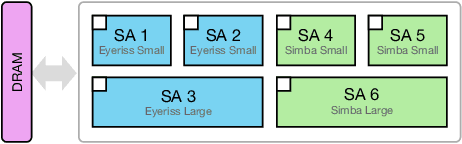
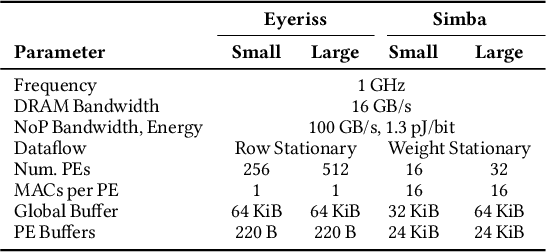
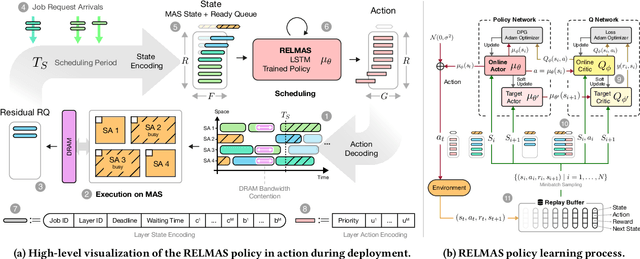
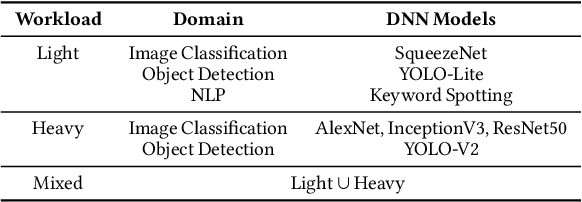
Currently, there is a growing trend of outsourcing the execution of DNNs to cloud services. For service providers, managing multi-tenancy and ensuring high-quality service delivery, particularly in meeting stringent execution time constraints, assumes paramount importance, all while endeavoring to maintain cost-effectiveness. In this context, the utilization of heterogeneous multi-accelerator systems becomes increasingly relevant. This paper presents RELMAS, a low-overhead deep reinforcement learning algorithm designed for the online scheduling of DNNs in multi-tenant environments, taking into account the dataflow heterogeneity of accelerators and memory bandwidths contentions. By doing so, service providers can employ the most efficient scheduling policy for user requests, optimizing Service-Level-Agreement (SLA) satisfaction rates and enhancing hardware utilization. The application of RELMAS to a heterogeneous multi-accelerator system composed of various instances of Simba and Eyeriss sub-accelerators resulted in up to a 173% improvement in SLA satisfaction rate compared to state-of-the-art scheduling techniques across different workload scenarios, with less than a 1.5% energy overhead.
A Survey on Design Methodologies for Accelerating Deep Learning on Heterogeneous Architectures
Nov 29, 2023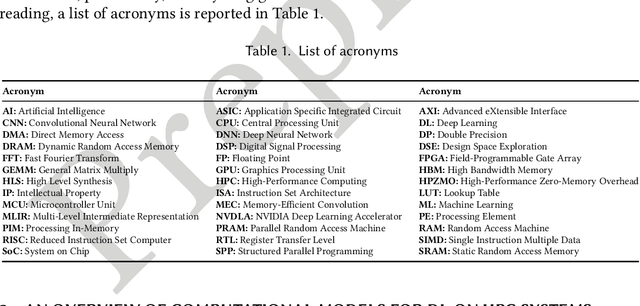
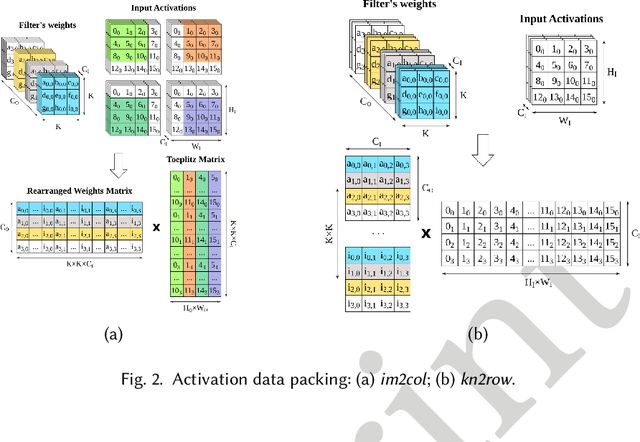
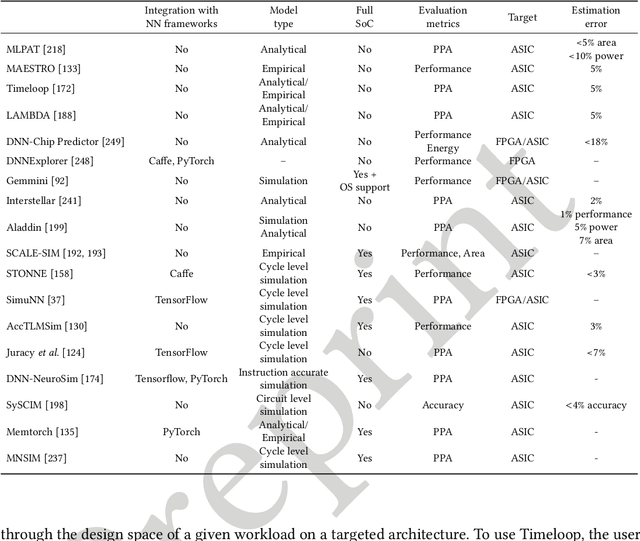
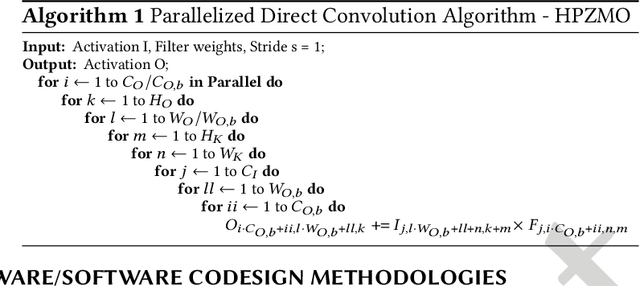
In recent years, the field of Deep Learning has seen many disruptive and impactful advancements. Given the increasing complexity of deep neural networks, the need for efficient hardware accelerators has become more and more pressing to design heterogeneous HPC platforms. The design of Deep Learning accelerators requires a multidisciplinary approach, combining expertise from several areas, spanning from computer architecture to approximate computing, computational models, and machine learning algorithms. Several methodologies and tools have been proposed to design accelerators for Deep Learning, including hardware-software co-design approaches, high-level synthesis methods, specific customized compilers, and methodologies for design space exploration, modeling, and simulation. These methodologies aim to maximize the exploitable parallelism and minimize data movement to achieve high performance and energy efficiency. This survey provides a holistic review of the most influential design methodologies and EDA tools proposed in recent years to implement Deep Learning accelerators, offering the reader a wide perspective in this rapidly evolving field. In particular, this work complements the previous survey proposed by the same authors in [203], which focuses on Deep Learning hardware accelerators for heterogeneous HPC platforms.