 Add to Chrome
 Add to Firefox
 Add to Edge
BioTrain: Sub-MB, Sub-50mW On-Device Fine-Tuning for Edge-AI on Biosignals
Apr 14, 2026
Biosignals exhibit substantial cross-subject and cross-session variability, inducing severe domain shifts that degrade post-deployment performance for small, edge-oriented AI models. On-device adaptation is therefore essential to both preserve user privacy and ensure system reliability. However, existing sub-100 mW MCU-based wearable platforms can only support shallow or sparse adaptation schemes due to the prohibitive memory footprint and computational cost of full backpropagation (BP). In this paper, we propose BioTrain, a framework enabling full-network fine-tuning of state-of-the-art biosignal models under milliwatt-scale power and sub-megabyte memory constraints. We validate BioTrain using both offline and on-device benchmarks on EEG and EOG datasets, covering Day-1 new-subject calibration and longitudinal adaptation to signal drift. Experimental results show that full-network fine-tuning achieves accuracy improvements of up to 35% over non-adapted baselines and outperforms last-layer updates by approximately 7% during new-subject calibration. On the GAP9 MCU platform, BioTrain enables efficient on-device training throughput of 17 samples/s for EEG and 85 samples/s for EOG models within a power envelope below 50 mW. In addition, BioTrain's efficient memory allocator and network topology optimization enable the use of a large batch size, reducing peak memory usage. For fully on-chip BP on GAP9, BioTrain reduces the memory footprint by 8.1x, from 5.4 MB to 0.67 MB, compared to conventional full-network fine-tuning using batch normalization with batch size 8.

Competition-Aware CPC Forecasting with Near-Market Coverage
Mar 13, 2026Cost-per-click (CPC) in paid search is a volatile auction outcome generated by a competitive landscape that is only partially observable from any single advertiser's history. Using Google Ads auction logs from a concentrated car-rental market (2021--2023), we forecast weekly CPC for 1,811 keyword series and approximate latent competition through complementary signals derived from keyword text, CPC trajectories, and geographic market structure. We construct (i) semantic neighborhoods and a semantic keyword graph from pretrained transformer-based representations of keyword text, (ii) behavioral neighborhoods via Dynamic Time Warping (DTW) alignment of CPC trajectories, and (iii) geographic-intent covariates capturing localized demand and marketplace heterogeneity. We extensively evaluate these signals both as stand-alone covariates and as relational priors in spatiotemporal graph forecasters, benchmarking them against strong statistical, neural, and time-series foundation-model baselines. Across methods, competition-aware augmentation improves stability and error profiles at business-relevant medium and longer horizons, where competitive regimes shift and volatility is most consequential. The results show that broad market-outcome coverage, combined with keyword-derived semantic and geographic priors, provides a scalable way to approximate latent competition and improve CPC forecasting in auction-driven markets.
SilentWear: an Ultra-Low Power Wearable System for EMG-based Silent Speech Recognition
Mar 04, 2026Detecting speech from biosignals is gaining increasing attention due to the potential to develop human-computer interfaces that are noise-robust, privacy-preserving, and scalable for both clinical applications and daily use. However, most existing approaches remain limited by insufficient wearability and the lack of edge-processing capabilities, which are essential for minimally obtrusive, responsive, and private assistive technologies. In this work, we present SilentWear, a fully wearable, textile-based neck interface for EMG signal acquisition and processing. Powered by BioGAP-Ultra, the system enables end-to-end data acquisition from 14 differential channels and on-device speech recognition. SilentWear is coupled with SpeechNet, a lightweight 15k-parameter CNN architecture specifically tailored for EMG-based speech decoding, achieving an average cross-validated accuracy of 84.8$\pm$4.6% and 77.5$\pm$6.6% for vocalized and silent speech, respectively, over eight representative human-machine interaction commands collected over multiple days. We evaluate robustness to repositioning induced by multi-day use. In an inter-session setting, the system achieves average accuracies of 71.1$\pm$8.3% and 59.3\pm2.2% for vocalized and silent speech, respectively. To mitigate performance degradation due to repositioning, we propose an incremental fine-tuning strategy, demonstrating more than 10% accuracy recovery with less than 10 minutes of additional user data. Finally, we demonstrate end-to-end real-time on-device speech recognition on a commercial multi-core microcontroller unit (MCU), achieving an energy consumption of 63.9$μ$J per inference with a latency of 2.47 ms. With a total power consumption of 20.5mW for acquisition, inference, and wireless transmission of results, SilentWear enables continuous operation for more than 27 hours.
Wearable and Ultra-Low-Power Fusion of EMG and A-Mode US for Hand-Wrist Kinematic Tracking
Oct 02, 2025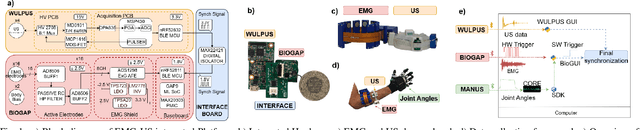
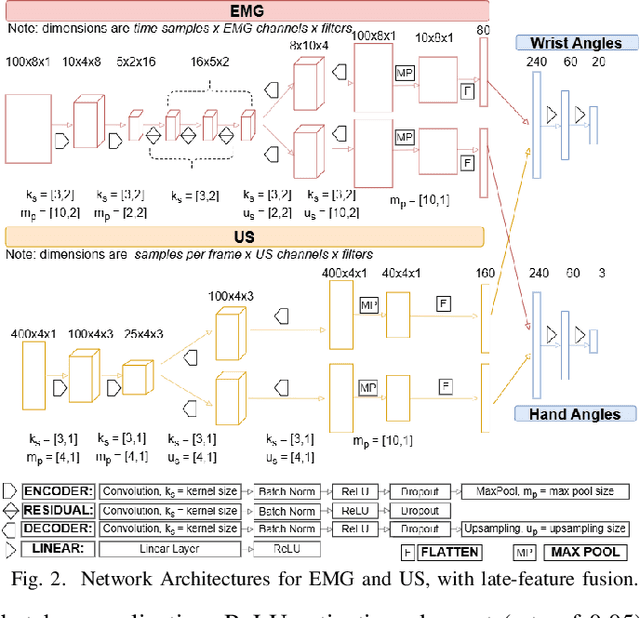
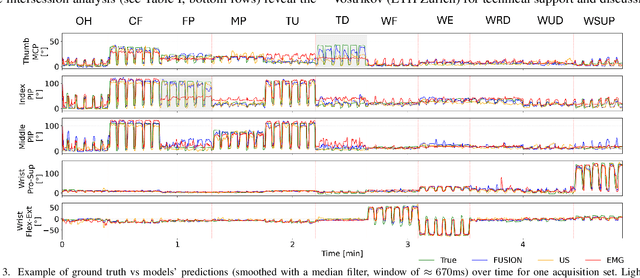
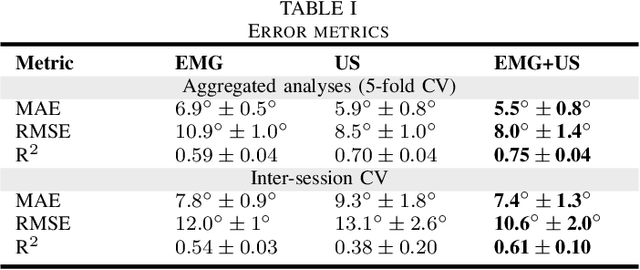
Hand gesture recognition based on biosignals has shown strong potential for developing intuitive human-machine interaction strategies that closely mimic natural human behavior. In particular, sensor fusion approaches have gained attention for combining complementary information and overcoming the limitations of individual sensing modalities, thereby enabling more robust and reliable systems. Among them, the fusion of surface electromyography (EMG) and A-mode ultrasound (US) is very promising. However, prior solutions rely on power-hungry platforms unsuitable for multi-day use and are limited to discrete gesture classification. In this work, we present an ultra-low-power (sub-50 mW) system for concurrent acquisition of 8-channel EMG and 4-channel A-mode US signals, integrating two state-of-the-art platforms into fully wearable, dry-contact armbands. We propose a framework for continuous tracking of 23 degrees of freedom (DoFs), 20 for the hand and 3 for the wrist, using a kinematic glove for ground-truth labeling. Our method employs lightweight encoder-decoder architectures with multi-task learning to simultaneously estimate hand and wrist joint angles. Experimental results under realistic sensor repositioning conditions demonstrate that EMG-US fusion achieves a root mean squared error of $10.6^\circ\pm2.0^\circ$, compared to $12.0^\circ\pm1^\circ$ for EMG and $13.1^\circ\pm2.6^\circ$ for US, and a R$^2$ score of $0.61\pm0.1$, with $0.54\pm0.03$ for EMG and $0.38\pm0.20$ for US.
A Parallel Ultra-Low Power Silent Speech Interface based on a Wearable, Fully-dry EMG Neckband
Sep 26, 2025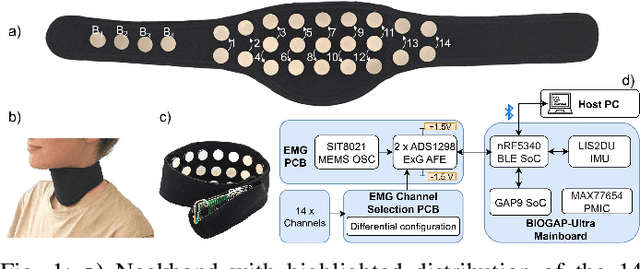
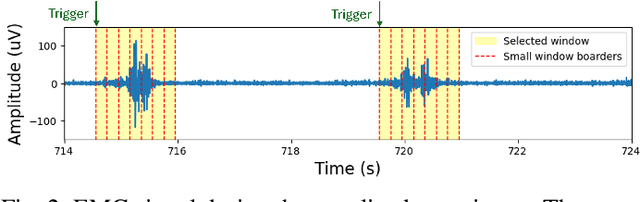
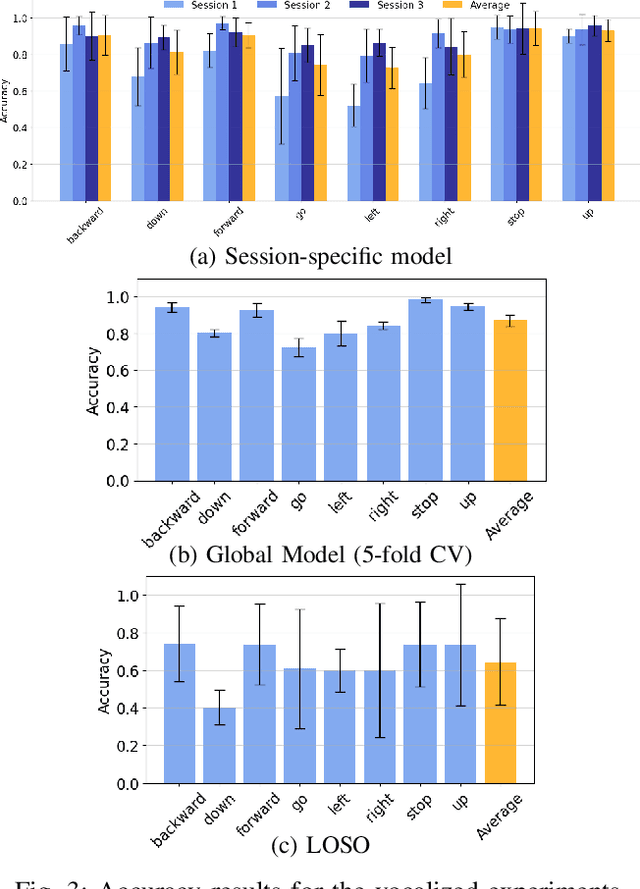
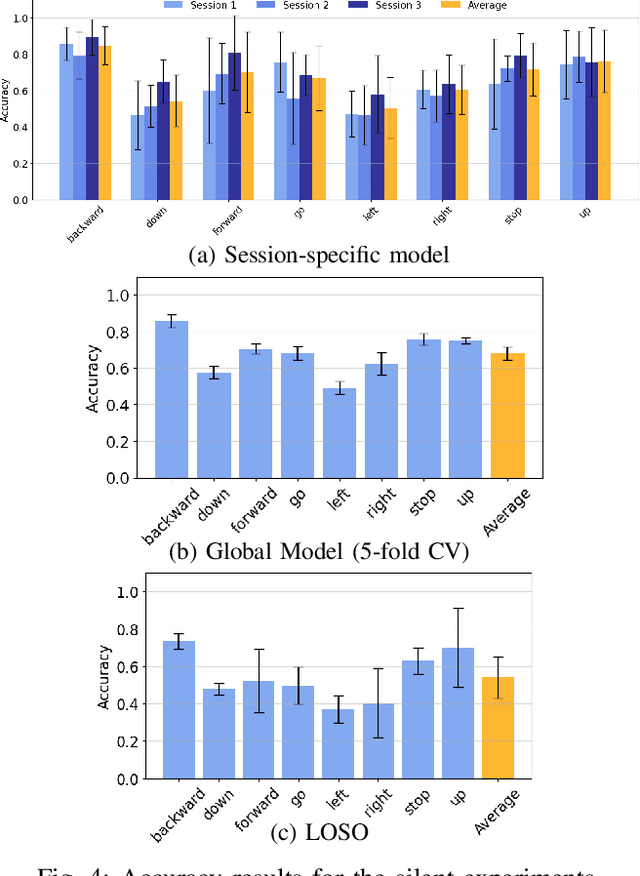
We present a wearable, fully-dry, and ultra-low power EMG system for silent speech recognition, integrated into a textile neckband to enable comfortable, non-intrusive use. The system features 14 fully-differential EMG channels and is based on the BioGAP-Ultra platform for ultra-low power (22 mW) biosignal acquisition and wireless transmission. We evaluate its performance on eight speech commands under both vocalized and silent articulation, achieving average classification accuracies of 87$\pm$3% and 68$\pm$3% respectively, with a 5-fold CV approach. To mimic everyday-life conditions, we introduce session-to-session variability by repositioning the neckband between sessions, achieving leave-one-session-out accuracies of 64$\pm$18% and 54$\pm$7% for the vocalized and silent experiments, respectively. These results highlight the robustness of the proposed approach and the promise of energy-efficient silent-speech decoding.
Real-Time, Single-Ear, Wearable ECG Reconstruction, R-Peak Detection, and HR/HRV Monitoring
May 03, 2025Biosignal monitoring, in particular heart activity through heart rate (HR) and heart rate variability (HRV) tracking, is vital in enabling continuous, non-invasive tracking of physiological and cognitive states. Recent studies have explored compact, head-worn devices for HR and HRV monitoring to improve usability and reduce stigma. However, this approach is challenged by the current reliance on wet electrodes, which limits usability, the weakness of ear-derived signals, making HR/HRV extraction more complex, and the incompatibility of current algorithms for embedded deployment. This work introduces a single-ear wearable system for real-time ECG (Electrocardiogram) parameter estimation, which directly runs on BioGAP, an energy-efficient device for biosignal acquisition and processing. By combining SoA in-ear electrode technology, an optimized DeepMF algorithm, and BioGAP, our proposed subject-independent approach allows for robust extraction of HR/HRV parameters directly on the device with just 36.7 uJ/inference at comparable performance with respect to the current state-of-the-art architecture, achieving 0.49 bpm and 25.82 ms for HR/HRV mean errors, respectively and an estimated battery life of 36h with a total system power consumption of 7.6 mW. Clinical relevance: The ability to reconstruct ECG signals and extract HR and HRV paves the way for continuous, unobtrusive cardiovascular monitoring with head-worn devices. In particular, the integration of cardiovascular measurements in everyday-use devices (such as earbuds) has potential in continuous at-home monitoring to enable early detection of cardiovascular irregularities.
GAPses: Versatile smart glasses for comfortable and fully-dry acquisition and parallel ultra-low-power processing of EEG and EOG
Jun 12, 2024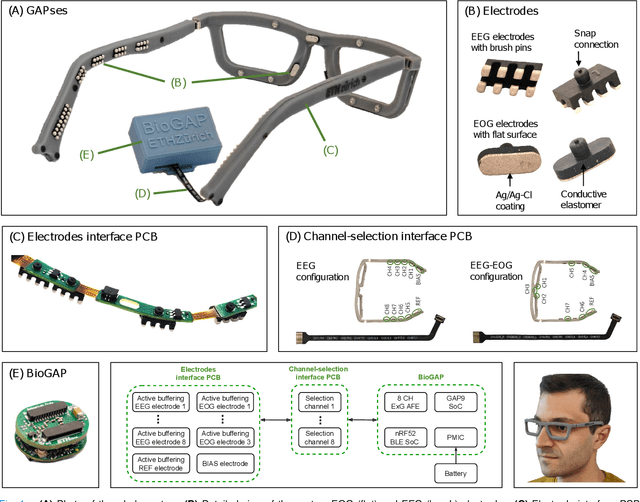
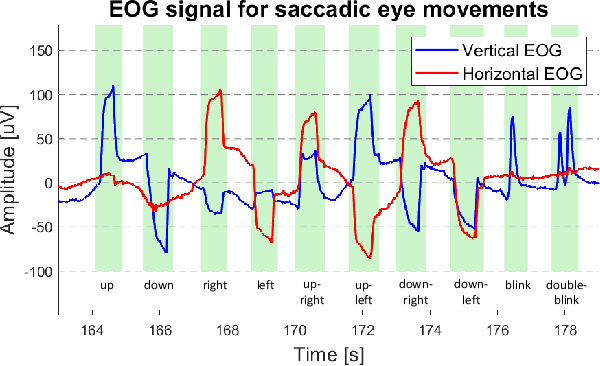
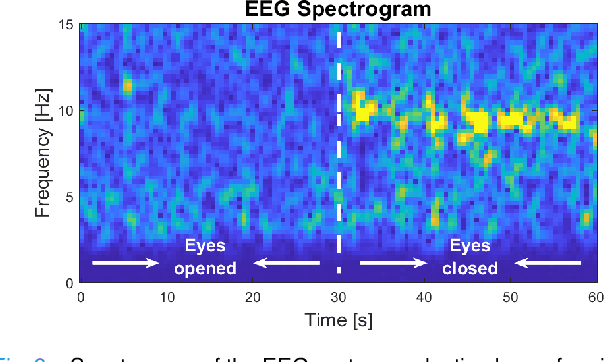
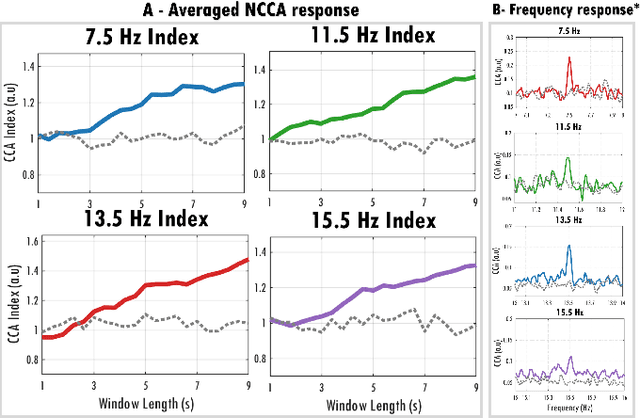
Recent advancements in head-mounted wearable technology are revolutionizing the field of biopotential measurement, but the integration of these technologies into practical, user-friendly devices remains challenging due to issues with design intrusiveness, comfort, and data privacy. To address these challenges, this paper presents GAPSES, a novel smart glasses platform designed for unobtrusive, comfortable, and secure acquisition and processing of electroencephalography (EEG) and electrooculography (EOG) signals. We introduce a direct electrode-electronics interface with custom fully dry soft electrodes to enhance comfort for long wear. An integrated parallel ultra-low-power RISC-V processor (GAP9, Greenwaves Technologies) processes data at the edge, thereby eliminating the need for continuous data streaming through a wireless link, enhancing privacy, and increasing system reliability in adverse channel conditions. We demonstrate the broad applicability of the designed prototype through validation in a number of EEG-based interaction tasks, including alpha waves, steady-state visual evoked potential analysis, and motor movement classification. Furthermore, we demonstrate an EEG-based biometric subject recognition task, where we reach a sensitivity and specificity of 98.87% and 99.86% respectively, with only 8 EEG channels and an energy consumption per inference on the edge as low as 121 uJ. Moreover, in an EOG-based eye movement classification task, we reach an accuracy of 96.68% on 11 classes, resulting in an information transfer rate of 94.78 bit/min, which can be further increased to 161.43 bit/min by reducing the accuracy to 81.43%. The deployed implementation has an energy consumption of 24 uJ per inference and a total system power of only 16.28 mW, allowing for continuous operation of more than 12 h with a small 75 mAh battery.
A Wearable Ultra-Low-Power sEMG-Triggered Ultrasound System for Long-Term Muscle Activity Monitoring
Sep 14, 2023Surface electromyography (sEMG) is a well-established approach to monitor muscular activity on wearable and resource-constrained devices. However, when measuring deeper muscles, its low signal-to-noise ratio (SNR), high signal attenuation, and crosstalk degrade sensing performance. Ultrasound (US) complements sEMG effectively with its higher SNR at high penetration depths. In fact, combining US and sEMG improves the accuracy of muscle dynamic assessment, compared to using only one modality. However, the power envelope of US hardware is considerably higher than that of sEMG, thus inflating energy consumption and reducing the battery life. This work proposes a wearable solution that integrates both modalities and utilizes an EMG-driven wake-up approach to achieve ultra-low power consumption as needed for wearable long-term monitoring. We integrate two wearable state-of-the-art (SoA) US and ExG biosignal acquisition devices to acquire time-synchronized measurements of the short head of the biceps. To minimize power consumption, the US probe is kept in a sleep state when there is no muscle activity. sEMG data are processed on the probe (filtering, envelope extraction and thresholding) to identify muscle activity and generate a trigger to wake-up the US counterpart. The US acquisition starts before muscle fascicles displacement thanks to a triggering time faster than the electromechanical delay (30-100 ms) between the neuromuscular junction stimulation and the muscle contraction. Assuming a muscle contraction of 200 ms at a contraction rate of 1 Hz, the proposed approach enables more than 59% energy saving (with a full-system average power consumption of 12.2 mW) as compared to operating both sEMG and US continuously.