 Add to Chrome
 Add to Firefox
 Add to Edge
PALP: Prompt Aligned Personalization of Text-to-Image Models
Jan 11, 2024

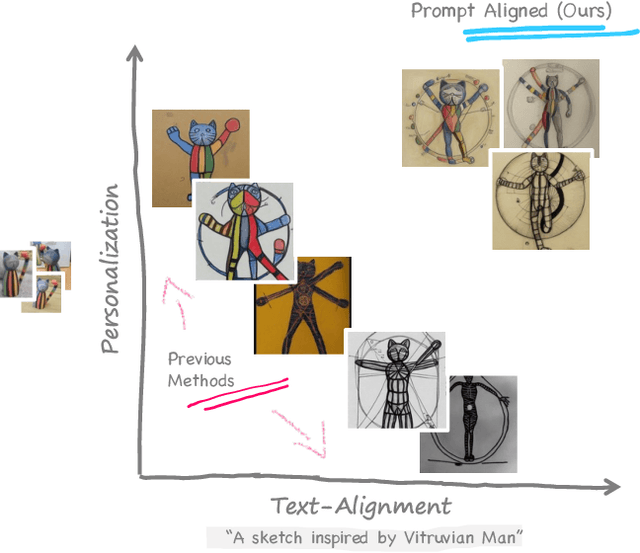


Content creators often aim to create personalized images using personal subjects that go beyond the capabilities of conventional text-to-image models. Additionally, they may want the resulting image to encompass a specific location, style, ambiance, and more. Existing personalization methods may compromise personalization ability or the alignment to complex textual prompts. This trade-off can impede the fulfillment of user prompts and subject fidelity. We propose a new approach focusing on personalization methods for a \emph{single} prompt to address this issue. We term our approach prompt-aligned personalization. While this may seem restrictive, our method excels in improving text alignment, enabling the creation of images with complex and intricate prompts, which may pose a challenge for current techniques. In particular, our method keeps the personalized model aligned with a target prompt using an additional score distillation sampling term. We demonstrate the versatility of our method in multi- and single-shot settings and further show that it can compose multiple subjects or use inspiration from reference images, such as artworks. We compare our approach quantitatively and qualitatively with existing baselines and state-of-the-art techniques.

Generating Non-Stationary Textures using Self-Rectification
Jan 05, 2024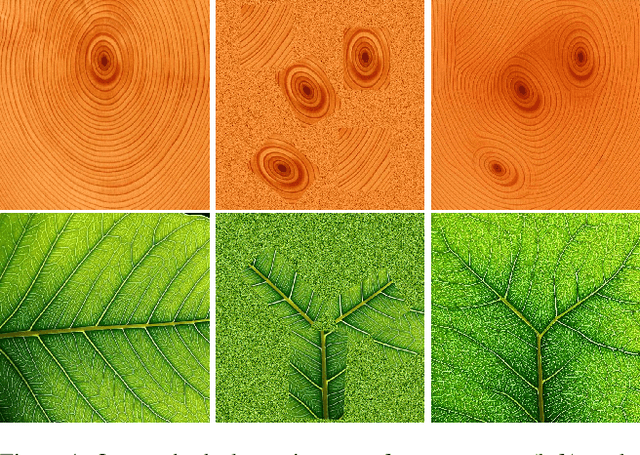
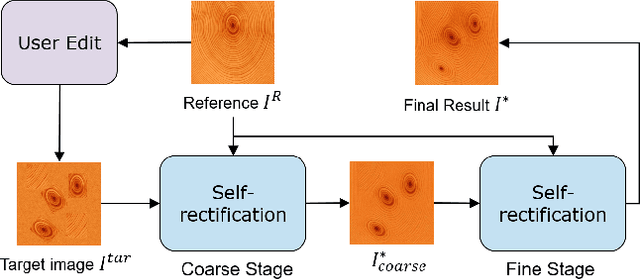
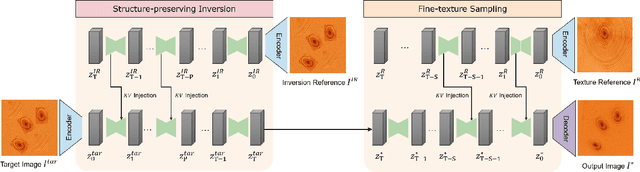
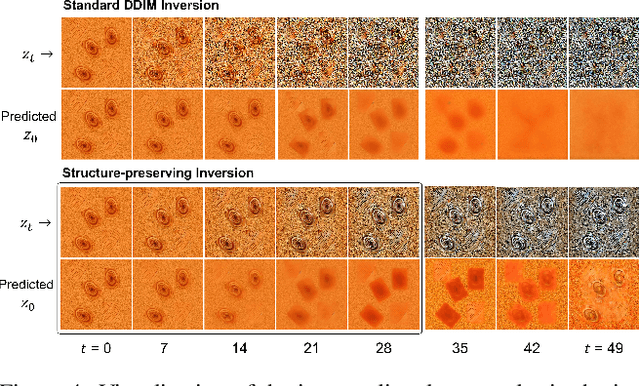
This paper addresses the challenge of example-based non-stationary texture synthesis. We introduce a novel twostep approach wherein users first modify a reference texture using standard image editing tools, yielding an initial rough target for the synthesis. Subsequently, our proposed method, termed "self-rectification", automatically refines this target into a coherent, seamless texture, while faithfully preserving the distinct visual characteristics of the reference exemplar. Our method leverages a pre-trained diffusion network, and uses self-attention mechanisms, to gradually align the synthesized texture with the reference, ensuring the retention of the structures in the provided target. Through experimental validation, our approach exhibits exceptional proficiency in handling non-stationary textures, demonstrating significant advancements in texture synthesis when compared to existing state-of-the-art techniques. Code is available at https://github.com/xiaorongjun000/Self-Rectification
SAI3D: Segment Any Instance in 3D Scenes
Dec 17, 2023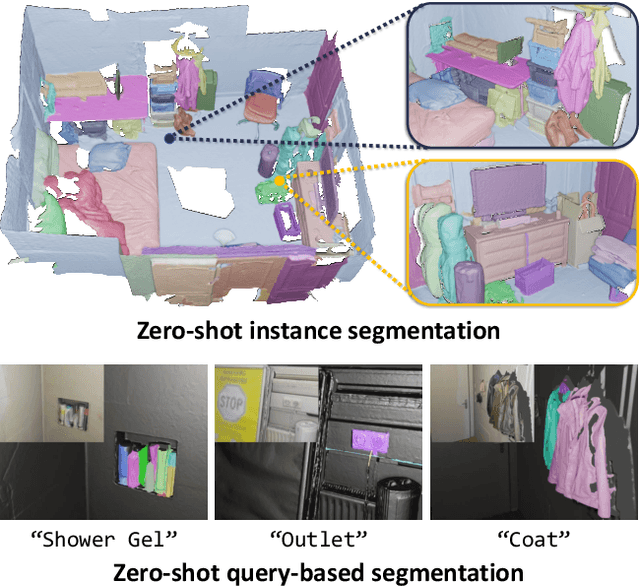
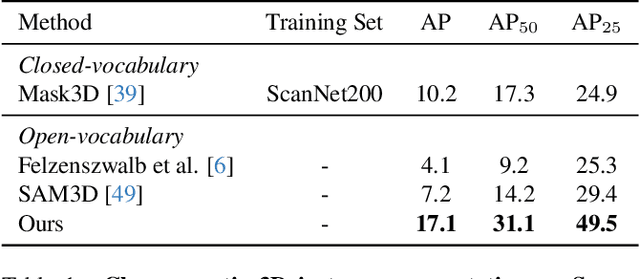
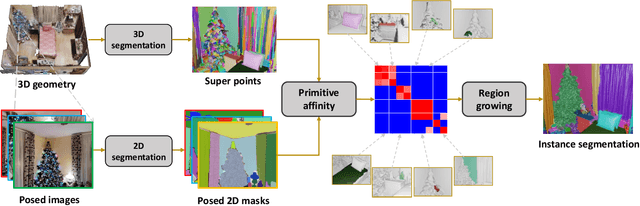

Advancements in 3D instance segmentation have traditionally been tethered to the availability of annotated datasets, limiting their application to a narrow spectrum of object categories. Recent efforts have sought to harness vision-language models like CLIP for open-set semantic reasoning, yet these methods struggle to distinguish between objects of the same categories and rely on specific prompts that are not universally applicable. In this paper, we introduce SAI3D, a novel zero-shot 3D instance segmentation approach that synergistically leverages geometric priors and semantic cues derived from Segment Anything Model (SAM). Our method partitions a 3D scene into geometric primitives, which are then progressively merged into 3D instance segmentations that are consistent with the multi-view SAM masks. Moreover, we design a hierarchical region-growing algorithm with a dynamic thresholding mechanism, which largely improves the robustness of finegrained 3D scene parsing. Empirical evaluations on Scan-Net and the more challenging ScanNet++ datasets demonstrate the superiority of our approach. Notably, SAI3D outperforms existing open-vocabulary baselines and even surpasses fully-supervised methods in class-agnostic segmentation on ScanNet++.
Mismatch Quest: Visual and Textual Feedback for Image-Text Misalignment
Dec 05, 2023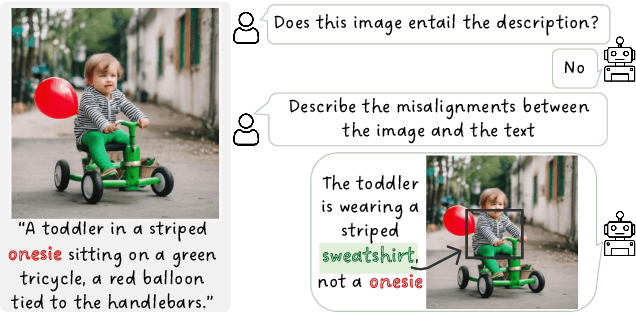
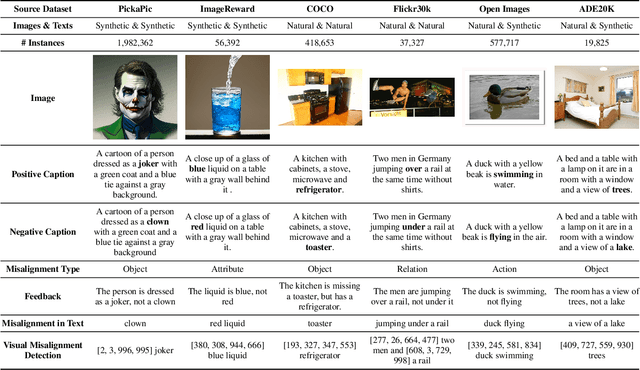
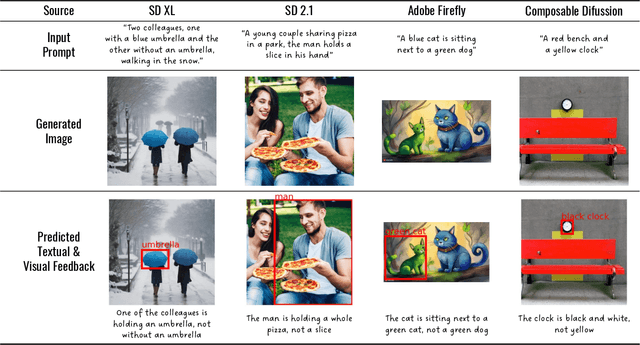

While existing image-text alignment models reach high quality binary assessments, they fall short of pinpointing the exact source of misalignment. In this paper, we present a method to provide detailed textual and visual explanation of detected misalignments between text-image pairs. We leverage large language models and visual grounding models to automatically construct a training set that holds plausible misaligned captions for a given image and corresponding textual explanations and visual indicators. We also publish a new human curated test set comprising ground-truth textual and visual misalignment annotations. Empirical results show that fine-tuning vision language models on our training set enables them to articulate misalignments and visually indicate them within images, outperforming strong baselines both on the binary alignment classification and the explanation generation tasks. Our method code and human curated test set are available at: https://mismatch-quest.github.io/
Style Aligned Image Generation via Shared Attention
Dec 04, 2023Large-scale Text-to-Image (T2I) models have rapidly gained prominence across creative fields, generating visually compelling outputs from textual prompts. However, controlling these models to ensure consistent style remains challenging, with existing methods necessitating fine-tuning and manual intervention to disentangle content and style. In this paper, we introduce StyleAligned, a novel technique designed to establish style alignment among a series of generated images. By employing minimal `attention sharing' during the diffusion process, our method maintains style consistency across images within T2I models. This approach allows for the creation of style-consistent images using a reference style through a straightforward inversion operation. Our method's evaluation across diverse styles and text prompts demonstrates high-quality synthesis and fidelity, underscoring its efficacy in achieving consistent style across various inputs.
AnyLens: A Generative Diffusion Model with Any Rendering Lens
Nov 29, 2023State-of-the-art diffusion models can generate highly realistic images based on various conditioning like text, segmentation, and depth. However, an essential aspect often overlooked is the specific camera geometry used during image capture. The influence of different optical systems on the final scene appearance is frequently overlooked. This study introduces a framework that intimately integrates a text-to-image diffusion model with the particular lens geometry used in image rendering. Our method is based on a per-pixel coordinate conditioning method, enabling the control over the rendering geometry. Notably, we demonstrate the manipulation of curvature properties, achieving diverse visual effects, such as fish-eye, panoramic views, and spherical texturing using a single diffusion model.
CLiC: Concept Learning in Context
Nov 28, 2023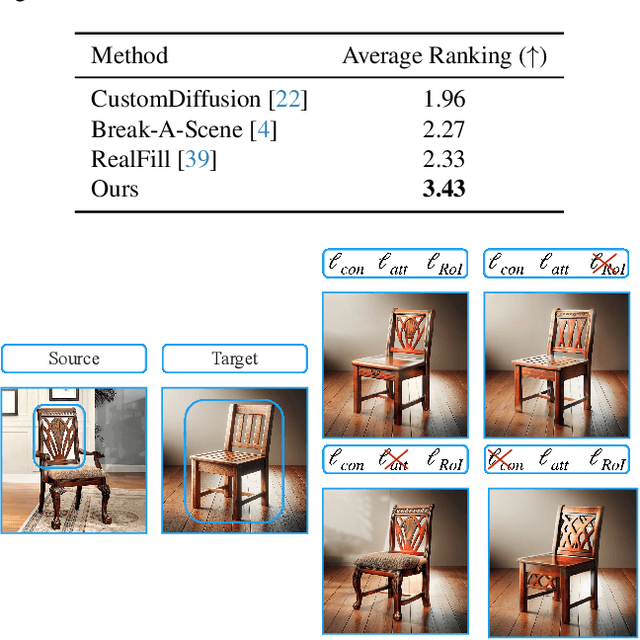
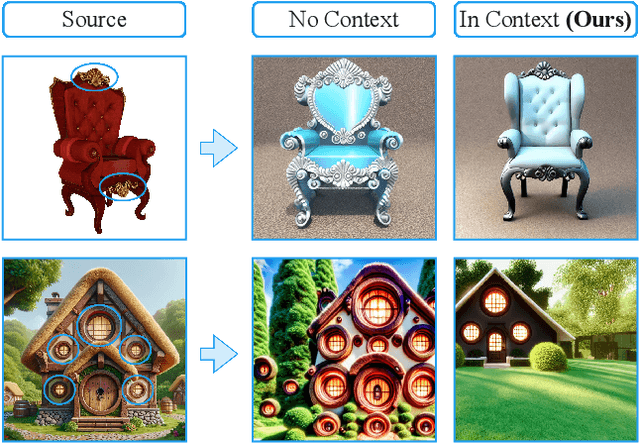
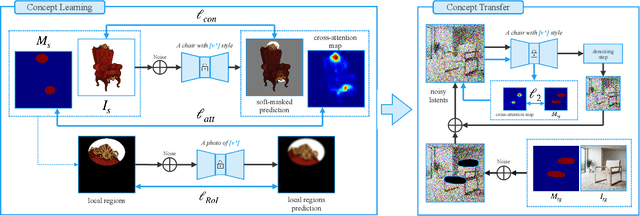
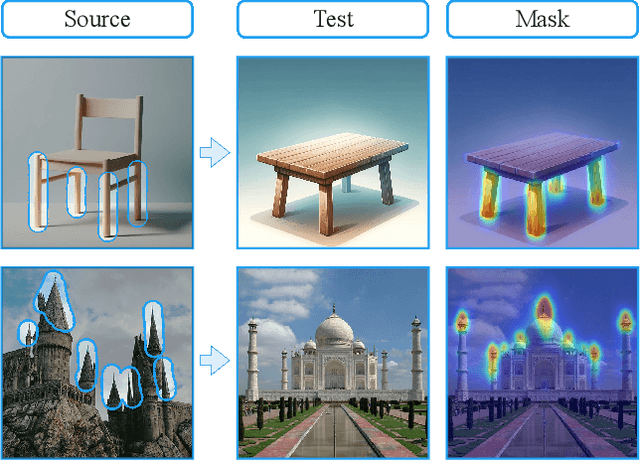
This paper addresses the challenge of learning a local visual pattern of an object from one image, and generating images depicting objects with that pattern. Learning a localized concept and placing it on an object in a target image is a nontrivial task, as the objects may have different orientations and shapes. Our approach builds upon recent advancements in visual concept learning. It involves acquiring a visual concept (e.g., an ornament) from a source image and subsequently applying it to an object (e.g., a chair) in a target image. Our key idea is to perform in-context concept learning, acquiring the local visual concept within the broader context of the objects they belong to. To localize the concept learning, we employ soft masks that contain both the concept within the mask and the surrounding image area. We demonstrate our approach through object generation within an image, showcasing plausible embedding of in-context learned concepts. We also introduce methods for directing acquired concepts to specific locations within target images, employing cross-attention mechanisms, and establishing correspondences between source and target objects. The effectiveness of our method is demonstrated through quantitative and qualitative experiments, along with comparisons against baseline techniques.
The Chosen One: Consistent Characters in Text-to-Image Diffusion Models
Nov 27, 2023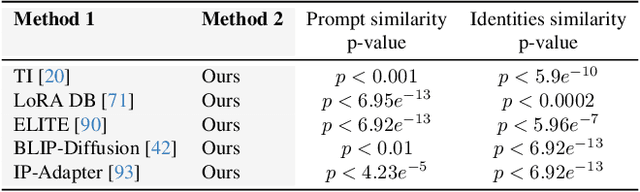
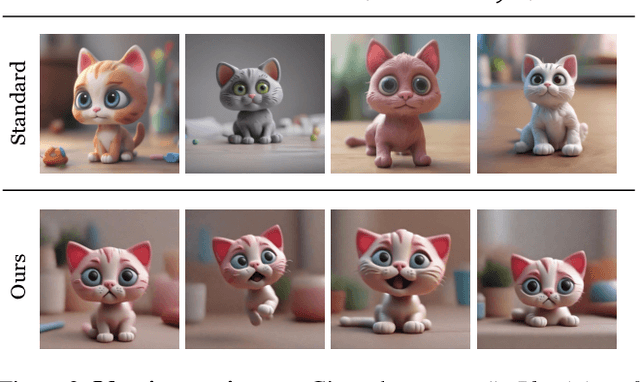
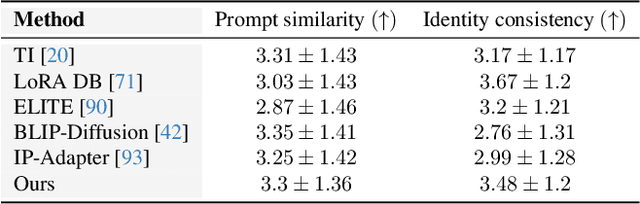
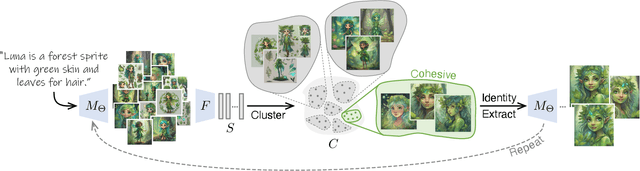
Recent advances in text-to-image generation models have unlocked vast potential for visual creativity. However, these models struggle with generation of consistent characters, a crucial aspect for numerous real-world applications such as story visualization, game development asset design, advertising, and more. Current methods typically rely on multiple pre-existing images of the target character or involve labor-intensive manual processes. In this work, we propose a fully automated solution for consistent character generation, with the sole input being a text prompt. We introduce an iterative procedure that, at each stage, identifies a coherent set of images sharing a similar identity and extracts a more consistent identity from this set. Our quantitative analysis demonstrates that our method strikes a better balance between prompt alignment and identity consistency compared to the baseline methods, and these findings are reinforced by a user study. To conclude, we showcase several practical applications of our approach. Project page is available at https://omriavrahami.com/the-chosen-one
Breathing Life Into Sketches Using Text-to-Video Priors
Nov 21, 2023


A sketch is one of the most intuitive and versatile tools humans use to convey their ideas visually. An animated sketch opens another dimension to the expression of ideas and is widely used by designers for a variety of purposes. Animating sketches is a laborious process, requiring extensive experience and professional design skills. In this work, we present a method that automatically adds motion to a single-subject sketch (hence, "breathing life into it"), merely by providing a text prompt indicating the desired motion. The output is a short animation provided in vector representation, which can be easily edited. Our method does not require extensive training, but instead leverages the motion prior of a large pretrained text-to-video diffusion model using a score-distillation loss to guide the placement of strokes. To promote natural and smooth motion and to better preserve the sketch's appearance, we model the learned motion through two components. The first governs small local deformations and the second controls global affine transformations. Surprisingly, we find that even models that struggle to generate sketch videos on their own can still serve as a useful backbone for animating abstract representations.
Cross-Image Attention for Zero-Shot Appearance Transfer
Nov 06, 2023Recent advancements in text-to-image generative models have demonstrated a remarkable ability to capture a deep semantic understanding of images. In this work, we leverage this semantic knowledge to transfer the visual appearance between objects that share similar semantics but may differ significantly in shape. To achieve this, we build upon the self-attention layers of these generative models and introduce a cross-image attention mechanism that implicitly establishes semantic correspondences across images. Specifically, given a pair of images -- one depicting the target structure and the other specifying the desired appearance -- our cross-image attention combines the queries corresponding to the structure image with the keys and values of the appearance image. This operation, when applied during the denoising process, leverages the established semantic correspondences to generate an image combining the desired structure and appearance. In addition, to improve the output image quality, we harness three mechanisms that either manipulate the noisy latent codes or the model's internal representations throughout the denoising process. Importantly, our approach is zero-shot, requiring no optimization or training. Experiments show that our method is effective across a wide range of object categories and is robust to variations in shape, size, and viewpoint between the two input images.