 Add to Chrome
 Add to Firefox
 Add to Edge
Unified Prediction and Planning via Conflict-Aware Disjoint Parameter Training
Jul 22, 2026
Accurate motion prediction of surrounding agents and safe motion planning are two closely coupled key tasks for social robot navigation in crowded environments. Deploying these systems on resource-constrained edge devices necessitates compact, unified models that can perform both tasks simultaneously. However, within these compact shared encoders, recent unified models often overlook severe representational conflicts that arise from the distinct objectives of predicting neighbor behaviors versus ego-centric safety planning. To address this issue, we first identify the Skill Conflict$\unicode{x2014}$a phenomenon where overlapping parameter assignments cause distinct tasks to compete for the same weights, preventing the model from fully specializing in individual skills. To resolve this, we propose a novel model-merging-based framework, Disjoint Parameter Training (DPT). DPT mitigates performance degradation caused by Skill Conflict through distributed parameter learning, which separates the key parameter regions of each task while preserving their core capabilities prior to merging. In addition, we observe that sparse merging, which selectively integrates only the most influential parameters for each task rather than combining all task-specific parameters, yields optimal performance by preventing interference among adjacent features and concentrating representational capacity. DPT can be applied in parallel with a variety of merging methods. Evaluated on standard crowd navigation benchmarks (JRDB and JTA), our framework demonstrates superior performance, validating its versatility and effectiveness for safe, resource-efficient robot navigation.

CascadeOcc: Rethinking 3D Occupancy World Models with Cascaded VQ Representations
Jun 26, 2026This letter proposes CascadeOcc, a novel occupancy world model that prioritizes intrinsic structural hierarchy over extrinsic auxiliary modalities for autonomous driving. Occupancy world models -- forecasting the future driving environment and planning the driving trajectory -- effectively bridge perception and planning, but current approaches often heavily rely on external modalities or large language models, failing to fully exploit the inherent structural potential of occupancy representations themselves. To enhance representational capacity for complex 3D scenes, we integrate a cascaded Vector Quantized (VQ) mechanism into an autoregressive framework. Following a coarse-to-fine principle, CascadeOcc progressively refines fine-grained details from global structures through a multi-scale architecture. Additionally, we incorporate a TimeMixer to capture multi-scale temporal dependencies, establishing a dual-hierarchy mechanism in both space and time. Experimental results on 4D occupancy forecasting and motion planning benchmarks demonstrate that CascadeOcc achieves superior performance among vision-centric approaches, validating that optimizing inherent representations is a powerful alternative to relying on external foundation models.
BitTP: The Lightweight Trajectory Prediction Model with BitLLM for Edge-Devices
May 28, 2026Trajectory prediction is a fundamental task for autonomous systems, requiring complex reasoning about multi-agent interactions and intents. Large language models (LLMs) have recently been adopted for this task, as they provide strong contextual reasoning and interpretable, language-based trajectory representations. However, these LLM-based predictors are extremely memory- and compute-intensive, making them difficult to deploy on resource-constrained edge devices such as on-board computers in autonomous robots. To bridge this gap, we propose BitTP, which converts an LLM-based trajectory predictor into a lightweight bitlinear architecture. We demonstrate that weight-only quantization to 1.58-bit (BitTP-Weight) is optimal. Crucially, activations must remain in full precision, as quantizing them leads to severe degradation and instability in spatio-temporal reasoning. Empirically, BitTP-Weight not only preserves but improves prediction quality over the full-precision (BF16) LLM baseline, reducing ADE by 14.29% and FDE by 20.97% on average, while simultaneously reducing memory usage and inference latency relative to other quantization methods. These results demonstrate that carefully designed quantization acts as an effective regularizer, enabling the practical deployment of sophisticated LLM-based reasoning on edge devices. Code is available at: https://github.com/MintCat98/BitTP.
Generative Active Learning for Long-tail Trajectory Prediction via Controllable Diffusion Model
Jul 30, 2025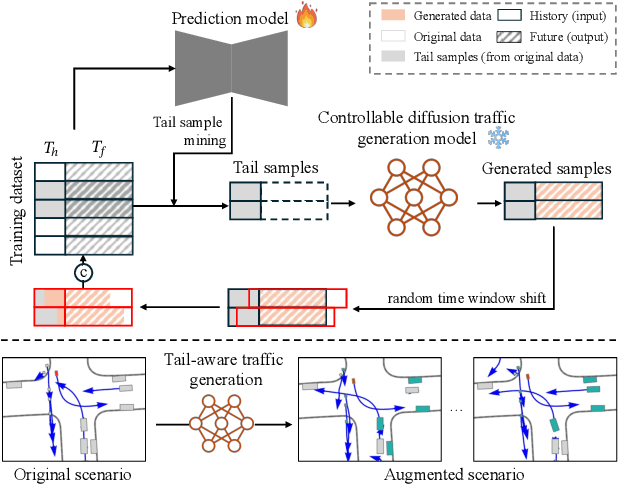

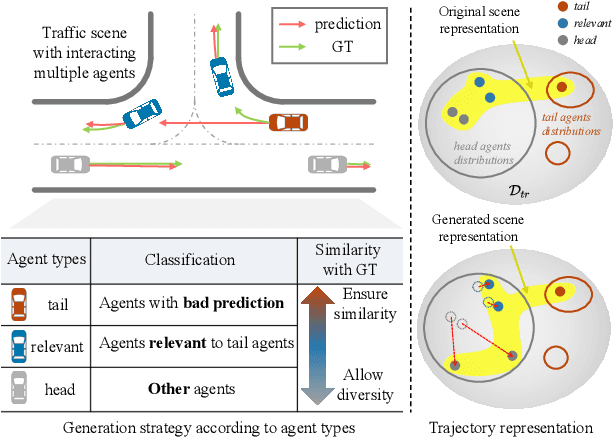
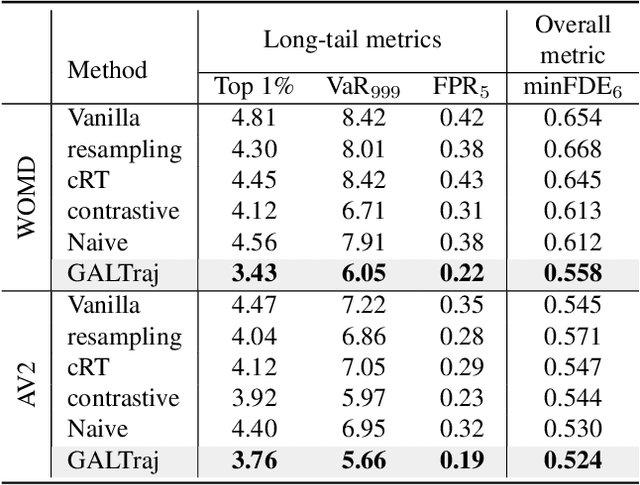
While data-driven trajectory prediction has enhanced the reliability of autonomous driving systems, it still struggles with rarely observed long-tail scenarios. Prior works addressed this by modifying model architectures, such as using hypernetworks. In contrast, we propose refining the training process to unlock each model's potential without altering its structure. We introduce Generative Active Learning for Trajectory prediction (GALTraj), the first method to successfully deploy generative active learning into trajectory prediction. It actively identifies rare tail samples where the model fails and augments these samples with a controllable diffusion model during training. In our framework, generating scenarios that are diverse, realistic, and preserve tail-case characteristics is paramount. Accordingly, we design a tail-aware generation method that applies tailored diffusion guidance to generate trajectories that both capture rare behaviors and respect traffic rules. Unlike prior simulation methods focused solely on scenario diversity, GALTraj is the first to show how simulator-driven augmentation benefits long-tail learning in trajectory prediction. Experiments on multiple trajectory datasets (WOMD, Argoverse2) with popular backbones (QCNet, MTR) confirm that our method significantly boosts performance on tail samples and also enhances accuracy on head samples.
Non-differentiable Reward Optimization for Diffusion-based Autonomous Motion Planning
Jul 17, 2025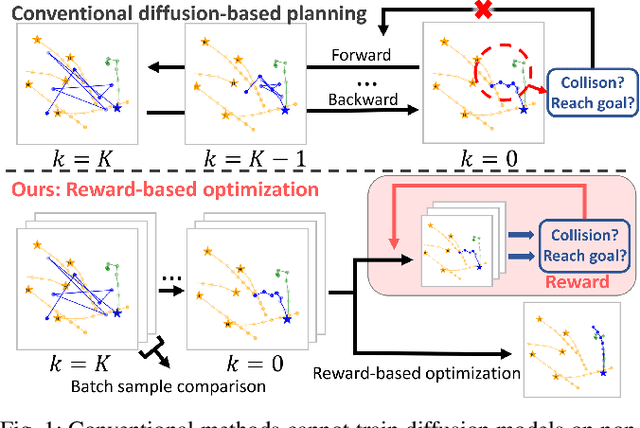
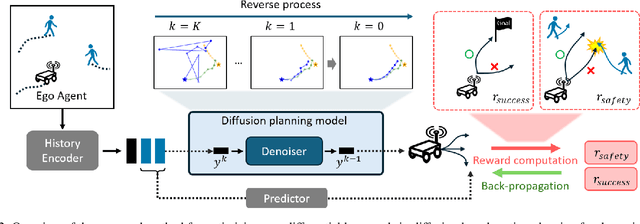
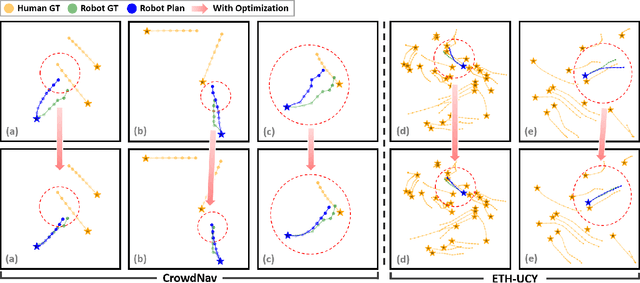
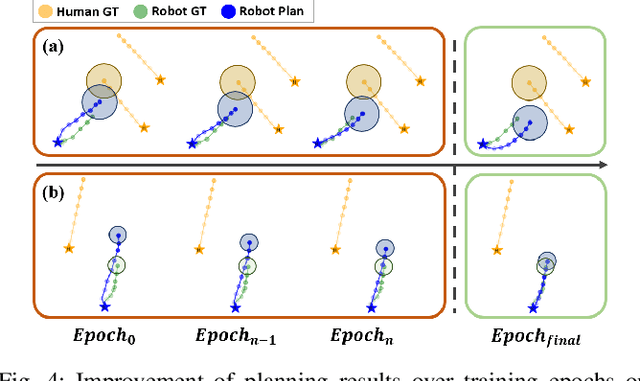
Safe and effective motion planning is crucial for autonomous robots. Diffusion models excel at capturing complex agent interactions, a fundamental aspect of decision-making in dynamic environments. Recent studies have successfully applied diffusion models to motion planning, demonstrating their competence in handling complex scenarios and accurately predicting multi-modal future trajectories. Despite their effectiveness, diffusion models have limitations in training objectives, as they approximate data distributions rather than explicitly capturing the underlying decision-making dynamics. However, the crux of motion planning lies in non-differentiable downstream objectives, such as safety (collision avoidance) and effectiveness (goal-reaching), which conventional learning algorithms cannot directly optimize. In this paper, we propose a reinforcement learning-based training scheme for diffusion motion planning models, enabling them to effectively learn non-differentiable objectives that explicitly measure safety and effectiveness. Specifically, we introduce a reward-weighted dynamic thresholding algorithm to shape a dense reward signal, facilitating more effective training and outperforming models trained with differentiable objectives. State-of-the-art performance on pedestrian datasets (CrowdNav, ETH-UCY) compared to various baselines demonstrates the versatility of our approach for safe and effective motion planning.
Multi-modal Knowledge Distillation-based Human Trajectory Forecasting
Mar 28, 2025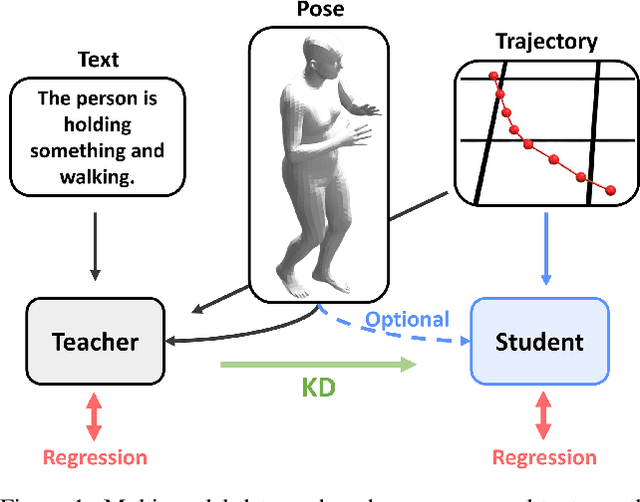

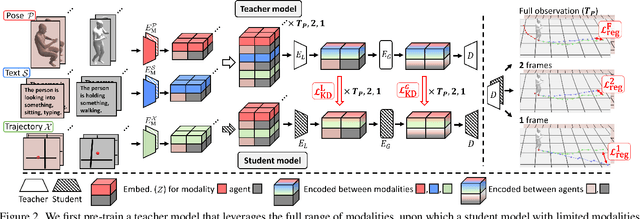
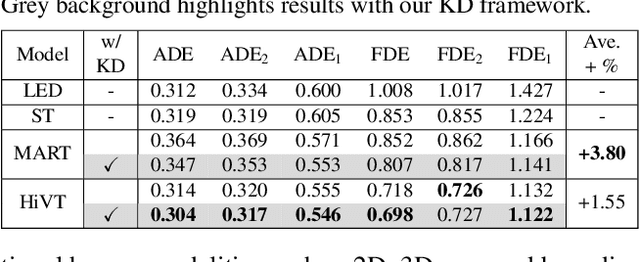
Pedestrian trajectory forecasting is crucial in various applications such as autonomous driving and mobile robot navigation. In such applications, camera-based perception enables the extraction of additional modalities (human pose, text) to enhance prediction accuracy. Indeed, we find that textual descriptions play a crucial role in integrating additional modalities into a unified understanding. However, online extraction of text requires the use of VLM, which may not be feasible for resource-constrained systems. To address this challenge, we propose a multi-modal knowledge distillation framework: a student model with limited modality is distilled from a teacher model trained with full range of modalities. The comprehensive knowledge of a teacher model trained with trajectory, human pose, and text is distilled into a student model using only trajectory or human pose as a sole supplement. In doing so, we separately distill the core locomotion insights from intra-agent multi-modality and inter-agent interaction. Our generalizable framework is validated with two state-of-the-art models across three datasets on both ego-view (JRDB, SIT) and BEV-view (ETH/UCY) setups, utilizing both annotated and VLM-generated text captions. Distilled student models show consistent improvement in all prediction metrics for both full and instantaneous observations, improving up to ~13%. The code is available at https://github.com/Jaewoo97/KDTF.
Multi-agent Long-term 3D Human Pose Forecasting via Interaction-aware Trajectory Conditioning
Apr 08, 2024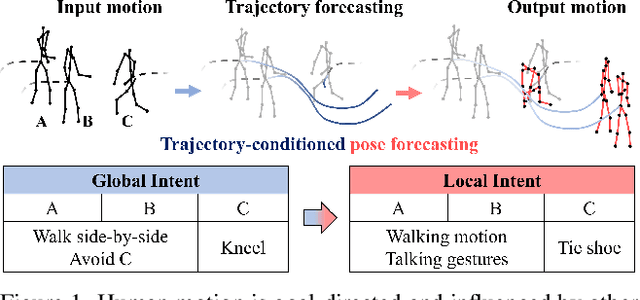
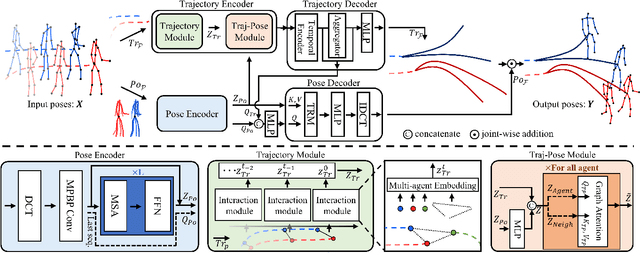
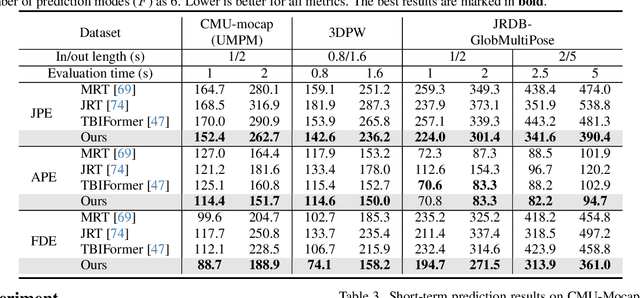
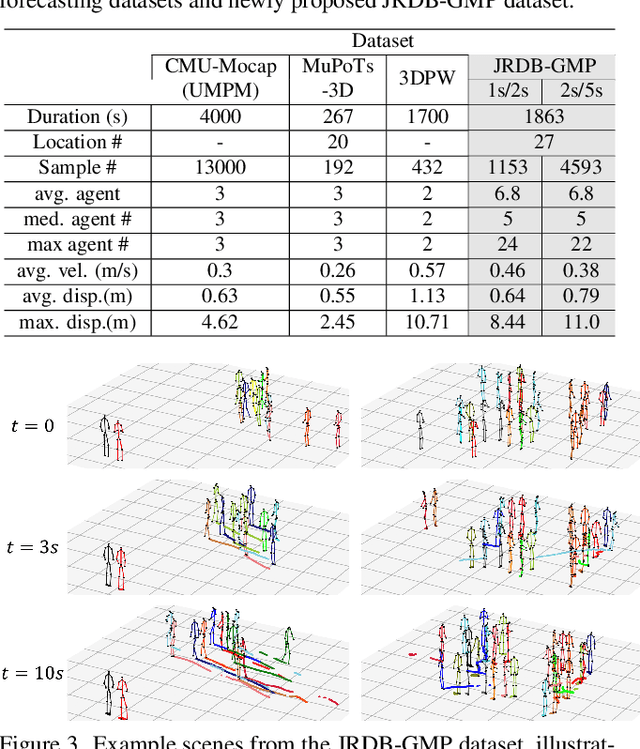
Human pose forecasting garners attention for its diverse applications. However, challenges in modeling the multi-modal nature of human motion and intricate interactions among agents persist, particularly with longer timescales and more agents. In this paper, we propose an interaction-aware trajectory-conditioned long-term multi-agent human pose forecasting model, utilizing a coarse-to-fine prediction approach: multi-modal global trajectories are initially forecasted, followed by respective local pose forecasts conditioned on each mode. In doing so, our Trajectory2Pose model introduces a graph-based agent-wise interaction module for a reciprocal forecast of local motion-conditioned global trajectory and trajectory-conditioned local pose. Our model effectively handles the multi-modality of human motion and the complexity of long-term multi-agent interactions, improving performance in complex environments. Furthermore, we address the lack of long-term (6s+) multi-agent (5+) datasets by constructing a new dataset from real-world images and 2D annotations, enabling a comprehensive evaluation of our proposed model. State-of-the-art prediction performance on both complex and simpler datasets confirms the generalized effectiveness of our method. The code is available at https://github.com/Jaewoo97/T2P.
T4P: Test-Time Training of Trajectory Prediction via Masked Autoencoder and Actor-specific Token Memory
Mar 15, 2024
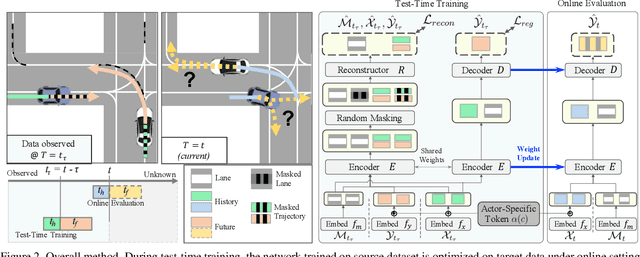
Trajectory prediction is a challenging problem that requires considering interactions among multiple actors and the surrounding environment. While data-driven approaches have been used to address this complex problem, they suffer from unreliable predictions under distribution shifts during test time. Accordingly, several online learning methods have been proposed using regression loss from the ground truth of observed data leveraging the auto-labeling nature of trajectory prediction task. We mainly tackle the following two issues. First, previous works underfit and overfit as they only optimize the last layer of the motion decoder. To this end, we employ the masked autoencoder (MAE) for representation learning to encourage complex interaction modeling in shifted test distribution for updating deeper layers. Second, utilizing the sequential nature of driving data, we propose an actor-specific token memory that enables the test-time learning of actor-wise motion characteristics. Our proposed method has been validated across various challenging cross-dataset distribution shift scenarios including nuScenes, Lyft, Waymo, and Interaction. Our method surpasses the performance of existing state-of-the-art online learning methods in terms of both prediction accuracy and computational efficiency. The code is available at https://github.com/daeheepark/T4P.
Improving Transferability for Cross-domain Trajectory Prediction via Neural Stochastic Differential Equation
Dec 26, 2023


Multi-agent trajectory prediction is crucial for various practical applications, spurring the construction of many large-scale trajectory datasets, including vehicles and pedestrians. However, discrepancies exist among datasets due to external factors and data acquisition strategies. External factors include geographical differences and driving styles, while data acquisition strategies include data acquisition rate, history/prediction length, and detector/tracker error. Consequently, the proficient performance of models trained on large-scale datasets has limited transferability on other small-size datasets, bounding the utilization of existing large-scale datasets. To address this limitation, we propose a method based on continuous and stochastic representations of Neural Stochastic Differential Equations (NSDE) for alleviating discrepancies due to data acquisition strategy. We utilize the benefits of continuous representation for handling arbitrary time steps and the use of stochastic representation for handling detector/tracker errors. Additionally, we propose a dataset-specific diffusion network and its training framework to handle dataset-specific detection/tracking errors. The effectiveness of our method is validated against state-of-the-art trajectory prediction models on the popular benchmark datasets: nuScenes, Argoverse, Lyft, INTERACTION, and Waymo Open Motion Dataset (WOMD). Improvement in performance gain on various source and target dataset configurations shows the generalized competence of our approach in addressing cross-dataset discrepancies.
Leveraging Future Relationship Reasoning for Vehicle Trajectory Prediction
May 24, 2023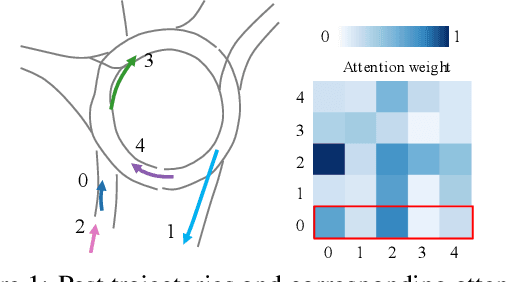
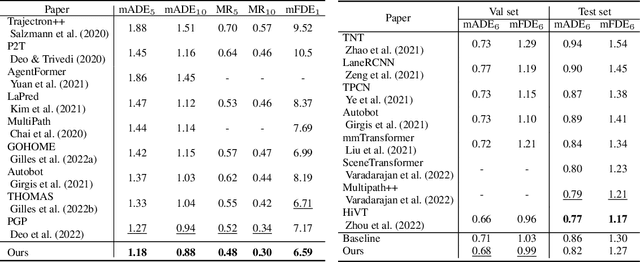
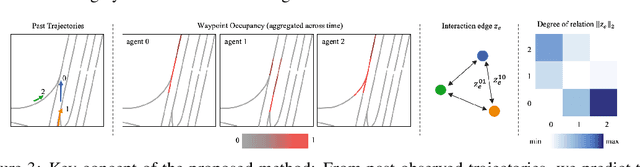

Understanding the interaction between multiple agents is crucial for realistic vehicle trajectory prediction. Existing methods have attempted to infer the interaction from the observed past trajectories of agents using pooling, attention, or graph-based methods, which rely on a deterministic approach. However, these methods can fail under complex road structures, as they cannot predict various interactions that may occur in the future. In this paper, we propose a novel approach that uses lane information to predict a stochastic future relationship among agents. To obtain a coarse future motion of agents, our method first predicts the probability of lane-level waypoint occupancy of vehicles. We then utilize the temporal probability of passing adjacent lanes for each agent pair, assuming that agents passing adjacent lanes will highly interact. We also model the interaction using a probabilistic distribution, which allows for multiple possible future interactions. The distribution is learned from the posterior distribution of interaction obtained from ground truth future trajectories. We validate our method on popular trajectory prediction datasets: nuScenes and Argoverse. The results show that the proposed method brings remarkable performance gain in prediction accuracy, and achieves state-of-the-art performance in long-term prediction benchmark dataset.