 Add to Chrome
 Add to Firefox
 Add to Edge
BitTP: The Lightweight Trajectory Prediction Model with BitLLM for Edge-Devices
May 28, 2026
Trajectory prediction is a fundamental task for autonomous systems, requiring complex reasoning about multi-agent interactions and intents. Large language models (LLMs) have recently been adopted for this task, as they provide strong contextual reasoning and interpretable, language-based trajectory representations. However, these LLM-based predictors are extremely memory- and compute-intensive, making them difficult to deploy on resource-constrained edge devices such as on-board computers in autonomous robots. To bridge this gap, we propose BitTP, which converts an LLM-based trajectory predictor into a lightweight bitlinear architecture. We demonstrate that weight-only quantization to 1.58-bit (BitTP-Weight) is optimal. Crucially, activations must remain in full precision, as quantizing them leads to severe degradation and instability in spatio-temporal reasoning. Empirically, BitTP-Weight not only preserves but improves prediction quality over the full-precision (BF16) LLM baseline, reducing ADE by 14.29% and FDE by 20.97% on average, while simultaneously reducing memory usage and inference latency relative to other quantization methods. These results demonstrate that carefully designed quantization acts as an effective regularizer, enabling the practical deployment of sophisticated LLM-based reasoning on edge devices. Code is available at: https://github.com/MintCat98/BitTP.

Can We Delegate Learning to Automation?: A Comparative Study of LLM Chatbots, Search Engines, and Books
Oct 02, 2024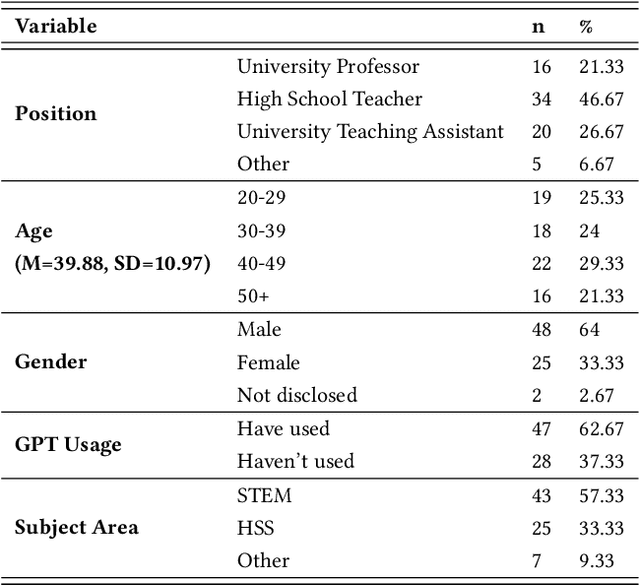
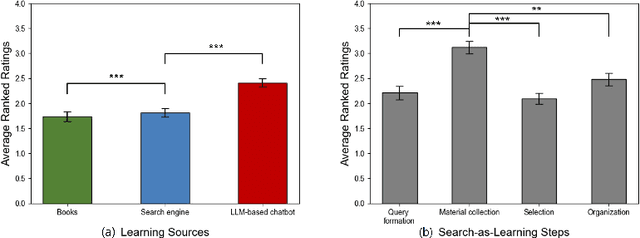
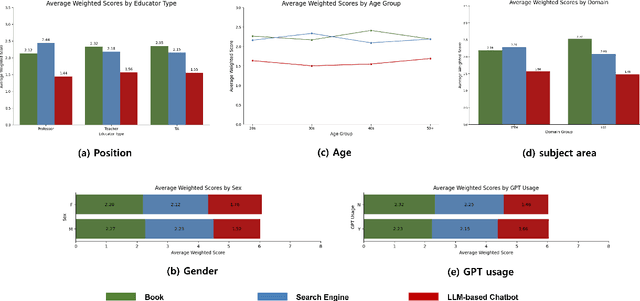
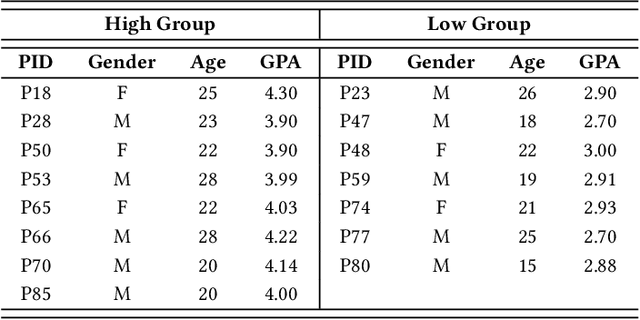
Learning is a key motivator behind information search behavior. With the emergence of LLM-based chatbots, students are increasingly turning to these tools as their primary resource for acquiring knowledge. However, the transition from traditional resources like textbooks and web searches raises concerns among educators. They worry that these fully-automated LLMs might lead students to delegate critical steps of search as learning. In this paper, we systematically uncover three main concerns from educators' perspectives. In response to these concerns, we conducted a mixed-methods study with 92 university students to compare three learning sources with different automation levels. Our results show that LLMs support comprehensive understanding of key concepts without promoting passive learning, though their effectiveness in knowledge retention was limited. Additionally, we found that academic performance impacted both learning outcomes and search patterns. Notably, higher-competence learners engaged more deeply with content through reading-intensive behaviors rather than relying on search activities.