 Add to Chrome
 Add to Firefox
 Add to Edge
Post-Training and Test-Time Scaling of Generative Agent Behavior Models for Interactive Autonomous Driving
Dec 15, 2025
Learning interactive motion behaviors among multiple agents is a core challenge in autonomous driving. While imitation learning models generate realistic trajectories, they often inherit biases from datasets dominated by safe demonstrations, limiting robustness in safety-critical cases. Moreover, most studies rely on open-loop evaluation, overlooking compounding errors in closed-loop execution. We address these limitations with two complementary strategies. First, we propose Group Relative Behavior Optimization (GRBO), a reinforcement learning post-training method that fine-tunes pretrained behavior models via group relative advantage maximization with human regularization. Using only 10% of the training dataset, GRBO improves safety performance by over 40% while preserving behavioral realism. Second, we introduce Warm-K, a warm-started Top-K sampling strategy that balances consistency and diversity in motion selection. Our Warm-K method-based test-time scaling enhances behavioral consistency and reactivity at test time without retraining, mitigating covariate shift and reducing performance discrepancies. Demo videos are available in the supplementary material.

Generative Active Learning for Long-tail Trajectory Prediction via Controllable Diffusion Model
Jul 30, 2025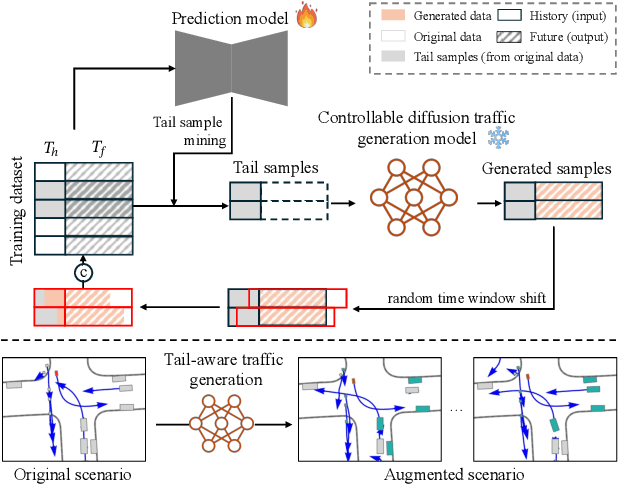

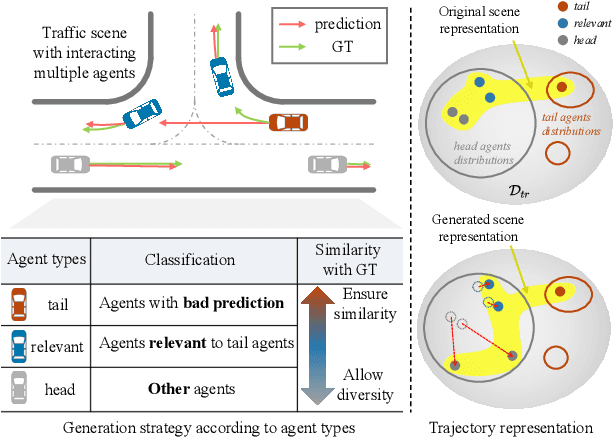
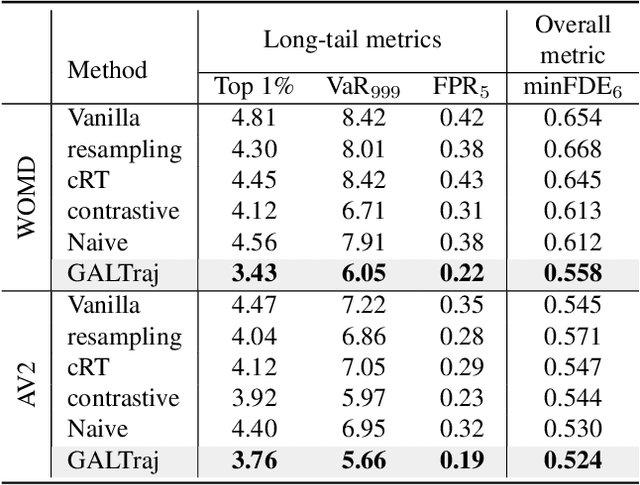
While data-driven trajectory prediction has enhanced the reliability of autonomous driving systems, it still struggles with rarely observed long-tail scenarios. Prior works addressed this by modifying model architectures, such as using hypernetworks. In contrast, we propose refining the training process to unlock each model's potential without altering its structure. We introduce Generative Active Learning for Trajectory prediction (GALTraj), the first method to successfully deploy generative active learning into trajectory prediction. It actively identifies rare tail samples where the model fails and augments these samples with a controllable diffusion model during training. In our framework, generating scenarios that are diverse, realistic, and preserve tail-case characteristics is paramount. Accordingly, we design a tail-aware generation method that applies tailored diffusion guidance to generate trajectories that both capture rare behaviors and respect traffic rules. Unlike prior simulation methods focused solely on scenario diversity, GALTraj is the first to show how simulator-driven augmentation benefits long-tail learning in trajectory prediction. Experiments on multiple trajectory datasets (WOMD, Argoverse2) with popular backbones (QCNet, MTR) confirm that our method significantly boosts performance on tail samples and also enhances accuracy on head samples.