 Add to Chrome
 Add to Firefox
 Add to Edge
Emergent Transfer of a Physics Foundation Model from Simulation to Laboratory Turbulence
May 31, 2026
Whether physics foundation models can be usefully deployed on laboratory experiments remains an open question for scientific machine learning (ML). We test this question on the Rayleigh-Taylor instability (RTI), a ubiquitous and demanding fluid instability seen from tabletop flows to supernova explosions, in which small perturbations at a density interface grow into chaotic, multiscale mixing as a lighter fluid accelerates into a heavier one. Standard ML models struggle with RTI, and despite over a century of theoretical, numerical, and experimental work, it carries an unresolved discrepancy between simulation and experiment: the late-time mixing growth rate, $α$, measured in most laboratory experiments ($\sim$ 0.06-0.07), is roughly three times the value from idealized direct numerical simulations (DNS, $\sim$ 0.02). The gap's origin remains debated. These properties make RTI a stringent test for a question that matters well beyond RTI: can foundation models trained only on simulations generalise to sparse, messy, and noisy laboratory settings? We finetune Walrus, a foundation model for continuum dynamics, on three or fewer DNS realizations and recover key RTI physics over long rollouts. Applied zero-shot to sliding-barrier laboratory data, the finetuned model leaves the DNS-like regime and enters the observed growth band, having never seen a single experimental sample. These results provide independent, data-driven evidence that initial conditions play a crucial role in the longstanding sim-experiment gap in $α$. The model also generalises zero-shot to stable stratification, a buoyancy regime absent from training, correctly slowing mixing-layer growth. Together, our results show that foundation models can generalise well beyond their training data, predicting laboratory behavior and unseen physical regimes, opening new ways to probe longstanding simulation-experiment gaps.

Probabilistic Retrofitting of Learned Simulators
Mar 02, 2026Dominant approaches for modelling Partial Differential Equations (PDEs) rely on deterministic predictions, yet many physical systems of interest are inherently chaotic and uncertain. While training probabilistic models from scratch is possible, it is computationally expensive and fails to leverage the significant resources already invested in high-performing deterministic backbones. In this work, we adopt a training-efficient strategy to transform pre-trained deterministic models into probabilistic ones via retrofitting with a proper scoring rule: the Continuous Ranked Probability Score (CRPS). Crucially, this approach is architecture-agnostic: it applies the same adaptation mechanism across distinct model backbones with minimal code modifications. The method proves highly effective across different scales of pre-training: for models trained on single dynamical systems, we achieve 20-54% reductions in rollout CRPS and up to 30% improvements in variance-normalised RMSE (VRMSE) relative to compute-matched deterministic fine-tuning. We further validate our approach on a PDE foundation model, trained on multiple systems and retrofitted on the dataset of interest, to show that our probabilistic adaptation yields an improvement of up to 40% in CRPS and up to 15% in VRMSE compared to deterministic fine-tuning. Validated across diverse architectures and dynamics, our results show that probabilistic PDE modelling need not require retraining from scratch, but can be unlocked from existing deterministic backbones with modest additional training cost.
Incremental Transformer Neural Processes
Feb 21, 2026Neural Processes (NPs), and specifically Transformer Neural Processes (TNPs), have demonstrated remarkable performance across tasks ranging from spatiotemporal forecasting to tabular data modelling. However, many of these applications are inherently sequential, involving continuous data streams such as real-time sensor readings or database updates. In such settings, models should support cheap, incremental updates rather than recomputing internal representations from scratch for every new observation -- a capability existing TNP variants lack. Drawing inspiration from Large Language Models, we introduce the Incremental TNP (incTNP). By leveraging causal masking, Key-Value (KV) caching, and a data-efficient autoregressive training strategy, incTNP matches the predictive performance of standard TNPs while reducing the computational cost of updates from quadratic to linear time complexity. We empirically evaluate our model on a range of synthetic and real-world tasks, including tabular regression and temperature prediction. Our results show that, surprisingly, incTNP delivers performance comparable to -- or better than -- non-causal TNPs while unlocking orders-of-magnitude speedups for sequential inference. Finally, we assess the consistency of the model's updates -- by adapting a metric of ``implicit Bayesianness", we show that incTNP retains a prediction rule as implicitly Bayesian as standard non-causal TNPs, demonstrating that incTNP achieves the computational benefits of causal masking without sacrificing the consistency required for streaming inference.
Use What You Know: Causal Foundation Models with Partial Graphs
Feb 16, 2026Estimating causal quantities traditionally relies on bespoke estimators tailored to specific assumptions. Recently proposed Causal Foundation Models (CFMs) promise a more unified approach by amortising causal discovery and inference in a single step. However, in their current state, they do not allow for the incorporation of any domain knowledge, which can lead to suboptimal predictions. We bridge this gap by introducing methods to condition CFMs on causal information, such as the causal graph or more readily available ancestral information. When access to complete causal graph information is too strict a requirement, our approach also effectively leverages partial causal information. We systematically evaluate conditioning strategies and find that injecting learnable biases into the attention mechanism is the most effective method to utilise full and partial causal information. Our experiments show that this conditioning allows a general-purpose CFM to match the performance of specialised models trained on specific causal structures. Overall, our approach addresses a central hurdle on the path towards all-in-one causal foundation models: the capability to answer causal queries in a data-driven manner while effectively leveraging any amount of domain expertise.
Walrus: A Cross-Domain Foundation Model for Continuum Dynamics
Nov 19, 2025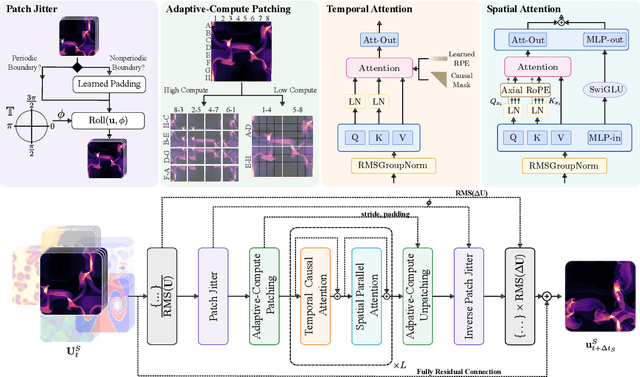
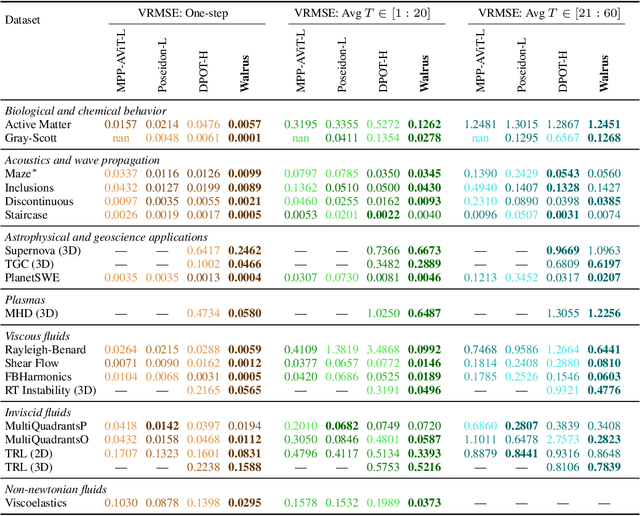
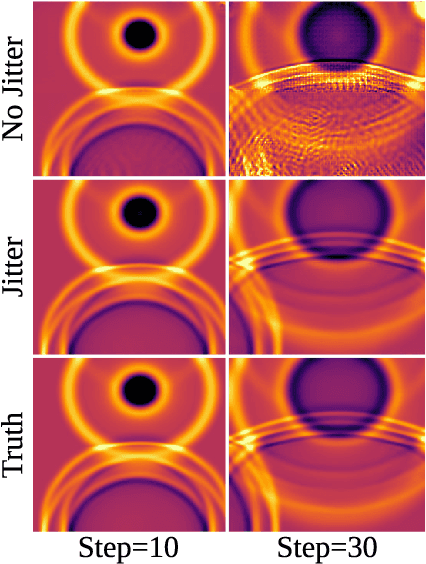
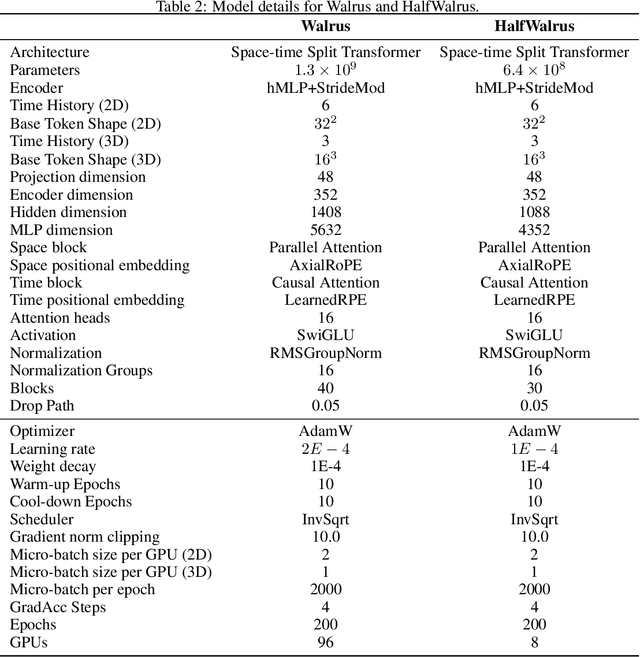
Foundation models have transformed machine learning for language and vision, but achieving comparable impact in physical simulation remains a challenge. Data heterogeneity and unstable long-term dynamics inhibit learning from sufficiently diverse dynamics, while varying resolutions and dimensionalities challenge efficient training on modern hardware. Through empirical and theoretical analysis, we incorporate new approaches to mitigate these obstacles, including a harmonic-analysis-based stabilization method, load-balanced distributed 2D and 3D training strategies, and compute-adaptive tokenization. Using these tools, we develop Walrus, a transformer-based foundation model developed primarily for fluid-like continuum dynamics. Walrus is pretrained on nineteen diverse scenarios spanning astrophysics, geoscience, rheology, plasma physics, acoustics, and classical fluids. Experiments show that Walrus outperforms prior foundation models on both short and long term prediction horizons on downstream tasks and across the breadth of pretraining data, while ablation studies confirm the value of our contributions to forecast stability, training throughput, and transfer performance over conventional approaches. Code and weights are released for community use.
On conditional diffusion models for PDE simulations
Oct 21, 2024
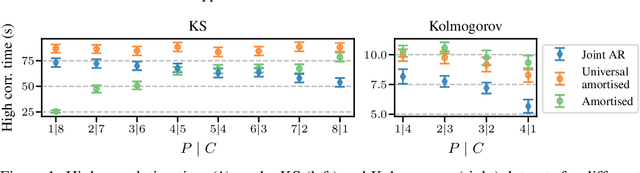
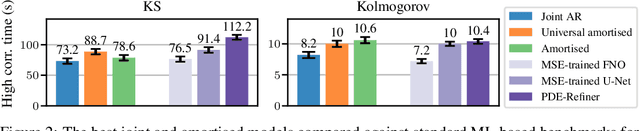

Modelling partial differential equations (PDEs) is of crucial importance in science and engineering, and it includes tasks ranging from forecasting to inverse problems, such as data assimilation. However, most previous numerical and machine learning approaches that target forecasting cannot be applied out-of-the-box for data assimilation. Recently, diffusion models have emerged as a powerful tool for conditional generation, being able to flexibly incorporate observations without retraining. In this work, we perform a comparative study of score-based diffusion models for forecasting and assimilation of sparse observations. In particular, we focus on diffusion models that are either trained in a conditional manner, or conditioned after unconditional training. We address the shortcomings of existing models by proposing 1) an autoregressive sampling approach that significantly improves performance in forecasting, 2) a new training strategy for conditional score-based models that achieves stable performance over a range of history lengths, and 3) a hybrid model which employs flexible pre-training conditioning on initial conditions and flexible post-training conditioning to handle data assimilation. We empirically show that these modifications are crucial for successfully tackling the combination of forecasting and data assimilation, a task commonly encountered in real-world scenarios.
Gridded Transformer Neural Processes for Large Unstructured Spatio-Temporal Data
Oct 10, 2024Many important problems require modelling large-scale spatio-temporal datasets, with one prevalent example being weather forecasting. Recently, transformer-based approaches have shown great promise in a range of weather forecasting problems. However, these have mostly focused on gridded data sources, neglecting the wealth of unstructured, off-the-grid data from observational measurements such as those at weather stations. A promising family of models suitable for such tasks are neural processes (NPs), notably the family of transformer neural processes (TNPs). Although TNPs have shown promise on small spatio-temporal datasets, they are unable to scale to the quantities of data used by state-of-the-art weather and climate models. This limitation stems from their lack of efficient attention mechanisms. We address this shortcoming through the introduction of gridded pseudo-token TNPs which employ specialised encoders and decoders to handle unstructured observations and utilise a processor containing gridded pseudo-tokens that leverage efficient attention mechanisms. Our method consistently outperforms a range of strong baselines on various synthetic and real-world regression tasks involving large-scale data, while maintaining competitive computational efficiency. The real-life experiments are performed on weather data, demonstrating the potential of our approach to bring performance and computational benefits when applied at scale in a weather modelling pipeline.
Approximately Equivariant Neural Processes
Jun 19, 2024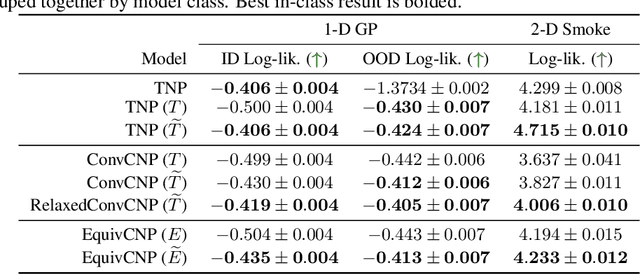

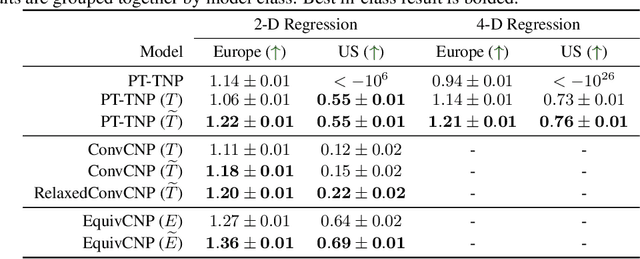
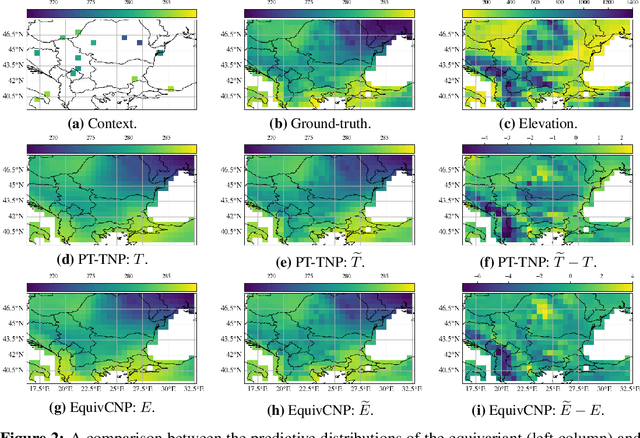
Equivariant deep learning architectures exploit symmetries in learning problems to improve the sample efficiency of neural-network-based models and their ability to generalise. However, when modelling real-world data, learning problems are often not exactly equivariant, but only approximately. For example, when estimating the global temperature field from weather station observations, local topographical features like mountains break translation equivariance. In these scenarios, it is desirable to construct architectures that can flexibly depart from exact equivariance in a data-driven way. In this paper, we develop a general approach to achieving this using existing equivariant architectures. Our approach is agnostic to both the choice of symmetry group and model architecture, making it widely applicable. We consider the use of approximately equivariant architectures in neural processes (NPs), a popular family of meta-learning models. We demonstrate the effectiveness of our approach on a number of synthetic and real-world regression experiments, demonstrating that approximately equivariant NP models can outperform both their non-equivariant and strictly equivariant counterparts.
In-Context In-Context Learning with Transformer Neural Processes
Jun 19, 2024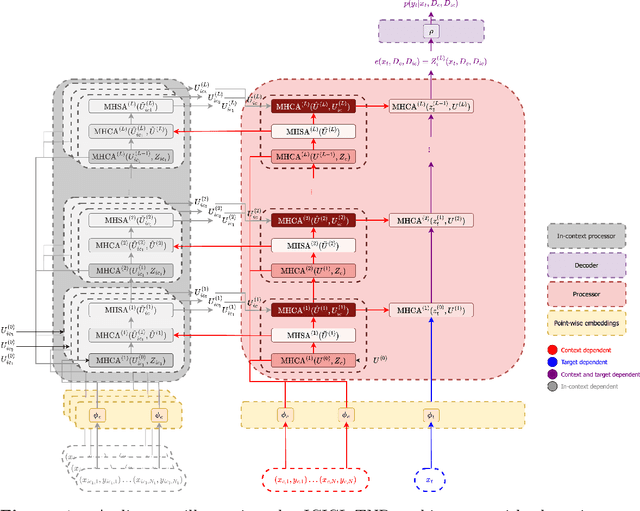
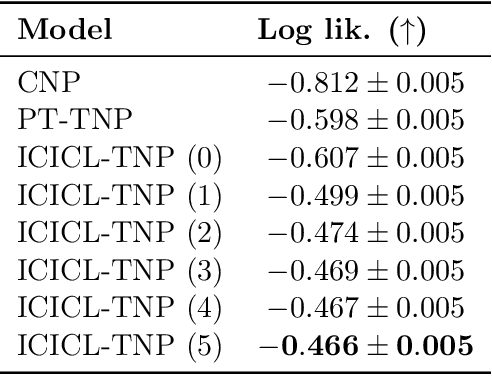
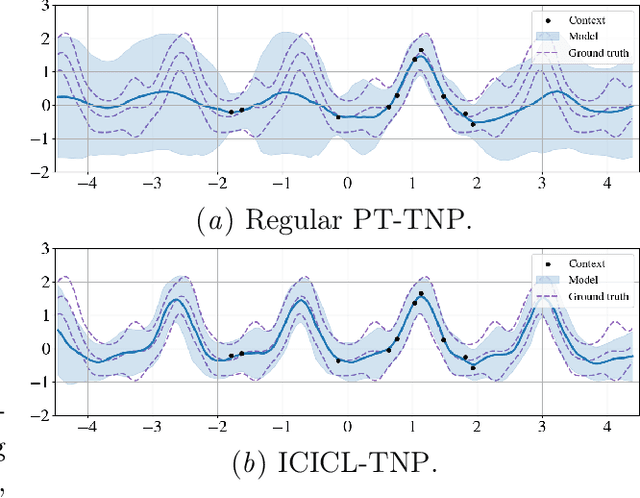
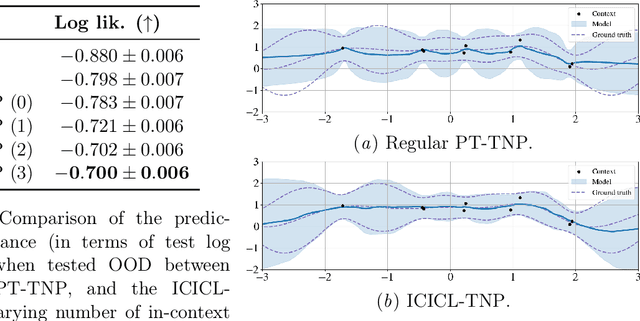
Neural processes (NPs) are a powerful family of meta-learning models that seek to approximate the posterior predictive map of the ground-truth stochastic process from which each dataset in a meta-dataset is sampled. There are many cases in which practitioners, besides having access to the dataset of interest, may also have access to other datasets that share similarities with it. In this case, integrating these datasets into the NP can improve predictions. We equip NPs with this functionality and describe this paradigm as in-context in-context learning. Standard NP architectures, such as the convolutional conditional NP (ConvCNP) or the family of transformer neural processes (TNPs), are not capable of in-context in-context learning, as they are only able to condition on a single dataset. We address this shortcoming by developing the in-context in-context learning pseudo-token TNP (ICICL-TNP). The ICICL-TNP builds on the family of PT-TNPs, which utilise pseudo-token-based transformer architectures to sidestep the quadratic computational complexity associated with regular transformer architectures. Importantly, the ICICL-TNP is capable of conditioning on both sets of datapoints and sets of datasets, enabling it to perform in-context in-context learning. We demonstrate the importance of in-context in-context learning and the effectiveness of the ICICL-TNP in a number of experiments.
Translation Equivariant Transformer Neural Processes
Jun 18, 2024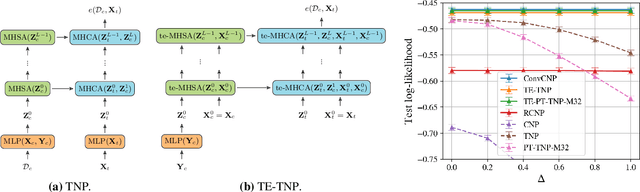
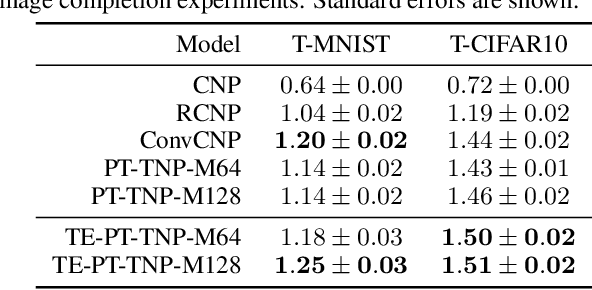
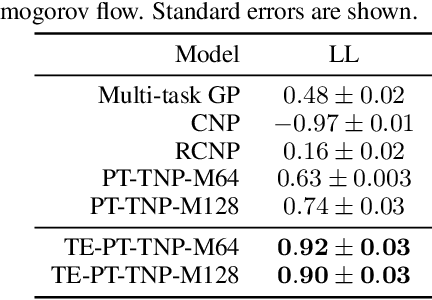
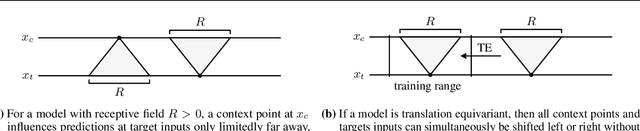
The effectiveness of neural processes (NPs) in modelling posterior prediction maps -- the mapping from data to posterior predictive distributions -- has significantly improved since their inception. This improvement can be attributed to two principal factors: (1) advancements in the architecture of permutation invariant set functions, which are intrinsic to all NPs; and (2) leveraging symmetries present in the true posterior predictive map, which are problem dependent. Transformers are a notable development in permutation invariant set functions, and their utility within NPs has been demonstrated through the family of models we refer to as TNPs. Despite significant interest in TNPs, little attention has been given to incorporating symmetries. Notably, the posterior prediction maps for data that are stationary -- a common assumption in spatio-temporal modelling -- exhibit translation equivariance. In this paper, we introduce of a new family of translation equivariant TNPs that incorporate translation equivariance. Through an extensive range of experiments on synthetic and real-world spatio-temporal data, we demonstrate the effectiveness of TE-TNPs relative to their non-translation-equivariant counterparts and other NP baselines.