 Add to Chrome
 Add to Firefox
 Add to Edge
Pruning and Distilling Mixture-of-Experts into Dense Language Models
May 27, 2026
Mixture-of-Experts (MoE) is now the dominant architecture for frontier language models, yet it requires all expert parameters to be loaded in memory, making it less preferable for memory-constrained deployment. Existing compression methods reduce the number of experts but the output remains an MoE model with the same fundamental limitation. We present the first systematic framework for converting a trained MoE into a standard fully dense architecture: experts are scored, selected, and grouped, then concatenated into a dense FFN and refined by knowledge distillation from the MoE teacher. We evaluate 7 scoring, 5 grouping, and 2 magnitude scaling methods across a range of selected expert counts on Qwen3-30B-A3B, yielding 350 configurations. We find that the choice of scoring method is the most impactful, with our novel diversity-aware scoring consistently outperforming prior methods on Qwen3-30B-A3B, DeepSeek-V2-Lite, and GPT-OSS-20B. Under a controlled comparison at matched parameter count, MoE-to-dense outperforms dense-to-dense pruning by +6.3 pp in average downstream accuracy after ~4B-token distillation at 1.6x faster training wall-clock speed.

Lexico: Extreme KV Cache Compression via Sparse Coding over Universal Dictionaries
Dec 12, 2024


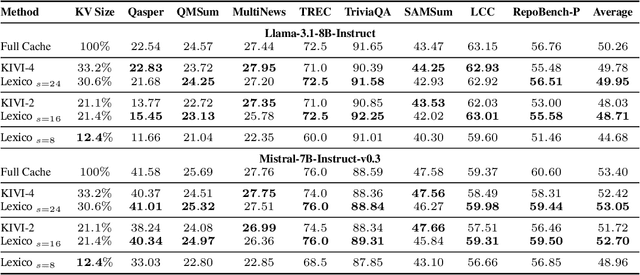
We introduce Lexico, a novel KV cache compression method that leverages sparse coding with a universal dictionary. Our key finding is that key-value cache in modern LLMs can be accurately approximated using sparse linear combination from a small, input-agnostic dictionary of ~4k atoms, enabling efficient compression across different input prompts, tasks and models. Using orthogonal matching pursuit for sparse approximation, Lexico achieves flexible compression ratios through direct sparsity control. On GSM8K, across multiple model families (Mistral, Llama 3, Qwen2.5), Lexico maintains 90-95% of the original performance while using only 15-25% of the full KV-cache memory, outperforming both quantization and token eviction methods. Notably, Lexico remains effective in low memory regimes where 2-bit quantization fails, achieving up to 1.7x better compression on LongBench and GSM8K while maintaining high accuracy.
Translation Equivariant Transformer Neural Processes
Jun 18, 2024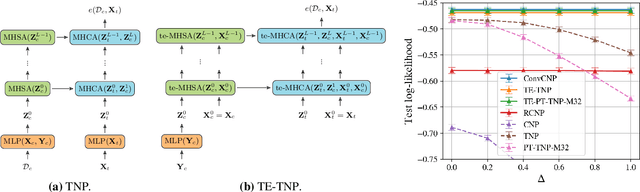
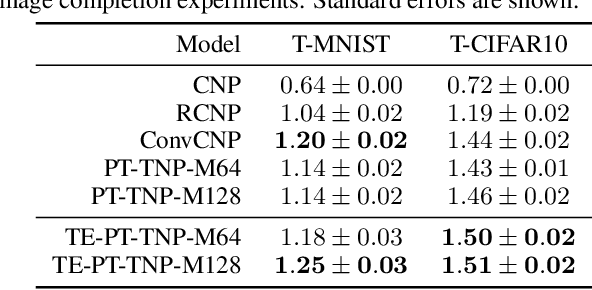
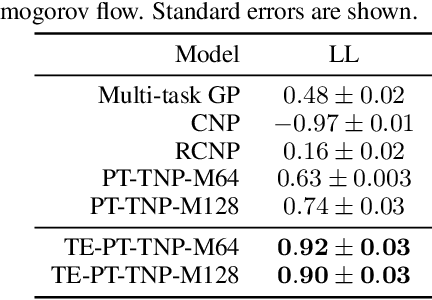
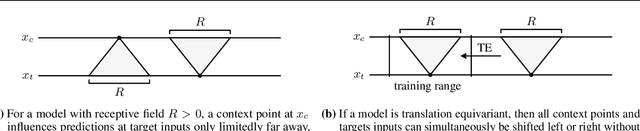
The effectiveness of neural processes (NPs) in modelling posterior prediction maps -- the mapping from data to posterior predictive distributions -- has significantly improved since their inception. This improvement can be attributed to two principal factors: (1) advancements in the architecture of permutation invariant set functions, which are intrinsic to all NPs; and (2) leveraging symmetries present in the true posterior predictive map, which are problem dependent. Transformers are a notable development in permutation invariant set functions, and their utility within NPs has been demonstrated through the family of models we refer to as TNPs. Despite significant interest in TNPs, little attention has been given to incorporating symmetries. Notably, the posterior prediction maps for data that are stationary -- a common assumption in spatio-temporal modelling -- exhibit translation equivariance. In this paper, we introduce of a new family of translation equivariant TNPs that incorporate translation equivariance. Through an extensive range of experiments on synthetic and real-world spatio-temporal data, we demonstrate the effectiveness of TE-TNPs relative to their non-translation-equivariant counterparts and other NP baselines.