 Add to Chrome
 Add to Firefox
 Add to Edge
Anatomy-Anchored Self-Supervision: Distilling Vision Foundation Models for Invariant Ultrasound Representation
May 25, 2026
Self-supervised pre-training paradigm has gained increasing prominence for learning transferable representations in medical imaging, yet existing methods for ultrasound (US) images operate at the image or frame level, overlooking the anatomical context for clinical-aligned representation learning. In this work, we propose an anatomy-anchored ultrasound self-supervision framework ANAUS that shifts representation learning from generic visual regions to clinically meaningful anatomical structures. Utilizing a learnable latent prompt engine alongside a one-time domain adaptation on existing public image--mask pairs, we empower the LP-SAM module to achieve annotation-free anatomy delineation at scale. Building upon this anatomical grounding, we propose a dual-policy self-supervised learning paradigm consisting of inter-view semantics-aware anatomy-separating alignment and contextual core-region prediction to enhance representation learning. Specifically, the former enforces feature invariance within identical anatomical regions while promoting discriminability across distinct structures; the latter compels the model to reconstruct corrupted regions, thereby capturing fine-grained structural details. Extensive evaluations on six public datasets demonstrate that \ours{} consistently outstrips current state-of-the-art methods while maintaining the computational efficiency essential for clinical deployment. Code is available at https://github.com/zhcz328/ANAUS.

Subspace-Guided Semantic and Topological Invariant Registration for Annotation-Free Ultrasound Plane Quality Control
May 25, 2026Reliable quality control (QC) of ultrasound images is essential for both real-time acquisition guidance and retrospective clinical audit, yet existing approaches rely heavily on per-plane annotations, or employ pseudo-labeling prone to systematic bias under spatial deformations inherent in clinical acquisition. We present STRIQ, a registration-driven framework that recasts annotation-free US plane quality control as a subspace-guided consistency measurement problem. Specifically, STRIQ introduces a Latent Registration Aligner (LRA) to establish hierarchical feature space correspondences between query images and variance-driven anchors, which are autonomously distilled from unlabeled data via a variance spectrum criterion to serve as structurally stable prototypes. To further disambiguate anatomical planes and mitigate negative knowledge transfer, we propose an Orthogonal Knowledge Subspace (OKS) module. The OKS decomposes plane-specific representations into mutually orthogonal subspaces, enabling fine-grained expert collaboration while preventing inter-plane interference, ensuring that the quality metric is grounded in principled subspace proximity. Extensive experiments on the in-house US4QA and public CAMUS datasets demonstrate that STRIQ achieves state-of-the-art correlation with clinical quality scores, establishing a new paradigm for annotation-free, real-time reliable ultrasound quality control. Our code is available at https://github.com/zhcz328/STRIQ.
Difference Feedback: Generating Multimodal Process-Level Supervision for VLM Reinforcement Learning
Mar 29, 2026Vision--language models (VLMs) are increasingly aligned via Group Relative Policy Optimization (GRPO)-style training. However, relying solely on terminal outcome rewards yields sparse credit assignment in multi-step reasoning, weakening the linkage between visual evidence and intermediate steps and often causing unstable optimization and visual hallucinations. We propose Differential Feedback, which automatically constructs token/step-level supervision masks by repairing erroneous reasoning trajectories, explicitly marking the key positions that require correction. Without costly large-scale step-by-step human annotations, our method enables process-level visual alignment and can be seamlessly integrated into existing GRPO-like frameworks. Experiments on multimodal reasoning benchmarks including MMMStar and MathVista show an average 3% improvement under matched compute budgets. Our approach offers an effective, low-cost solution for accurate vision--reasoning process alignment.
MedCausalX: Adaptive Causal Reasoning with Self-Reflection for Trustworthy Medical Vision-Language Models
Mar 24, 2026Vision-Language Models (VLMs) have enabled interpretable medical diagnosis by integrating visual perception with linguistic reasoning. Yet, existing medical chain-of-thought (CoT) models lack explicit mechanisms to represent and enforce causal reasoning, leaving them vulnerable to spurious correlations and limiting their clinical reliability. We pinpoint three core challenges in medical CoT reasoning: how to adaptively trigger causal correction, construct high-quality causal-spurious contrastive samples, and maintain causal consistency across reasoning trajectories. To address these challenges, we propose MedCausalX, an end-to-end framework explicitly models causal reasoning chains in medical VLMs. We first introduce the CRMed dataset providing fine-grained anatomical annotations, structured causal reasoning chains, and counterfactual variants that guide the learning of causal relationships beyond superficial correlations. Building upon CRMed, MedCausalX employs a two-stage adaptive reflection architecture equipped with $\langle$causal$\rangle$ and $\langle$verify$\rangle$ tokens, enabling the model to autonomously determine when and how to perform causal analysis and verification. Finally, a trajectory-level causal correction objective optimized through error-attributed reinforcement learning refines the reasoning chain, allowing the model to distinguish genuine causal dependencies from shortcut associations. Extensive experiments on multiple benchmarks show that MedCausalX consistently outperforms state-of-the-art methods, improving diagnostic consistency by +5.4 points, reducing hallucination by over 10 points, and attaining top spatial grounding IoU, thereby setting a new standard for causally grounded medical reasoning.
NTIRE 2023 Quality Assessment of Video Enhancement Challenge
Jul 19, 2023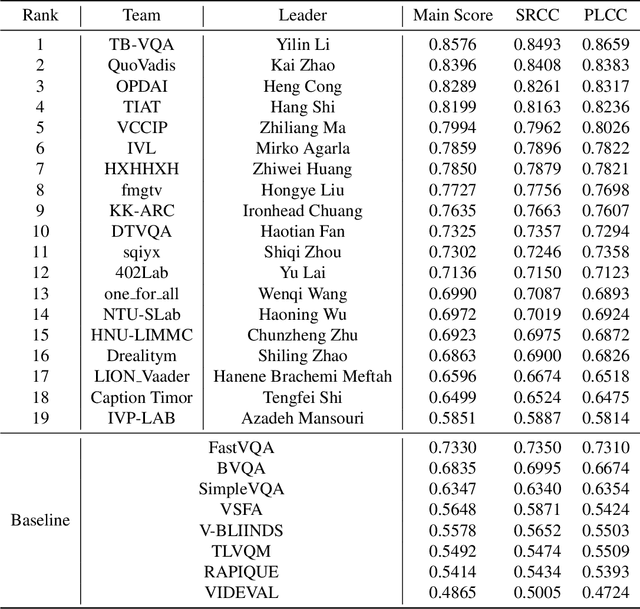

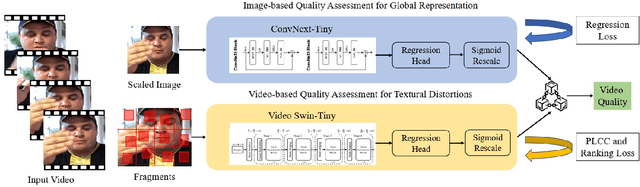
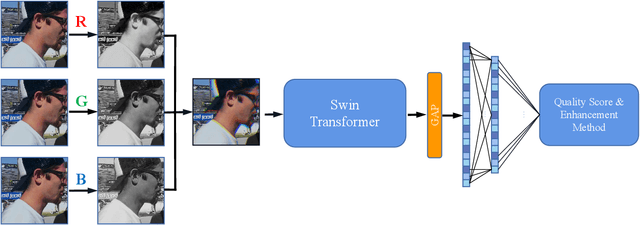
This paper reports on the NTIRE 2023 Quality Assessment of Video Enhancement Challenge, which will be held in conjunction with the New Trends in Image Restoration and Enhancement Workshop (NTIRE) at CVPR 2023. This challenge is to address a major challenge in the field of video processing, namely, video quality assessment (VQA) for enhanced videos. The challenge uses the VQA Dataset for Perceptual Video Enhancement (VDPVE), which has a total of 1211 enhanced videos, including 600 videos with color, brightness, and contrast enhancements, 310 videos with deblurring, and 301 deshaked videos. The challenge has a total of 167 registered participants. 61 participating teams submitted their prediction results during the development phase, with a total of 3168 submissions. A total of 176 submissions were submitted by 37 participating teams during the final testing phase. Finally, 19 participating teams submitted their models and fact sheets, and detailed the methods they used. Some methods have achieved better results than baseline methods, and the winning methods have demonstrated superior prediction performance.