 Add to Chrome
 Add to Firefox
 Add to Edge
IFHierBench: Hierarchical Instruction Following for Large Language Models
Jul 30, 2026
Instruction-following ability is critical for deploying large language models in real-world applications, where downstream components depend on the output satisfying specific constraints. Modern deployments increasingly handle the full task in a single LLM call, with one prompt specifying a layered output whose overall artifact, structural sections, and nested fields must each satisfy concrete constraints. Existing instruction-following benchmarks treat the constraint set as a flat list applied uniformly to the response, so they cannot scope a check to a particular section of the output. We introduce IFHierBench, a hierarchical instruction-following benchmark of 600 prompts stratified across four constraint-tree depths and 35 distinct constraints, each prompt paired with a deterministic checker that verifies satisfaction at every scope. Evaluating seven leading proprietary and open-weight models, we find that even the strongest model only marginally exceeds 50% prompt-level accuracy and that accuracy degrades sharply as constraint depth grows. Reliably following nested constraints remains a substantial gap for current LLMs, motivating future training methods that consider constraint adherence at finer granularity to achieve better instruction-following ability.

SemRF: A Semantic Reference Frame for Residual-Stream Dynamics in Language Models
Jun 30, 2026Residual-stream analysis asks how language-model computation evolves across depth, but intermediate decoding requires comparable readout coordinates across layers. If embedding anchors and unembedding readout disagree on the chosen span, apparent motion may reflect measurement drift rather than computation. We introduce \emph{Semantic Reference Frames} (SemRF), an anchor-based formalism separating semantic measurement from residual dynamics. A SemRF fixes anchors and measures states against them. Pseudo-inverse tying gives exact synchronization; under restricted bi-invertibility, SemRF yields stable semantic-basis coordinates, distortion bounds, and near-identity changes. With the frame fixed, residual computation becomes a depthwise semantic trajectory. The anchors induce a semantic Voronoi diagram: distance, or evidence such as logits, assigns each layer to a coarse cell, while coordinates retain within-cell motion and margins. We define layerwise steps, contribution profiles, and imbalance diagnostics, then use the Voronoi trace to define a margin-relaxed tube. The canonical trace is the minimum-action path inside this tube; when nonempty with positive quadratic weight, it is unique and obeys a discrete spline equation away from active constraints. Excess action controls step, curvature, and profile mismatch. Low curvature implies piecewise-linear compressibility and local knowledge density: lower trace complexity means fewer semantic knots. Through the parameter-to-trajectory map, this gives a conditional link to parameter efficiency: among admissible settings fitting data, lower-action and lower-complexity traces use fewer semantic degrees of freedom. The guarantees require controlled interface error and small projection residual under explicit tube constraints.
Evaluating LLMs on Real-World Software Performance Optimization
Jun 24, 2026Software performance optimization is a notoriously complex and manual task. Despite the growing use of Large Language Models (LLMs) for code refinement, we still lack benchmarks that capture how optimization actually happens in real-world codebases. Existing frameworks often oversimplify the problem by focusing on isolated functions or a single performance metric, missing the critical trade-offs between execution time and memory footprint, the inherent noise of the measurement environment, and the variability introduced by different input data and execution conditions. We address this by introducing SWE-Pro, a repository-level benchmark derived from 102 expert-written optimizations from open-source projects. Unlike previous benchmarks, SWE-Pro pairs each task with parameterized tests to evaluate runtime, peak memory, and Time-Weighted Memory Usage (TWMU) across varying input data and execution conditions under noise-aware measurement conditions. Our evaluation shows that current LLMs struggle significantly: runtime gains are negligible, and memory optimizations are nearly non-existent. This stands in sharp contrast to expert implementations, which achieve an aggregate speedup of 15.5x and peak memory reduction of 171.3x over benchmark tasks. Expert-written improvements are observed in 91.2% of tasks for runtime and 65.7% for peak memory. Our findings expose a substantial gap between current LLM capabilities and the demands of expert-level engineering.
How Smart Is Your GUI Agent? A Framework for the Future of Software Interaction
Feb 12, 2026GUI agents are rapidly becoming a new interaction to software, allowing people to navigate web, desktop and mobile rather than execute them click by click. Yet ``agent'' is described with radically different degrees of autonomy, obscuring capability, responsibility and risk. We call for conceptual clarity through GUI Agent Autonomy Levels (GAL), a six-level framework that makes autonomy explicit and helps benchmark progress toward trustworthy software interaction.
Rethinking Weight Tying: Pseudo-Inverse Tying for Stable LM Training and Updates
Feb 04, 2026Weight tying is widely used in compact language models to reduce parameters by sharing the token table between the input embedding and the output projection. However, weight sharing does not guarantee a stable token interface: during training, the correspondence between encoding tokens into hidden states and decoding hidden states into logits can drift, worsening optimization sensitivity and making post-training interventions such as editing, patching, and lightweight adaptation less predictable. We propose Pseudo-Inverse Tying (PIT), which synchronizes embedding and unembedding as coupled projections of a shared latent token memory, guaranteeing a pseudo-inverse-consistent interface throughout training. PIT maintains an orthonormal shared memory, obtained by thin polar decomposition for teacher initialization or random orthonormal initialization from scratch, and introduces a fully learned symmetric positive definite hidden-space transform parameterized via a Cholesky factor. The output head applies this transform to hidden states before the vocabulary projection, while the embedding applies the inverse transform to token vectors using stable triangular solves, avoiding explicit pseudo-inverse recomputation and any vocabulary-sized auxiliary parameters. We evaluate PIT on on-device models spanning 256M-1.3B parameters across pretraining and adaptation, and consistently observe improved training stability, stronger layerwise semantic consistency, and substantially reduced side effects.
Adoption of Generative Artificial Intelligence in the German Software Engineering Industry: An Empirical Study
Jan 23, 2026Generative artificial intelligence (GenAI) tools have seen rapid adoption among software developers. While adoption rates in the industry are rising, the underlying factors influencing the effective use of these tools, including the depth of interaction, organizational constraints, and experience-related considerations, have not been thoroughly investigated. This issue is particularly relevant in environments with stringent regulatory requirements, such as Germany, where practitioners must address the GDPR and the EU AI Act while balancing productivity gains with intellectual property considerations. Despite the significant impact of GenAI on software engineering, to the best of our knowledge, no empirical study has systematically examined the adoption dynamics of GenAI tools within the German context. To address this gap, we present a comprehensive mixed-methods study on GenAI adoption among German software engineers. Specifically, we conducted 18 exploratory interviews with practitioners, followed by a developer survey with 109 participants. We analyze patterns of tool adoption, prompting strategies, and organizational factors that influence effectiveness. Our results indicate that experience level moderates the perceived benefits of GenAI tools, and productivity gains are not evenly distributed among developers. Further, organizational size affects both tool selection and the intensity of tool use. Limited awareness of the project context is identified as the most significant barrier. We summarize a set of actionable implications for developers, organizations, and tool vendors seeking to advance artificial intelligence (AI) assisted software development.
SeMe: Training-Free Language Model Merging via Semantic Alignment
May 26, 2025Despite the remarkable capabilities of Language Models (LMs) across diverse tasks, no single model consistently outperforms others, necessitating efficient methods to combine their strengths without expensive retraining. Existing model merging techniques, such as parameter averaging and task-guided fusion, often rely on data-dependent computations or fail to preserve internal knowledge, limiting their robustness and scalability. We introduce SeMe (Semantic-based Merging), a novel, data-free, and training-free approach that leverages latent semantic alignment to merge LMs at a fine-grained, layer-wise level. Unlike prior work, SeMe not only preserves model behaviors but also explicitly stabilizes internal knowledge, addressing a critical gap in LM fusion. Through extensive experiments across diverse architectures and tasks, we demonstrate that SeMe outperforms existing methods in both performance and efficiency while eliminating reliance on external data. Our work establishes a new paradigm for knowledge-aware model merging and provides insights into the semantic structure of LMs, paving the way for more scalable and interpretable model composition.
THEMIS: Towards Practical Intellectual Property Protection for Post-Deployment On-Device Deep Learning Models
Mar 31, 2025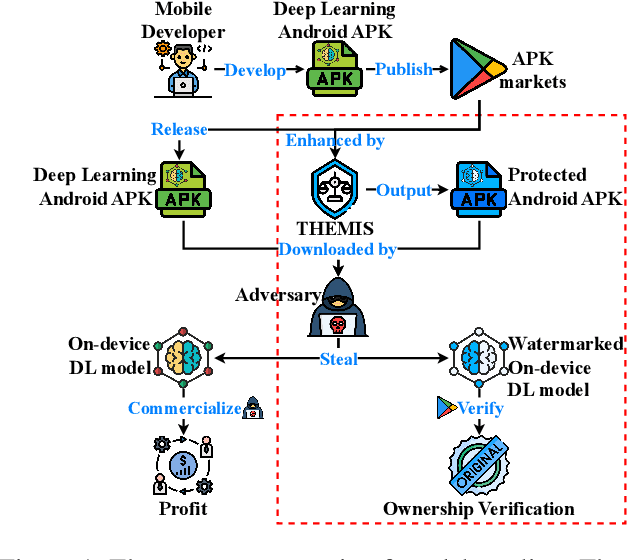
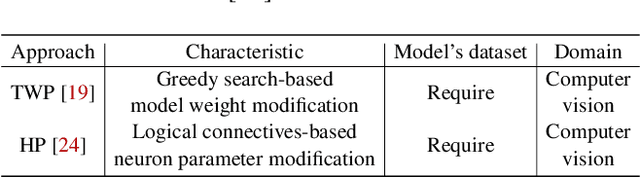
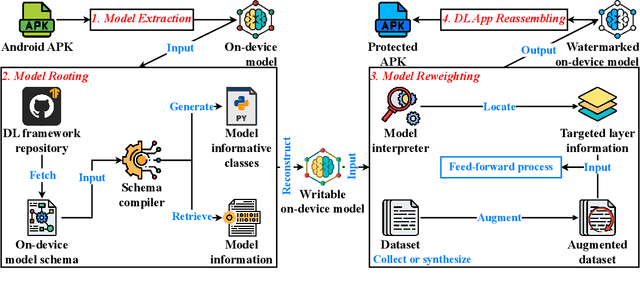
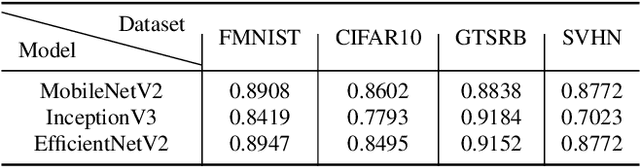
On-device deep learning (DL) has rapidly gained adoption in mobile apps, offering the benefits of offline model inference and user privacy preservation over cloud-based approaches. However, it inevitably stores models on user devices, introducing new vulnerabilities, particularly model-stealing attacks and intellectual property infringement. While system-level protections like Trusted Execution Environments (TEEs) provide a robust solution, practical challenges remain in achieving scalable on-device DL model protection, including complexities in supporting third-party models and limited adoption in current mobile solutions. Advancements in TEE-enabled hardware, such as NVIDIA's GPU-based TEEs, may address these obstacles in the future. Currently, watermarking serves as a common defense against model theft but also faces challenges here as many mobile app developers lack corresponding machine learning expertise and the inherent read-only and inference-only nature of on-device DL models prevents third parties like app stores from implementing existing watermarking techniques in post-deployment models. To protect the intellectual property of on-device DL models, in this paper, we propose THEMIS, an automatic tool that lifts the read-only restriction of on-device DL models by reconstructing their writable counterparts and leverages the untrainable nature of on-device DL models to solve watermark parameters and protect the model owner's intellectual property. Extensive experimental results across various datasets and model structures show the superiority of THEMIS in terms of different metrics. Further, an empirical investigation of 403 real-world DL mobile apps from Google Play is performed with a success rate of 81.14%, showing the practicality of THEMIS.
A Semantic-based Optimization Approach for Repairing LLMs: Case Study on Code Generation
Mar 17, 2025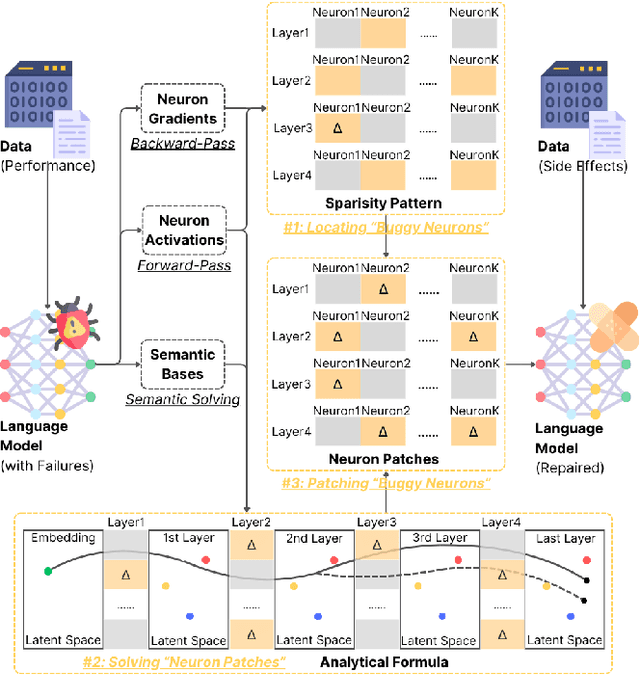
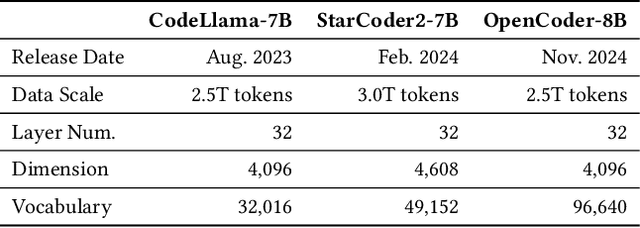
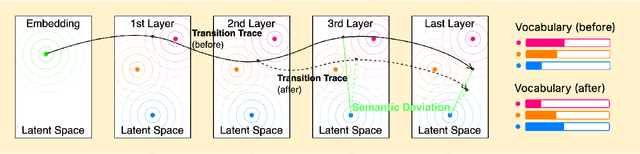
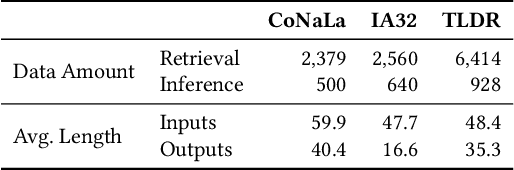
Language Models (LMs) are widely used in software engineering for code generation, but they may produce code with errors. Rather than repairing the generated code, an alternative way is to address the underlying failures of models. LM repair offers a lightweight solution to this challenge: it requires minimal data, reduces computational costs, and reduces the side effects. Unlike retraining, LM repair focuses on applying tailored updates to targeted neurons, making it ideal for scenarios with limited resources, high-performance demands, or strict safety requirements. In this paper, we propose \ul{S}emantic \ul{T}argeting for \ul{A}nalytical \ul{R}epair (\textsc{STAR}), a pioneering and novel semantic-based optimization approach for repairing LLMs. \textsc{STAR} realizes main operations in LM repair methods in an optimization process, including locating ``buggy neurons'', solving ``neuron patches'', and patching ``buggy neurons''. Correspondingly, it computes the deltas of weight matrix as the prior information to guide optimization; and attributes the targeted layers and neurons leveraging statistical insights. The neuron patches are computed with a solid semantic-based analytical formula, which directly bridges the changes to logits with the deltas of neurons, by steering latent representations. Compared to the prior work of LM repair (\textsc{MINT}) and optimization methods (\textsc{SGD}), \textsc{STAR} integrates their strengths while mitigating their limitations. \textsc{STAR} supports solving multiple failures together, significantly improving the usefulness. Evaluated on three code generation tasks using popular code LMs, \textsc{STAR} demonstrates superior effectiveness. Additionally, \textsc{STAR} exhibits better efficiency. In terms of side effects, namely the balance between generalization and specificity, \textsc{STAR} outperforms prior work by a significant margin.
A Semantic-based Layer Freezing Approach to Efficient Fine-Tuning of Language Models
Jun 17, 2024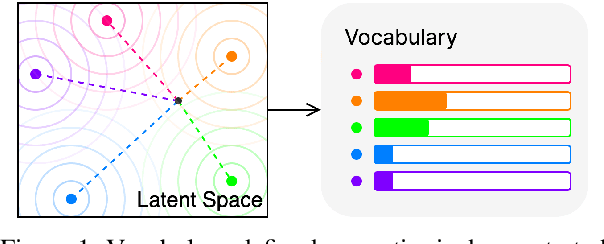
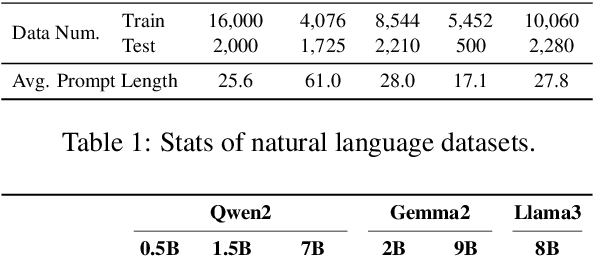
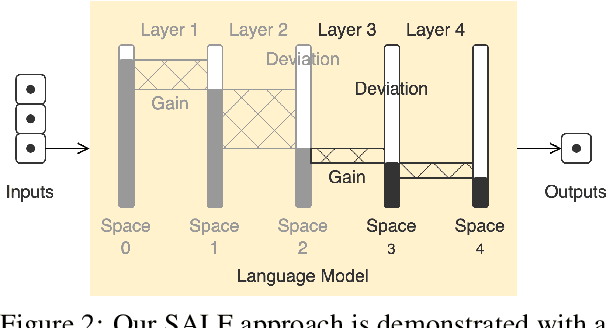

Finetuning language models (LMs) is crucial for adapting the models to downstream data and tasks. However, full finetuning is usually costly. Existing work, such as parameter-efficient finetuning (PEFT), often focuses on \textit{how to finetune} but neglects the issue of \textit{where to finetune}. As a pioneering work on answering where to finetune (at the layer level), we conduct a semantic analysis of the LM inference process. We first propose a virtual transition of the latent representation and then trace its factual transition. Based on the deviation in transitions, we estimate the gain of finetuning each model layer, and further, narrow down the scope for finetuning. We perform extensive experiments across well-known LMs and datasets. The results show that our approach is effective and efficient, and outperforms the existing baselines. Our approach is orthogonal to existing efficient techniques, such as PEFT methods, offering practical values on LM finetuning.