 Add to Chrome
 Add to Firefox
 Add to Edge
RAVEN: Long-Horizon Reasoning & Navigation with a Visuo-Spatio-Temporal Memory
Jun 23, 2026
Long-term robot deployment requires a compact and scalable memory that preserves fine-grained visual semantics, grounds observations in space and time, and enables efficient storage and retrieval. In this paper, we propose RAVEN, an agentic memory system for long-horizon robotic question answering and navigation. RAVEN stores visual embeddings with pose and time in a vector database, and grounds retrieval in a spatial map to answer queries and navigate to goals. By operating directly on visual embeddings, RAVEN avoids lossy image-to-text captioning and enables accurate semantic, spatial, and temporal retrieval at scale. Across several simulated and real-world video question-answering benchmarks, RAVEN consistently surpasses caption-based memory systems and matches frontier VLMs on long-horizon tasks at 10$\times$ lower retrieval cost. Finally, we instantiate RAVEN on a Unitree Go1 robot for the task of long-horizon navigation for natural language goal-reaching, and show successful deployment over several large indoor environments.

Contrastive Learning for Enhancing Robust Scene Transfer in Vision-based Agile Flight
Sep 29, 2023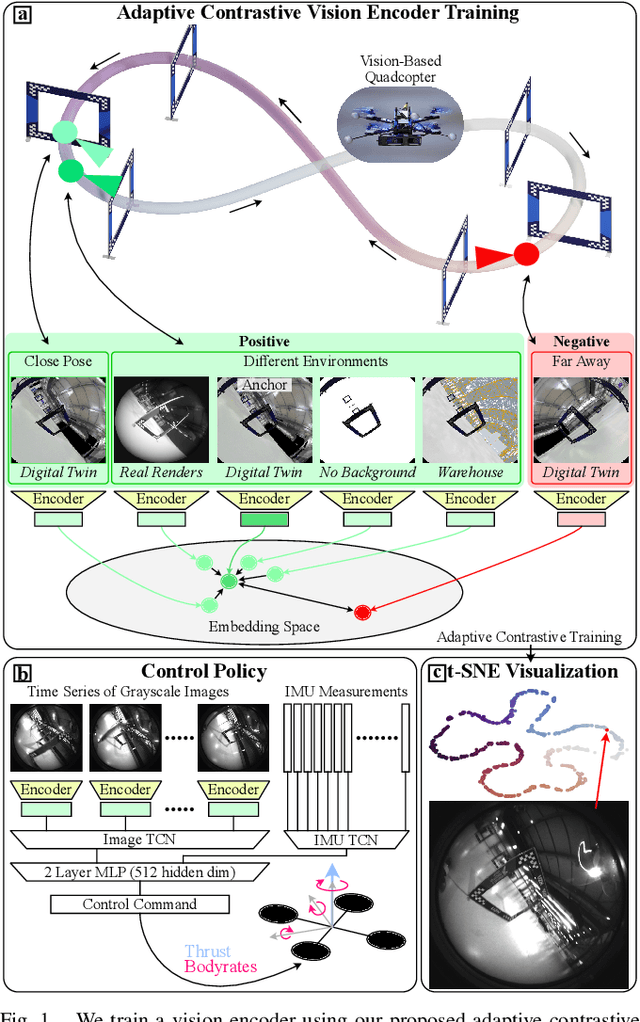
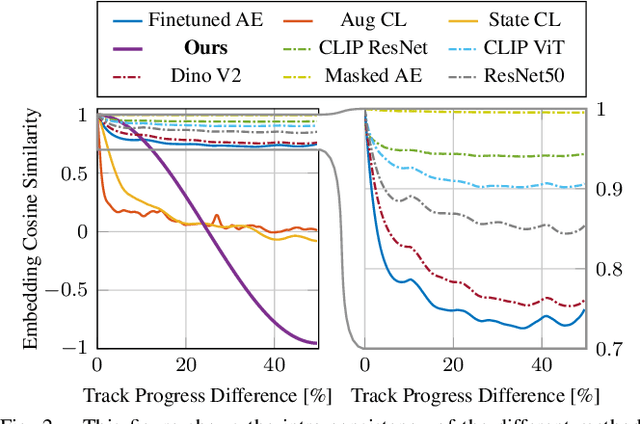
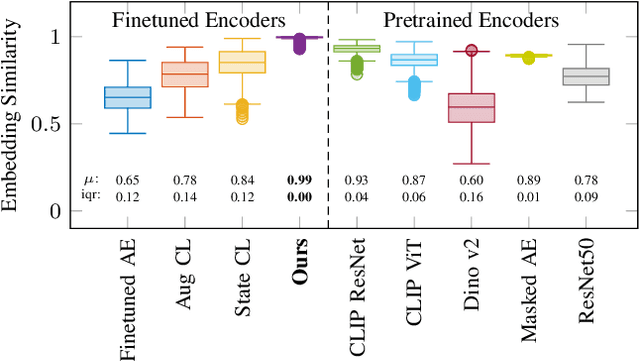
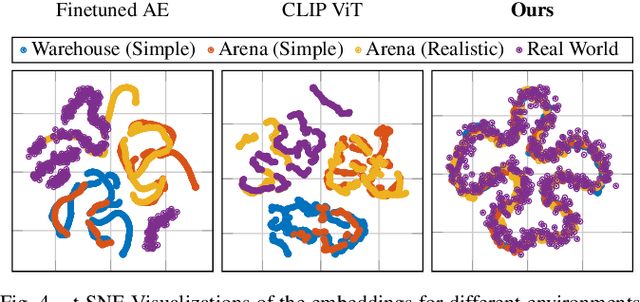
Scene transfer for vision-based mobile robotics applications is a highly relevant and challenging problem. The utility of a robot greatly depends on its ability to perform a task in the real world, outside of a well-controlled lab environment. Existing scene transfer end-to-end policy learning approaches often suffer from poor sample efficiency or limited generalization capabilities, making them unsuitable for mobile robotics applications. This work proposes an adaptive multi-pair contrastive learning strategy for visual representation learning that enables zero-shot scene transfer and real-world deployment. Control policies relying on the embedding are able to operate in unseen environments without the need for finetuning in the deployment environment. We demonstrate the performance of our approach on the task of agile, vision-based quadrotor flight. Extensive simulation and real-world experiments demonstrate that our approach successfully generalizes beyond the training domain and outperforms all baselines.
Descriptellation: Deep Learned Constellation Descriptors for SLAM
Mar 01, 2022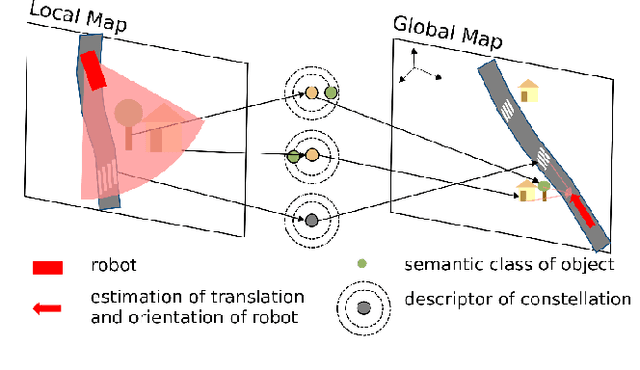
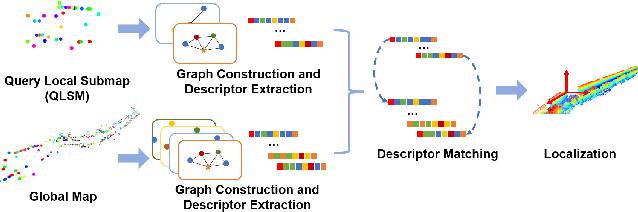
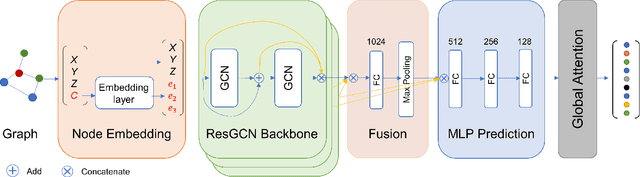
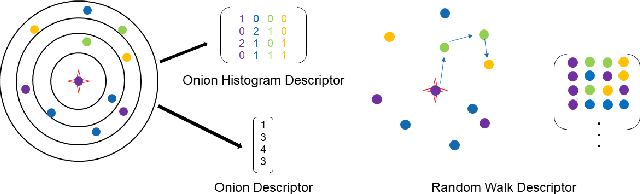
Current global localization descriptors in Simultaneous Localization and Mapping (SLAM) often fail under vast viewpoint or appearance changes. Adding topological information of semantic objects into the descriptors ameliorates the problem. However, hand-crafted topological descriptors extract limited information and they are not robust to environmental noise, drastic perspective changes, or object occlusion or misdetections. To solve this problem, we formulate a learning-based approach by constructing constellations from semantically meaningful objects and use Deep Graph Convolution Networks to map the constellation representation to a descriptor. We demonstrate the effectiveness of our Deep Learned Constellation Descriptor (Descriptellation) on the Paris-Rue-Lille and IQmulus datasets. Although Descriptellation is trained on randomly generated simulation datasets, it shows good generalization abilities on real-world datasets. Descriptellation outperforms the PointNet and handcrafted constellation descriptors for global localization, and shows robustness against different types of noise.