 Add to Chrome
 Add to Firefox
 Add to Edge
FlexiGrad: Adaptive Gradient Modulation for Hierarchical Fine-Grained Classification
Jul 20, 2026
Many fine-grained recognition tasks contain hierarchical labels such as order, family and species. Although this supervision should be beneficial, jointly optimising all levels often leads to unstable training because coarse and fine classifiers impose inconsistent gradients on the shared backbone. This hierarchical gradient conflict prevents the model from learning a coherent coarse-to-fine representation. In this paper, we propose FlexiGrad, a simple and parameter-free method that regulates gradient interactions during backpropagation. FlexiGrad removes only the harmful conflicting component when tasks disagree and reinforces the shared direction when they partially agree through a smooth hierarchy-aware weighting function. This produces stable optimisation and preserves both global structure and fine-grained discriminative cues. FlexiGrad integrates into existing architectures without modification while improves multi-granularity accuracy on CUB-200-2011, FGVC-Aircraft and Stanford Cars. The code will be available at PRIS-CV/FlexiGrad.

Seeing as Experts Do: A Knowledge-Augmented Agent for Open-Set Fine-Grained Visual Understanding
Mar 04, 2026Fine-grained visual understanding is shifting from static classification to knowledge-augmented reasoning, where models must justify as well as recognise. Existing approaches remain limited by closed-set taxonomies and single-label prediction, leading to significant degradation under open-set or context-dependent conditions. We present the Knowledge-Augmented Fine-Grained Reasoning Agent (KFRA), a unified framework that transforms fine-grained perception into evidence-driven reasoning. KFRA operates through a three-stage closed reasoning loop that emulates expert analysis. It first performs open-vocabulary detection and web-scale retrieval to generate category hypotheses. It then conducts discriminative regions localisation by aligning textual knowledge with visual evidence through a global-to-local focusing mechanism. Finally, it integrates all multimodal evidence within a large multimodal model to perform interpretable reasoning. Unlike existing agents that treat retrieval and reasoning as independent processes, KFRA establishes a retrieval-grounding coupling that converts retrieved knowledge into spatially grounded evidence for verification. This design enables factual, interpretable, and task-agnostic reasoning across diverse fine-grained scenarios. To evaluate this capability, we construct FGExpertBench, a benchmark designed to assess reasoning depth and cross-task generalisation across six knowledge dimensions. Extensive experiments demonstrate that KFRA consistently surpasses both standalone large multimodal models and current agent frameworks, achieving up to 19 percent improvement in reasoning accuracy and delivering evidence-grounded interpretability in open-set fine-grained visual understanding.
Implicit Federated In-context Learning For Task-Specific LLM Fine-Tuning
Nov 10, 2025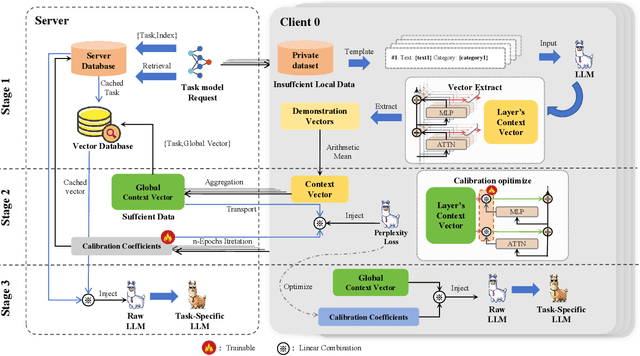

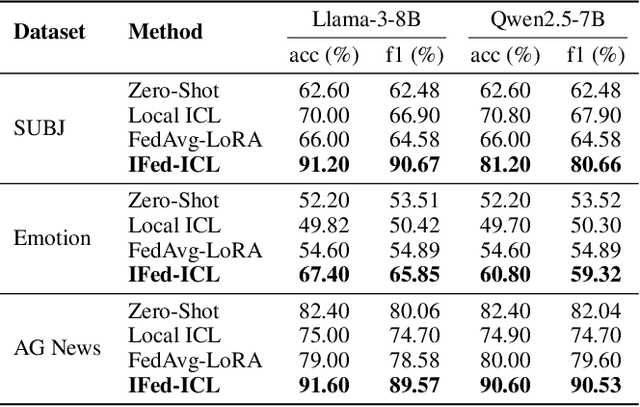
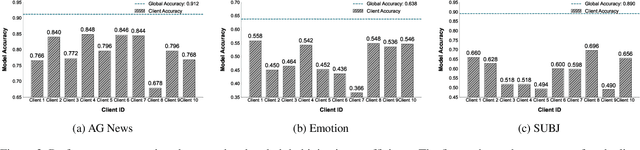
As large language models continue to develop and expand, the extensive public data they rely on faces the risk of depletion. Consequently, leveraging private data within organizations to enhance the performance of large models has emerged as a key challenge. The federated learning paradigm, combined with model fine-tuning techniques, effectively reduces the number of trainable parameters. However,the necessity to process high-dimensional feature spaces results in substantial overall computational overhead. To address this issue, we propose the Implicit Federated In-Context Learning (IFed-ICL) framework. IFed-ICL draws inspiration from federated learning to establish a novel distributed collaborative paradigm, by converting client local context examples into implicit vector representations, it enables distributed collaborative computation during the inference phase and injects model residual streams to enhance model performance. Experiments demonstrate that our proposed method achieves outstanding performance across multiple text classification tasks. Compared to traditional methods, IFed-ICL avoids the extensive parameter updates required by conventional fine-tuning methods while reducing data transmission and local computation at the client level in federated learning. This enables efficient distributed context learning using local private-domain data, significantly improving model performance on specific tasks.