 Add to Chrome
 Add to Firefox
 Add to Edge
Communication-Efficient Split Learning via Adaptive Feature-Wise Compression
Jul 20, 2023
This paper proposes a novel communication-efficient split learning (SL) framework, named SplitFC, which reduces the communication overhead required for transmitting intermediate feature and gradient vectors during the SL training process. The key idea of SplitFC is to leverage different dispersion degrees exhibited in the columns of the matrices. SplitFC incorporates two compression strategies: (i) adaptive feature-wise dropout and (ii) adaptive feature-wise quantization. In the first strategy, the intermediate feature vectors are dropped with adaptive dropout probabilities determined based on the standard deviation of these vectors. Then, by the chain rule, the intermediate gradient vectors associated with the dropped feature vectors are also dropped. In the second strategy, the non-dropped intermediate feature and gradient vectors are quantized using adaptive quantization levels determined based on the ranges of the vectors. To minimize the quantization error, the optimal quantization levels of this strategy are derived in a closed-form expression. Simulation results on the MNIST, CIFAR-10, and CelebA datasets demonstrate that SplitFC provides more than a 5.6% increase in classification accuracy compared to state-of-the-art SL frameworks, while they require 320 times less communication overhead compared to the vanilla SL framework without compression.

Mitigating Evasion Attacks in Federated Learning-Based Signal Classifiers
Jun 08, 2023There has been recent interest in leveraging federated learning (FL) for radio signal classification tasks. In FL, model parameters are periodically communicated from participating devices, which train on local datasets, to a central server which aggregates them into a global model. While FL has privacy/security advantages due to raw data not leaving the devices, it is still susceptible to adversarial attacks. In this work, we first reveal the susceptibility of FL-based signal classifiers to model poisoning attacks, which compromise the training process despite not observing data transmissions. In this capacity, we develop an attack framework that significantly degrades the training process of the global model. Our attack framework induces a more potent model poisoning attack to the global classifier than existing baselines while also being able to compromise existing server-driven defenses. In response to this gap, we develop Underlying Server Defense of Federated Learning (USD-FL), a novel defense methodology for FL-based signal classifiers. We subsequently compare the defensive efficacy, runtimes, and false positive detection rates of USD-FL relative to existing server-driven defenses, showing that USD-FL has notable advantages over the baseline defenses in all three areas.
Asynchronous Multi-Model Federated Learning over Wireless Networks: Theory, Modeling, and Optimization
May 22, 2023Federated learning (FL) has emerged as a key technique for distributed machine learning (ML). Most literature on FL has focused on systems with (i) ML model training for a single task/model, (ii) a synchronous setting for uplink/downlink transfer of model parameters, which is often unrealistic. To address this, we develop MA-FL, which considers FL with multiple downstream tasks to be trained over an asynchronous model transmission architecture. We first characterize the convergence of ML model training under MA-FL via introducing a family of scheduling tensors to capture the scheduling of devices. Our convergence analysis sheds light on the impact of resource allocation (e.g., the mini-batch size and number of gradient descent iterations), device scheduling, and individual model states (i.e., warmed vs. cold initialization) on the performance of ML models. We then formulate a non-convex mixed integer optimization problem for jointly configuring the resource allocation and device scheduling to strike an efficient trade-off between energy consumption and ML performance, which is solved via successive convex approximations. Through numerical simulations, we reveal the advantages of MA-FL in terms of model performance and network resource savings.
Dynamic and Robust Sensor Selection Strategies for Wireless Positioning with TOA/RSS Measurement
Apr 30, 2023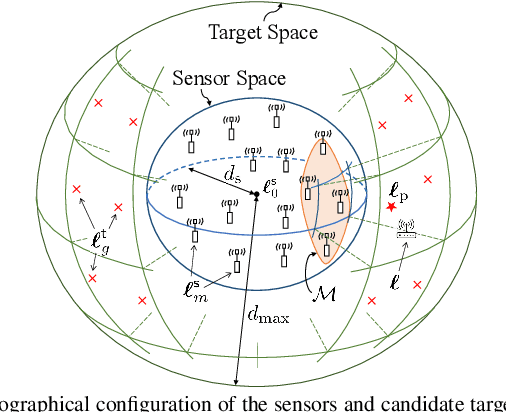
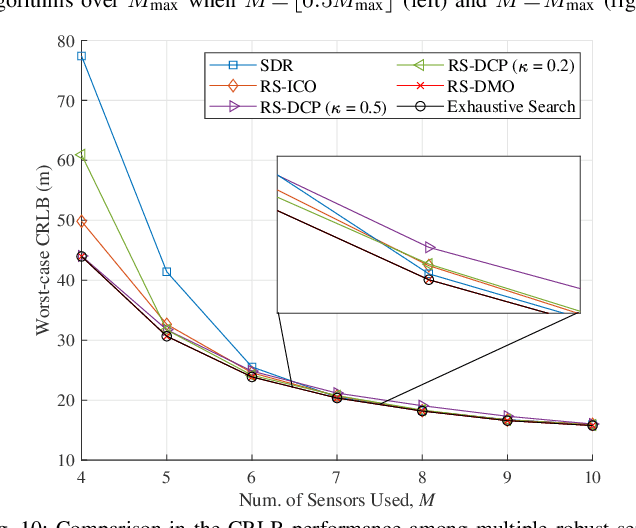
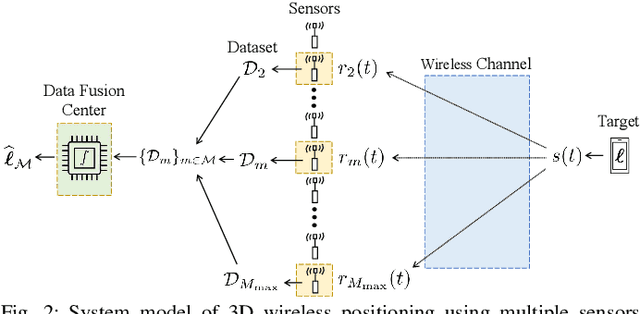
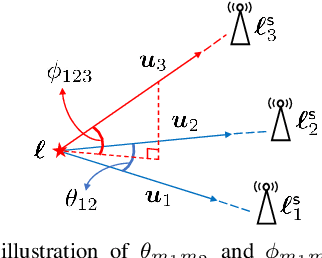
Emerging wireless applications are requiring ever more accurate location-positioning from sensor measurements. In this paper, we develop sensor selection strategies for 3D wireless positioning based on time of arrival (TOA) and received signal strength (RSS) measurements to handle two distinct scenarios: (i) known approximated target location, for which we conduct dynamic sensor selection to minimize the positioning error; and (ii) unknown approximated target location, in which the worst-case positioning error is minimized via robust sensor selection. We derive expressions for the Cram\'er-Rao lower bound (CRLB) as a performance metric to quantify the positioning accuracy resulted from selected sensors. For dynamic sensor selection, two greedy selection strategies are proposed, each of which exploits properties revealed in the derived CRLB expressions. These selection strategies are shown to strike an efficient balance between computational complexity and performance suboptimality. For robust sensor selection, we show that the conventional convex relaxation approach leads to instability, and then develop three algorithms based on (i) iterative convex optimization (ICO), (ii) difference of convex functions programming (DCP), and (iii) discrete monotonic optimization (DMO). Each of these strategies exhibits a different tradeoff between computational complexity and optimality guarantee. Simulation results show that the proposed sensor selection strategies provide significant improvements in terms of accuracy and/or complexity compared to existing sensor selection methods.
Multi-Source to Multi-Target Decentralized Federated Domain Adaptation
Apr 24, 2023Heterogeneity across devices in federated learning (FL) typically refers to statistical (e.g., non-i.i.d. data distributions) and resource (e.g., communication bandwidth) dimensions. In this paper, we focus on another important dimension that has received less attention: varying quantities/distributions of labeled and unlabeled data across devices. In order to leverage all data, we develop a decentralized federated domain adaptation methodology which considers the transfer of ML models from devices with high quality labeled data (called sources) to devices with low quality or unlabeled data (called targets). Our methodology, Source-Target Determination and Link Formation (ST-LF), optimizes both (i) classification of devices into sources and targets and (ii) source-target link formation, in a manner that considers the trade-off between ML model accuracy and communication energy efficiency. To obtain a concrete objective function, we derive a measurable generalization error bound that accounts for estimates of source-target hypothesis deviations and divergences between data distributions. The resulting optimization problem is a mixed-integer signomial program, a class of NP-hard problems, for which we develop an algorithm based on successive convex approximations to solve it tractably. Subsequent numerical evaluations of ST-LF demonstrate that it improves classification accuracy and energy efficiency over state-of-the-art baselines.
On the Effects of Data Heterogeneity on the Convergence Rates of Distributed Linear System Solvers
Apr 20, 2023We consider the fundamental problem of solving a large-scale system of linear equations. In particular, we consider the setting where a taskmaster intends to solve the system in a distributed/federated fashion with the help of a set of machines, who each have a subset of the equations. Although there exist several approaches for solving this problem, missing is a rigorous comparison between the convergence rates of the projection-based methods and those of the optimization-based ones. In this paper, we analyze and compare these two classes of algorithms with a particular focus on the most efficient method from each class, namely, the recently proposed Accelerated Projection-Based Consensus (APC) and the Distributed Heavy-Ball Method (D-HBM). To this end, we first propose a geometric notion of data heterogeneity called angular heterogeneity and discuss its generality. Using this notion, we bound and compare the convergence rates of the studied algorithms and capture the effects of both cross-machine and local data heterogeneity on these quantities. Our analysis results in a number of novel insights besides showing that APC is the most efficient method in realistic scenarios where there is a large data heterogeneity. Our numerical analyses validate our theoretical results.
Towards Cooperative Federated Learning over Heterogeneous Edge/Fog Networks
Mar 15, 2023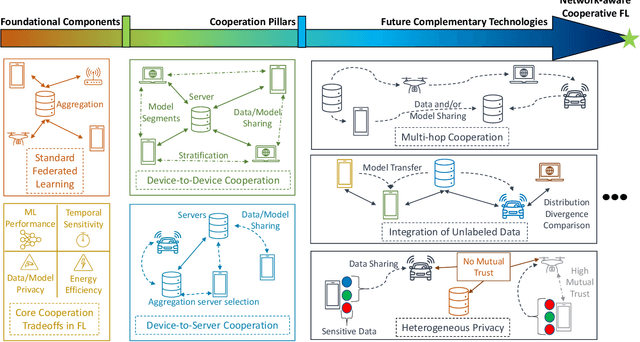
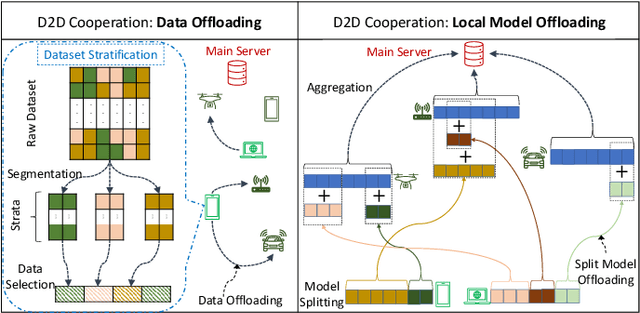
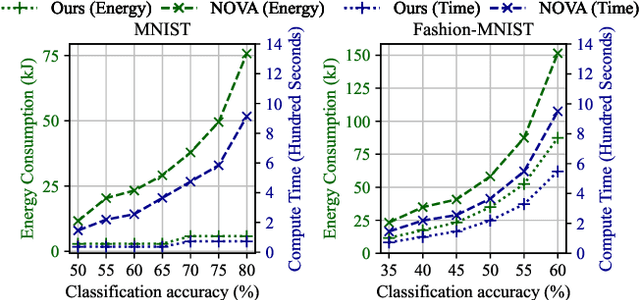
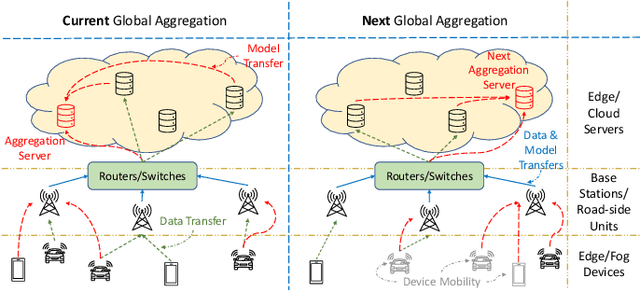
Federated learning (FL) has been promoted as a popular technique for training machine learning (ML) models over edge/fog networks. Traditional implementations of FL have largely neglected the potential for inter-network cooperation, treating edge/fog devices and other infrastructure participating in ML as separate processing elements. Consequently, FL has been vulnerable to several dimensions of network heterogeneity, such as varying computation capabilities, communication resources, data qualities, and privacy demands. We advocate for cooperative federated learning (CFL), a cooperative edge/fog ML paradigm built on device-to-device (D2D) and device-to-server (D2S) interactions. Through D2D and D2S cooperation, CFL counteracts network heterogeneity in edge/fog networks through enabling a model/data/resource pooling mechanism, which will yield substantial improvements in ML model training quality and network resource consumption. We propose a set of core methodologies that form the foundation of D2D and D2S cooperation and present preliminary experiments that demonstrate their benefits. We also discuss new FL functionalities enabled by this cooperative framework such as the integration of unlabeled data and heterogeneous device privacy into ML model training. Finally, we describe some open research directions at the intersection of cooperative edge/fog and FL.
Coded Matrix Computations for D2D-enabled Linearized Federated Learning
Feb 23, 2023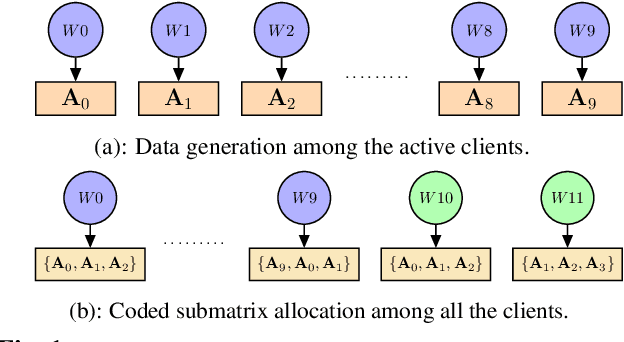
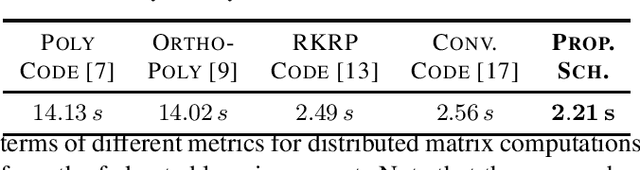
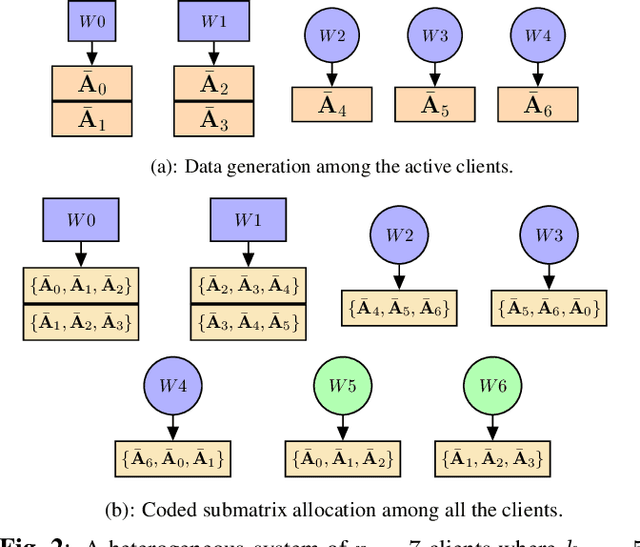
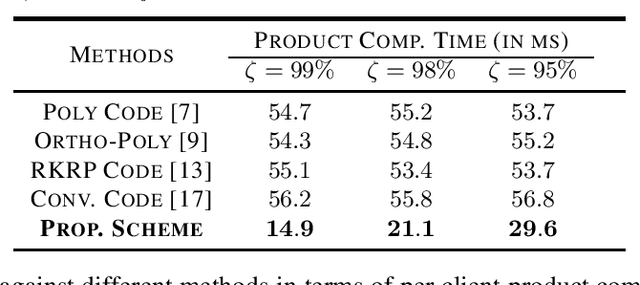
Federated learning (FL) is a popular technique for training a global model on data distributed across client devices. Like other distributed training techniques, FL is susceptible to straggler (slower or failed) clients. Recent work has proposed to address this through device-to-device (D2D) offloading, which introduces privacy concerns. In this paper, we propose a novel straggler-optimal approach for coded matrix computations which can significantly reduce the communication delay and privacy issues introduced from D2D data transmissions in FL. Moreover, our proposed approach leads to a considerable improvement of the local computation speed when the generated data matrix is sparse. Numerical evaluations confirm the superiority of our proposed method over baseline approaches.
Cross-Layer Federated Learning Optimization in MIMO Networks
Feb 04, 2023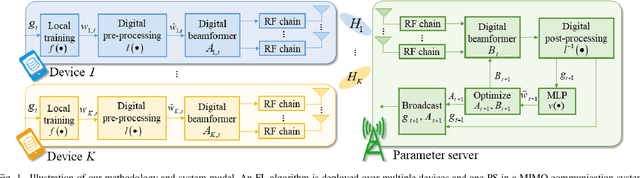
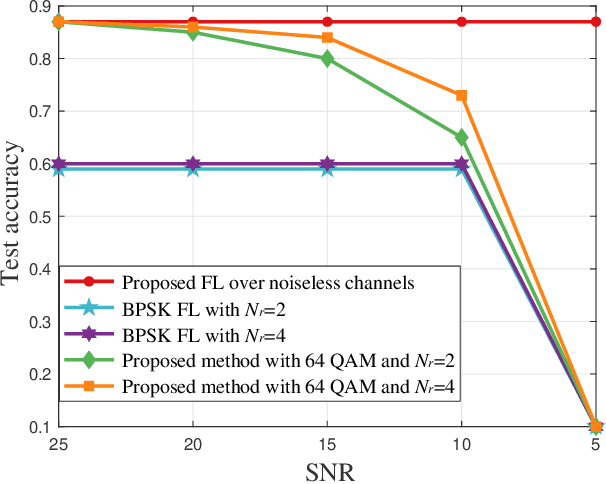
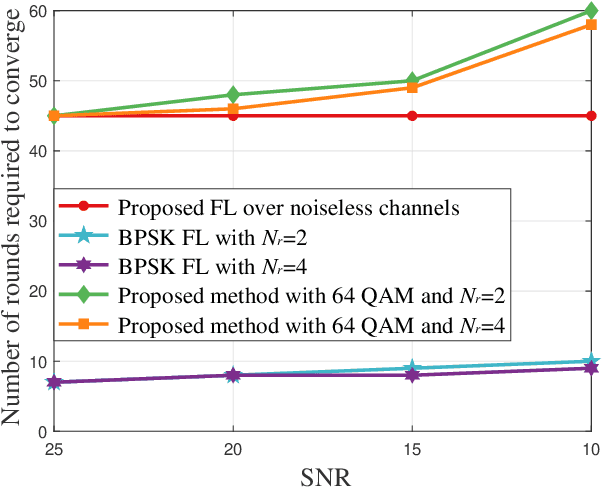
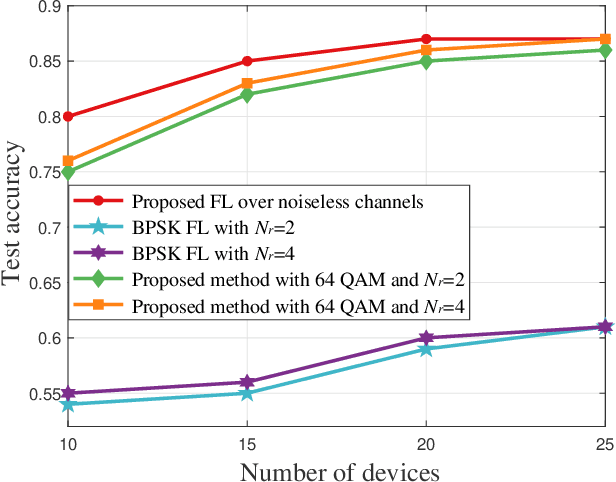
In this paper, the performance optimization of federated learning (FL), when deployed over a realistic wireless multiple-input multiple-output (MIMO) communication system with digital modulation and over-the-air computation (AirComp) is studied. In particular, an MIMO system is considered in which edge devices transmit their local FL models (trained using their locally collected data) to a parameter server (PS) using beamforming to maximize the number of devices scheduled for transmission. The PS, acting as a central controller, generates a global FL model using the received local FL models and broadcasts it back to all devices. Due to the limited bandwidth in a wireless network, AirComp is adopted to enable efficient wireless data aggregation. However, fading of wireless channels can produce aggregate distortions in an AirComp-based FL scheme. To tackle this challenge, we propose a modified federated averaging (FedAvg) algorithm that combines digital modulation with AirComp to mitigate wireless fading while ensuring the communication efficiency. This is achieved by a joint transmit and receive beamforming design, which is formulated as a optimization problem to dynamically adjust the beamforming matrices based on current FL model parameters so as to minimize the transmitting error and ensure the FL performance. To achieve this goal, we first analytically characterize how the beamforming matrices affect the performance of the FedAvg in different iterations. Based on this relationship, an artificial neural network (ANN) is used to estimate the local FL models of all devices and adjust the beamforming matrices at the PS for future model transmission. The algorithmic advantages and improved performance of the proposed methodologies are demonstrated through extensive numerical experiments.
How Potent are Evasion Attacks for Poisoning Federated Learning-Based Signal Classifiers?
Jan 21, 2023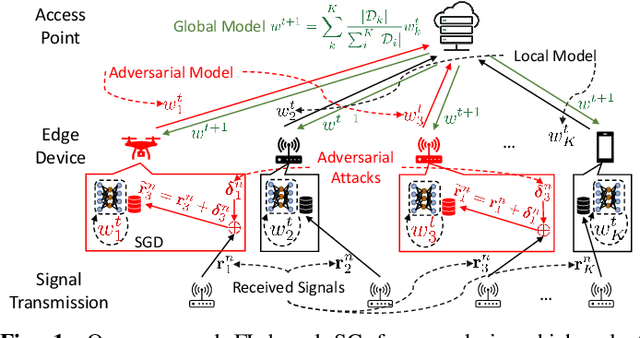

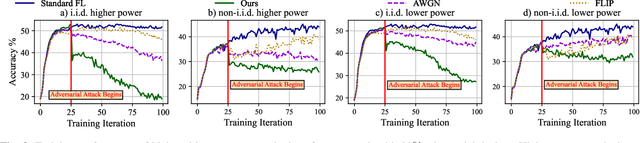
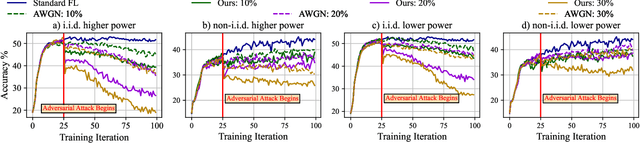
There has been recent interest in leveraging federated learning (FL) for radio signal classification tasks. In FL, model parameters are periodically communicated from participating devices, training on their own local datasets, to a central server which aggregates them into a global model. While FL has privacy/security advantages due to raw data not leaving the devices, it is still susceptible to several adversarial attacks. In this work, we reveal the susceptibility of FL-based signal classifiers to model poisoning attacks, which compromise the training process despite not observing data transmissions. In this capacity, we develop an attack framework in which compromised FL devices perturb their local datasets using adversarial evasion attacks. As a result, the training process of the global model significantly degrades on in-distribution signals (i.e., signals received over channels with identical distributions at each edge device). We compare our work to previously proposed FL attacks and reveal that as few as one adversarial device operating with a low-powered perturbation under our attack framework can induce the potent model poisoning attack to the global classifier. Moreover, we find that more devices partaking in adversarial poisoning will proportionally degrade the classification performance.