 Add to Chrome
 Add to Firefox
 Add to Edge
A Resource-Efficient CNN-Based EEG Auditory Attention Decoding ASIC
Aug 20, 2026
Following a target speaker in a noisy environment, commonly known as the cocktail party problem, remains particularly challenging for cochlear implant (CI) users. Recent studies have explored EEG-based auditory attention decoding (AAD) using neural networks to enhance hearing assistance. This paper presents a resource-efficient ASIC for real-time EEG-based auditory attention decoding by integrating a quantized CNN inference engine and a Pearson-correlation classifier. The proposed architecture employs streaming execution, on-chip buffering, and memory-efficient dataflow to reduce hardware cost while maintaining real-time performance. The proposed ASIC has been fully implemented in GF22FDX 22-nm CMOS technology, occupying a total silicon area of 2.09 mm$^2$(1264$μ$m x 1654$μ$m), with the CNN inference engine and streaming classification engine requiring only 0.076 mm$^2$. Operating at a core voltage of 0.55 V, the design achieves a power consumption of 0.4941 mW and an inference latency of 7.34 ms, providing an energy-efficient hardware platform for EEG-based auditory attention decoding in hearing-assistance applications.

Robust and Efficient Feature Extraction for Spike Sorting via the Walsh-Hadamard Transform
Aug 19, 2026Implantable neural interfaces require low-power real-time signal processing to remain within strict thermal and bandwidth constraints, motivating lightweight feature extraction methods for on-chip spike sorting. This work presents the Walsh-Hadamard Transform (WHT) as a hardware-efficient feature extraction method for neural spike classification. WHT can be implemented using only adders, subtractors, and registers without coefficient memory. WHT performance is compared against the Compressed Hadamard Transform (CHT) and Principal Component Analysis (PCA), improving mean F1-scores from 55-60% to 70-75% on difficult high-noise datasets and from 90-95% to 95-99% on all other simulated datasets. In addition to improved classification performance, WHT demonstrates greater robustness to noise, downsampling, reduced training size, and distance metric selection, maintaining standard deviations typically below 5%, while CHT and PCA reach up to 10% under high-noise conditions.
The SpiNNaker2 chip: a many-core platform for flexible and scalable brain-inspired computing
Jul 27, 2026In deep learning, efficiency gets more and more important to compensate for the ongoing growth in model sizes and applications. Neuromorphic hardware has long been advocated as an upcoming alternative to deep networks, taking inspiration from the brain for achieving unprecedented energy efficiency. However, demonstrations of these gains only recently began to grow in complexity and real-world applicability. With SpiNNaker2, we present a chip that bridges the gap between deep networks and neuromorphic computing and allows for flexible exploration of computing approaches that combine both worlds. It features 152 processing elements equipped with an ARM M4F processor and dedicated accelerators, an extended SpiNNaker routing fabric for scalable event-based communication and a range of external interfaces for system integration, including Gbit Ethernet and an LPDDR4 memory interface. We demonstrate performance and efficiency of the SpiNNaker2 chip for neuromorphic and deep network workloads, as well as novel event-based computing approaches. For deep network workloads, the chip achieves up to 4.5 TOPS in high performance mode and up to 2.7 TOPS/W efficiency in high efficiency mode for INT8 workloads. The chip supports spiking neural networks with >150000 neurons and >1.8 billion synaptic events/s when simulated with a 1 ms time step. Its low baseline power of less than 250 mW allows for efficiency even under varying workload conditions, allowing to explore sparse and event-based modes of computation. All this demonstrates the chip's capabilities as a universal hardware platform for scalable brain-inspired computing and its combinations with mainstream deep network approaches.
* 19 pages, 13 figures
Event-based Neural Decoding for Neuroprosthetic Motor Control
Jul 13, 2026A substantial number of patients experience diminished mobility due to disabilities, diseases, or accidents. Although modern prostheses, powered by deep neural networks, hold the promise of significantly enhancing the quality of life for these individuals, their widespread adoption is hindered by significant latency, energy consumption, and spatial requirements. Wired connections to external high-performance processors restrict patient mobility, while wireless connections limit the volume of information that can be transmitted to these processors. Spiking neural networks offer the potential for compressed communication and low-power inference, yet they often lag behind state-of-the-art deep learning models in various applications. In this study, we propose a high-performance neural decoding method that effectively balances task performance and efficiency. An eventbased gated recurrent unit generates a sparse communication pattern with graded spikes, surpassing classical spiking neural networks in terms of task performance. Utilising an efficient training method and sparse inference, our model presents new opportunities for on-device neural decoding.
Efficient Deployment of Spiking Neural Networks on SpiNNaker2 for DVS Gesture Recognition Using Neuromorphic Intermediate Representation
Apr 09, 2025Spiking Neural Networks (SNNs) are highly energy-efficient during inference, making them particularly suitable for deployment on neuromorphic hardware. Their ability to process event-driven inputs, such as data from dynamic vision sensors (DVS), further enhances their applicability to edge computing tasks. However, the resource constraints of edge hardware necessitate techniques like weight quantization, which reduce the memory footprint of SNNs while preserving accuracy. Despite its importance, existing quantization methods typically focus on synaptic weights quantization without taking account of other critical parameters, such as scaling neuron firing thresholds. To address this limitation, we present the first benchmark for the DVS gesture recognition task using SNNs optimized for the many-core neuromorphic chip SpiNNaker2. Our study evaluates two quantization pipelines for fixed-point computations. The first approach employs post training quantization (PTQ) with percentile-based threshold scaling, while the second uses quantization aware training (QAT) with adaptive threshold scaling. Both methods achieve accurate 8-bit on-chip inference, closely approximating 32-bit floating-point performance. Additionally, our baseline SNNs perform competitively against previously reported results without specialized techniques. These models are deployed on SpiNNaker2 using the neuromorphic intermediate representation (NIR). Ultimately, we achieve 94.13% classification accuracy on-chip, demonstrating the SpiNNaker2's potential for efficient, low-energy neuromorphic computing.
* 8 pages, 3 figures, 8 tables, Conference-2025 Neuro Inspired Computational Elements (NICE)
STREAM: A Universal State-Space Model for Sparse Geometric Data
Nov 19, 2024Handling sparse and unstructured geometric data, such as point clouds or event-based vision, is a pressing challenge in the field of machine vision. Recently, sequence models such as Transformers and state-space models entered the domain of geometric data. These methods require specialized preprocessing to create a sequential view of a set of points. Furthermore, prior works involving sequence models iterate geometric data with either uniform or learned step sizes, implicitly relying on the model to infer the underlying geometric structure. In this work, we propose to encode geometric structure explicitly into the parameterization of a state-space model. State-space models are based on linear dynamics governed by a one-dimensional variable such as time or a spatial coordinate. We exploit this dynamic variable to inject relative differences of coordinates into the step size of the state-space model. The resulting geometric operation computes interactions between all pairs of N points in O(N) steps. Our model deploys the Mamba selective state-space model with a modified CUDA kernel to efficiently map sparse geometric data to modern hardware. The resulting sequence model, which we call STREAM, achieves competitive results on a range of benchmarks from point-cloud classification to event-based vision and audio classification. STREAM demonstrates a powerful inductive bias for sparse geometric data by improving the PointMamba baseline when trained from scratch on the ModelNet40 and ScanObjectNN point cloud analysis datasets. It further achieves, for the first time, 100% test accuracy on all 11 classes of the DVS128 Gestures dataset.
68-Channel Highly-Integrated Neural Signal Processing PSoC with On-Chip Feature Extraction, Compression, and Hardware Accelerators for Neuroprosthetics in 22nm FDSOI
Jul 12, 2024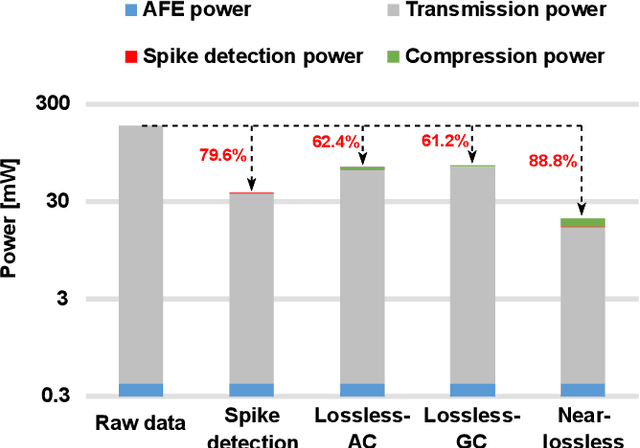
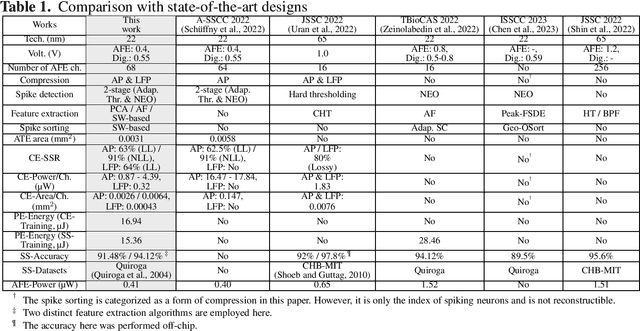
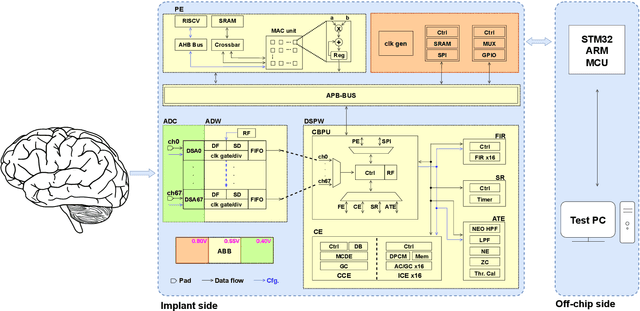
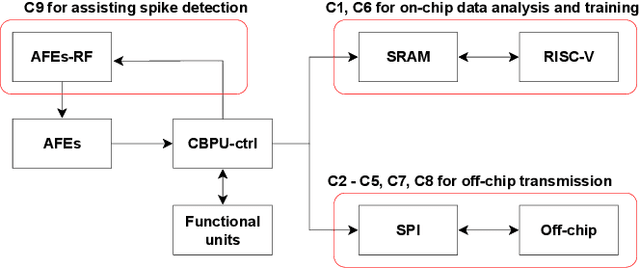
Multi-channel electrophysiology systems for recording of neuronal activity face significant data throughput limitations, hampering real-time, data-informed experiments. These limitations impact both experimental neurobiology research and next-generation neuroprosthetics. We present a novel solution that leverages the high integration density of 22nm FDSOI CMOS technology to address these challenges. The proposed highly integrated programmable System-on-Chip comprises 68-channel 0.41 \textmu W/Ch recording frontends, spike detectors, 16-channel 0.87-4.39 \textmu W/Ch action potential and 8-channel 0.32 \textmu W/Ch local field potential codecs, as well as a MAC-assisted power-efficient processor operating at 25 MHz (5.19 \textmu W/MHz). The system supports on-chip training processes for compression, training and inference for neural spike sorting. The spike sorting achieves an average accuracy of 91.48% or 94.12% depending on the utilized features. The proposed PSoC is optimized for reduced area (9 mm2) and power. On-chip processing and compression capabilities free up the data bottlenecks in data transmission (up to 91% space saving ratio), and moreover enable a fully autonomous yet flexible processor-driven operation. Combined, these design considerations overcome data-bottlenecks by allowing on-chip feature extraction and subsequent compression.
ON-OFF Neuromorphic ISING Machines using Fowler-Nordheim Annealers
Jun 07, 2024We introduce NeuroSA, a neuromorphic architecture specifically designed to ensure asymptotic convergence to the ground state of an Ising problem using an annealing process that is governed by the physics of quantum mechanical tunneling using Fowler-Nordheim (FN). The core component of NeuroSA consists of a pair of asynchronous ON-OFF neurons, which effectively map classical simulated annealing (SA) dynamics onto a network of integrate-and-fire (IF) neurons. The threshold of each ON-OFF neuron pair is adaptively adjusted by an FN annealer which replicates the optimal escape mechanism and convergence of SA, particularly at low temperatures. To validate the effectiveness of our neuromorphic Ising machine, we systematically solved various benchmark MAX-CUT combinatorial optimization problems. Across multiple runs, NeuroSA consistently generates solutions that approach the state-of-the-art level with high accuracy (greater than 99%), and without any graph-specific hyperparameter tuning. For practical illustration, we present results from an implementation of NeuroSA on the SpiNNaker2 platform, highlighting the feasibility of mapping our proposed architecture onto a standard neuromorphic accelerator platform.
Weight Sparsity Complements Activity Sparsity in Neuromorphic Language Models
May 01, 2024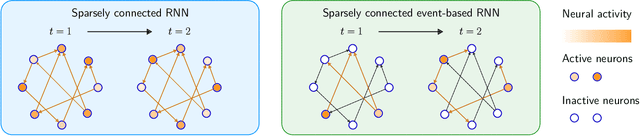
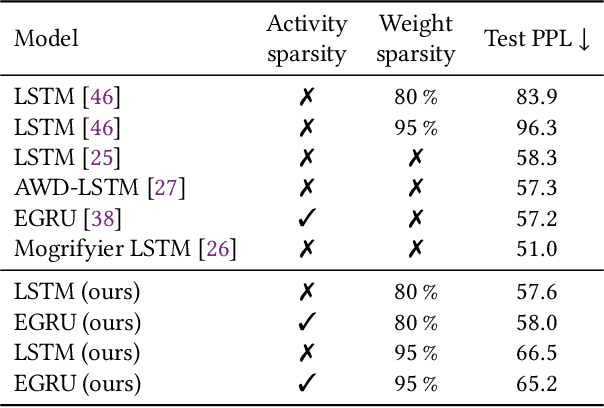
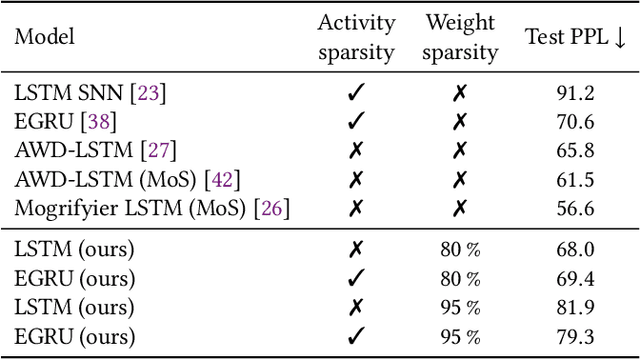
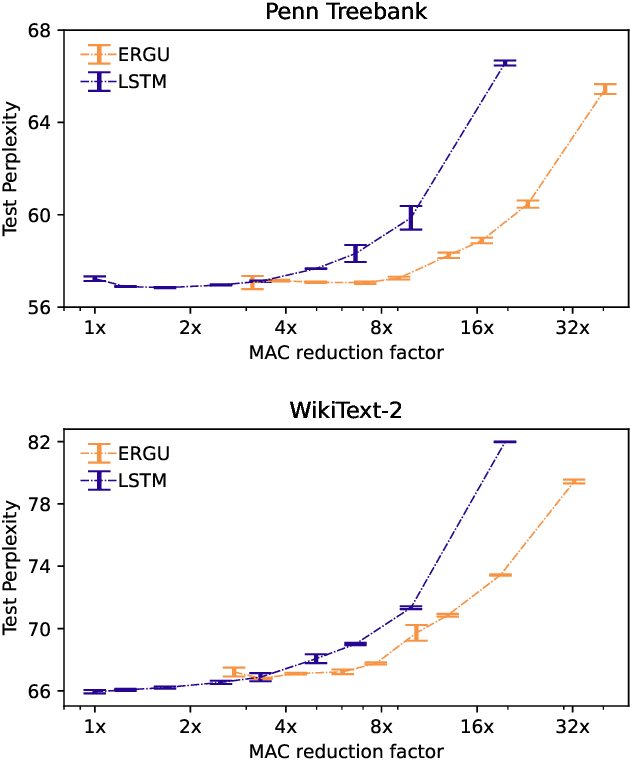
Activity and parameter sparsity are two standard methods of making neural networks computationally more efficient. Event-based architectures such as spiking neural networks (SNNs) naturally exhibit activity sparsity, and many methods exist to sparsify their connectivity by pruning weights. While the effect of weight pruning on feed-forward SNNs has been previously studied for computer vision tasks, the effects of pruning for complex sequence tasks like language modeling are less well studied since SNNs have traditionally struggled to achieve meaningful performance on these tasks. Using a recently published SNN-like architecture that works well on small-scale language modeling, we study the effects of weight pruning when combined with activity sparsity. Specifically, we study the trade-off between the multiplicative efficiency gains the combination affords and its effect on task performance for language modeling. To dissect the effects of the two sparsities, we conduct a comparative analysis between densely activated models and sparsely activated event-based models across varying degrees of connectivity sparsity. We demonstrate that sparse activity and sparse connectivity complement each other without a proportional drop in task performance for an event-based neural network trained on the Penn Treebank and WikiText-2 language modeling datasets. Our results suggest sparsely connected event-based neural networks are promising candidates for effective and efficient sequence modeling.
Scalable Event-by-event Processing of Neuromorphic Sensory Signals With Deep State-Space Models
Apr 29, 2024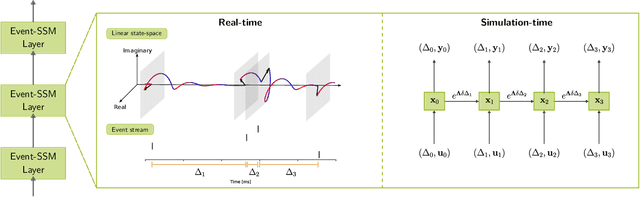
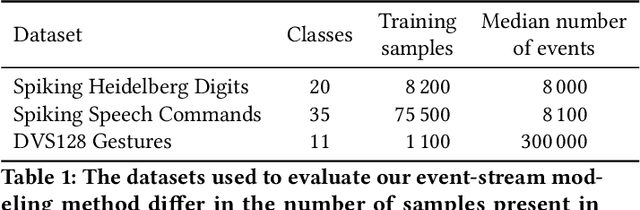
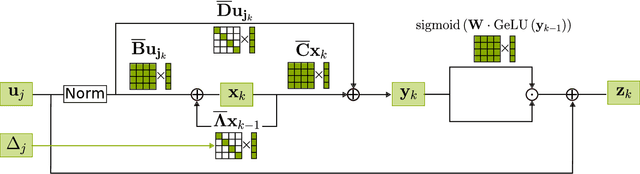
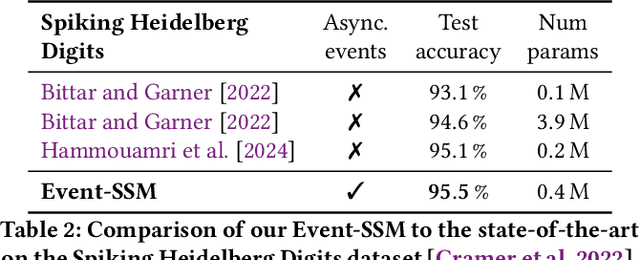
Event-based sensors are well suited for real-time processing due to their fast response times and encoding of the sensory data as successive temporal differences. These and other valuable properties, such as a high dynamic range, are suppressed when the data is converted to a frame-based format. However, most current methods either collapse events into frames or cannot scale up when processing the event data directly event-by-event. In this work, we address the key challenges of scaling up event-by-event modeling of the long event streams emitted by such sensors, which is a particularly relevant problem for neuromorphic computing. While prior methods can process up to a few thousand time steps, our model, based on modern recurrent deep state-space models, scales to event streams of millions of events for both training and inference.We leverage their stable parameterization for learning long-range dependencies, parallelizability along the sequence dimension, and their ability to integrate asynchronous events effectively to scale them up to long event streams.We further augment these with novel event-centric techniques enabling our model to match or beat the state-of-the-art performance on several event stream benchmarks. In the Spiking Speech Commands task, we improve state-of-the-art by a large margin of 6.6% to 87.1%. On the DVS128-Gestures dataset, we achieve competitive results without using frames or convolutional neural networks. Our work demonstrates, for the first time, that it is possible to use fully event-based processing with purely recurrent networks to achieve state-of-the-art task performance in several event-based benchmarks.