 Add to Chrome
 Add to Firefox
 Add to Edge
The SpiNNaker2 chip: a many-core platform for flexible and scalable brain-inspired computing
Jul 27, 2026
In deep learning, efficiency gets more and more important to compensate for the ongoing growth in model sizes and applications. Neuromorphic hardware has long been advocated as an upcoming alternative to deep networks, taking inspiration from the brain for achieving unprecedented energy efficiency. However, demonstrations of these gains only recently began to grow in complexity and real-world applicability. With SpiNNaker2, we present a chip that bridges the gap between deep networks and neuromorphic computing and allows for flexible exploration of computing approaches that combine both worlds. It features 152 processing elements equipped with an ARM M4F processor and dedicated accelerators, an extended SpiNNaker routing fabric for scalable event-based communication and a range of external interfaces for system integration, including Gbit Ethernet and an LPDDR4 memory interface. We demonstrate performance and efficiency of the SpiNNaker2 chip for neuromorphic and deep network workloads, as well as novel event-based computing approaches. For deep network workloads, the chip achieves up to 4.5 TOPS in high performance mode and up to 2.7 TOPS/W efficiency in high efficiency mode for INT8 workloads. The chip supports spiking neural networks with >150000 neurons and >1.8 billion synaptic events/s when simulated with a 1 ms time step. Its low baseline power of less than 250 mW allows for efficiency even under varying workload conditions, allowing to explore sparse and event-based modes of computation. All this demonstrates the chip's capabilities as a universal hardware platform for scalable brain-inspired computing and its combinations with mainstream deep network approaches.
* 19 pages, 13 figures

68-Channel Highly-Integrated Neural Signal Processing PSoC with On-Chip Feature Extraction, Compression, and Hardware Accelerators for Neuroprosthetics in 22nm FDSOI
Jul 12, 2024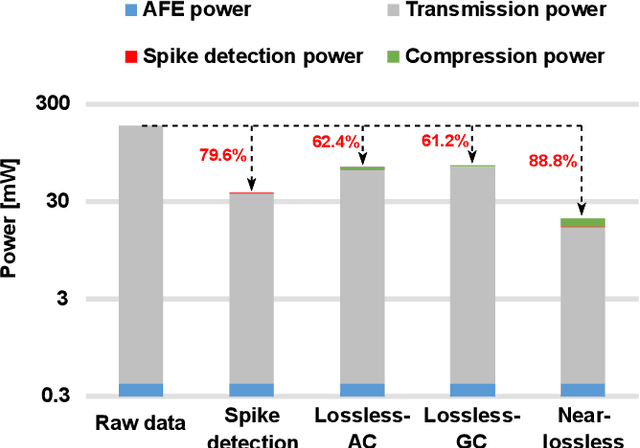
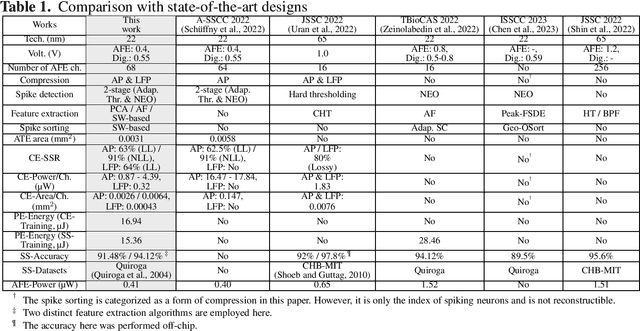
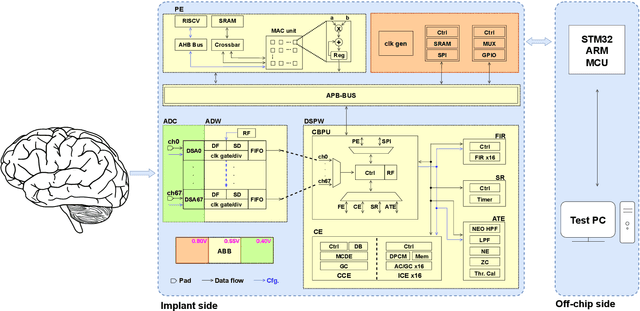
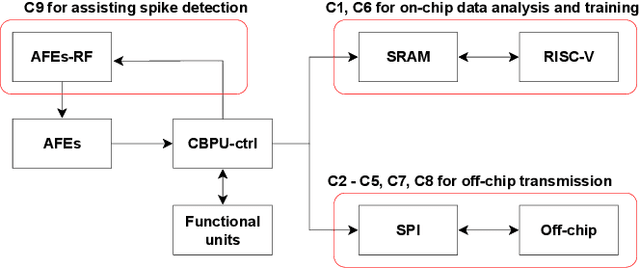
Multi-channel electrophysiology systems for recording of neuronal activity face significant data throughput limitations, hampering real-time, data-informed experiments. These limitations impact both experimental neurobiology research and next-generation neuroprosthetics. We present a novel solution that leverages the high integration density of 22nm FDSOI CMOS technology to address these challenges. The proposed highly integrated programmable System-on-Chip comprises 68-channel 0.41 \textmu W/Ch recording frontends, spike detectors, 16-channel 0.87-4.39 \textmu W/Ch action potential and 8-channel 0.32 \textmu W/Ch local field potential codecs, as well as a MAC-assisted power-efficient processor operating at 25 MHz (5.19 \textmu W/MHz). The system supports on-chip training processes for compression, training and inference for neural spike sorting. The spike sorting achieves an average accuracy of 91.48% or 94.12% depending on the utilized features. The proposed PSoC is optimized for reduced area (9 mm2) and power. On-chip processing and compression capabilities free up the data bottlenecks in data transmission (up to 91% space saving ratio), and moreover enable a fully autonomous yet flexible processor-driven operation. Combined, these design considerations overcome data-bottlenecks by allowing on-chip feature extraction and subsequent compression.