 Add to Chrome
 Add to Firefox
 Add to Edge
A Resource-Efficient CNN-Based EEG Auditory Attention Decoding ASIC
Aug 20, 2026
Following a target speaker in a noisy environment, commonly known as the cocktail party problem, remains particularly challenging for cochlear implant (CI) users. Recent studies have explored EEG-based auditory attention decoding (AAD) using neural networks to enhance hearing assistance. This paper presents a resource-efficient ASIC for real-time EEG-based auditory attention decoding by integrating a quantized CNN inference engine and a Pearson-correlation classifier. The proposed architecture employs streaming execution, on-chip buffering, and memory-efficient dataflow to reduce hardware cost while maintaining real-time performance. The proposed ASIC has been fully implemented in GF22FDX 22-nm CMOS technology, occupying a total silicon area of 2.09 mm$^2$(1264$μ$m x 1654$μ$m), with the CNN inference engine and streaming classification engine requiring only 0.076 mm$^2$. Operating at a core voltage of 0.55 V, the design achieves a power consumption of 0.4941 mW and an inference latency of 7.34 ms, providing an energy-efficient hardware platform for EEG-based auditory attention decoding in hearing-assistance applications.

Event-based Neural Decoding for Neuroprosthetic Motor Control
Jul 13, 2026A substantial number of patients experience diminished mobility due to disabilities, diseases, or accidents. Although modern prostheses, powered by deep neural networks, hold the promise of significantly enhancing the quality of life for these individuals, their widespread adoption is hindered by significant latency, energy consumption, and spatial requirements. Wired connections to external high-performance processors restrict patient mobility, while wireless connections limit the volume of information that can be transmitted to these processors. Spiking neural networks offer the potential for compressed communication and low-power inference, yet they often lag behind state-of-the-art deep learning models in various applications. In this study, we propose a high-performance neural decoding method that effectively balances task performance and efficiency. An eventbased gated recurrent unit generates a sparse communication pattern with graded spikes, surpassing classical spiking neural networks in terms of task performance. Utilising an efficient training method and sparse inference, our model presents new opportunities for on-device neural decoding.
68-Channel Highly-Integrated Neural Signal Processing PSoC with On-Chip Feature Extraction, Compression, and Hardware Accelerators for Neuroprosthetics in 22nm FDSOI
Jul 12, 2024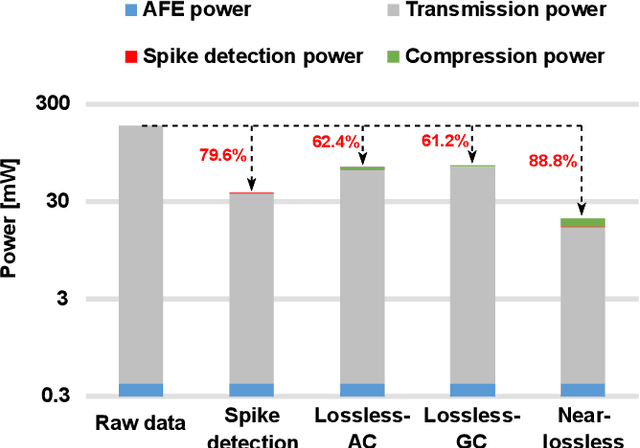
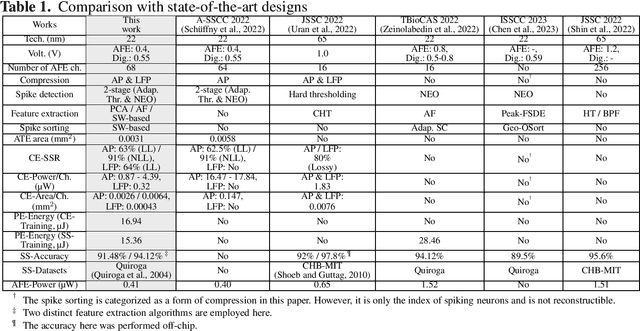
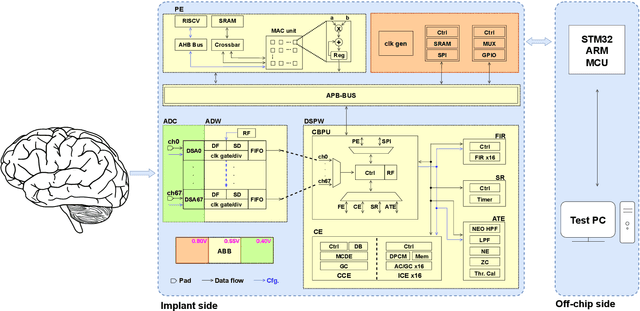
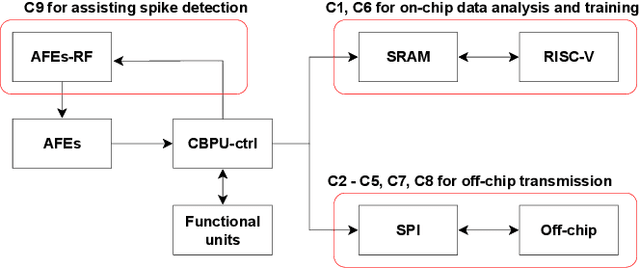
Multi-channel electrophysiology systems for recording of neuronal activity face significant data throughput limitations, hampering real-time, data-informed experiments. These limitations impact both experimental neurobiology research and next-generation neuroprosthetics. We present a novel solution that leverages the high integration density of 22nm FDSOI CMOS technology to address these challenges. The proposed highly integrated programmable System-on-Chip comprises 68-channel 0.41 \textmu W/Ch recording frontends, spike detectors, 16-channel 0.87-4.39 \textmu W/Ch action potential and 8-channel 0.32 \textmu W/Ch local field potential codecs, as well as a MAC-assisted power-efficient processor operating at 25 MHz (5.19 \textmu W/MHz). The system supports on-chip training processes for compression, training and inference for neural spike sorting. The spike sorting achieves an average accuracy of 91.48% or 94.12% depending on the utilized features. The proposed PSoC is optimized for reduced area (9 mm2) and power. On-chip processing and compression capabilities free up the data bottlenecks in data transmission (up to 91% space saving ratio), and moreover enable a fully autonomous yet flexible processor-driven operation. Combined, these design considerations overcome data-bottlenecks by allowing on-chip feature extraction and subsequent compression.