 Add to Chrome
 Add to Firefox
 Add to Edge
A Resource-Efficient CNN-Based EEG Auditory Attention Decoding ASIC
Aug 20, 2026
Following a target speaker in a noisy environment, commonly known as the cocktail party problem, remains particularly challenging for cochlear implant (CI) users. Recent studies have explored EEG-based auditory attention decoding (AAD) using neural networks to enhance hearing assistance. This paper presents a resource-efficient ASIC for real-time EEG-based auditory attention decoding by integrating a quantized CNN inference engine and a Pearson-correlation classifier. The proposed architecture employs streaming execution, on-chip buffering, and memory-efficient dataflow to reduce hardware cost while maintaining real-time performance. The proposed ASIC has been fully implemented in GF22FDX 22-nm CMOS technology, occupying a total silicon area of 2.09 mm$^2$(1264$μ$m x 1654$μ$m), with the CNN inference engine and streaming classification engine requiring only 0.076 mm$^2$. Operating at a core voltage of 0.55 V, the design achieves a power consumption of 0.4941 mW and an inference latency of 7.34 ms, providing an energy-efficient hardware platform for EEG-based auditory attention decoding in hearing-assistance applications.

68-Channel Highly-Integrated Neural Signal Processing PSoC with On-Chip Feature Extraction, Compression, and Hardware Accelerators for Neuroprosthetics in 22nm FDSOI
Jul 12, 2024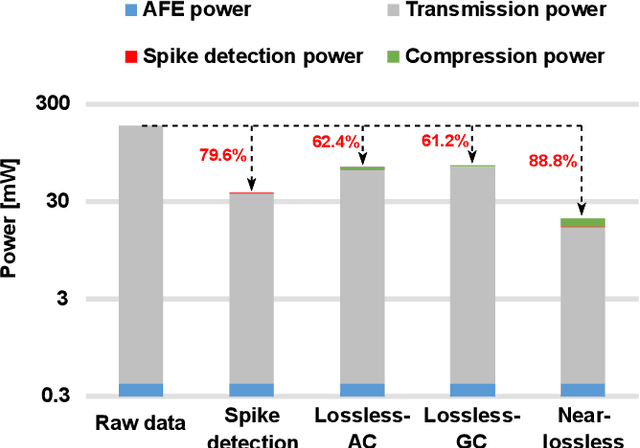
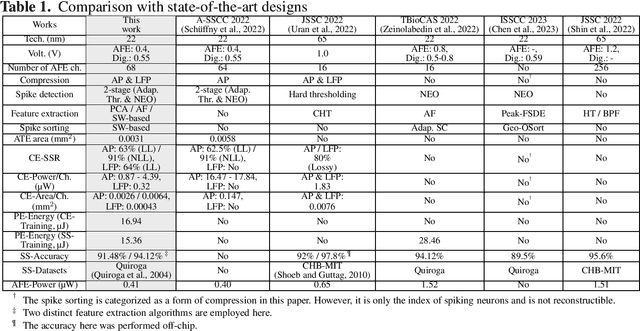
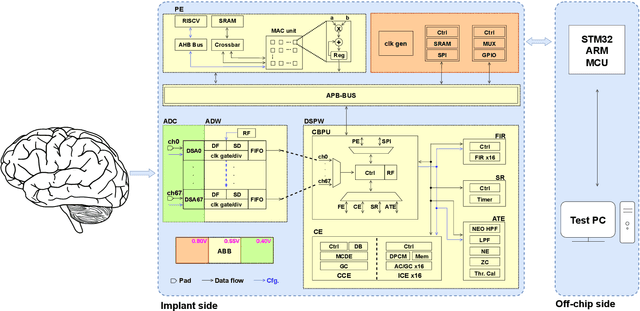
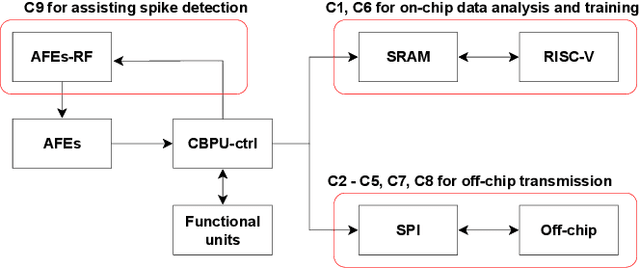
Multi-channel electrophysiology systems for recording of neuronal activity face significant data throughput limitations, hampering real-time, data-informed experiments. These limitations impact both experimental neurobiology research and next-generation neuroprosthetics. We present a novel solution that leverages the high integration density of 22nm FDSOI CMOS technology to address these challenges. The proposed highly integrated programmable System-on-Chip comprises 68-channel 0.41 \textmu W/Ch recording frontends, spike detectors, 16-channel 0.87-4.39 \textmu W/Ch action potential and 8-channel 0.32 \textmu W/Ch local field potential codecs, as well as a MAC-assisted power-efficient processor operating at 25 MHz (5.19 \textmu W/MHz). The system supports on-chip training processes for compression, training and inference for neural spike sorting. The spike sorting achieves an average accuracy of 91.48% or 94.12% depending on the utilized features. The proposed PSoC is optimized for reduced area (9 mm2) and power. On-chip processing and compression capabilities free up the data bottlenecks in data transmission (up to 91% space saving ratio), and moreover enable a fully autonomous yet flexible processor-driven operation. Combined, these design considerations overcome data-bottlenecks by allowing on-chip feature extraction and subsequent compression.