 Add to Chrome
 Add to Firefox
 Add to Edge
FUSE: FK-Steered Multi-Modal Flow Matching for Efficient Simulation-Based Posterior Estimation
Jul 06, 2026
Simulation-Based Inference (SBI) is critical for scientific discovery, with generative models offering a promising path toward efficient inference. However, existing methods struggle with effective multimodal modeling. They often rely on brute-force fusion strategies that ignore the structural disparities between parameters and observations, thus limiting estimation fidelity. In this work, we introduce FUSE (Feynman-Kac steered mUlti-modal flow matching for efficient Simulation-based posterior Estimation). Unlike prior work, FUSE employs a dual-track architecture that preserves the distinct features of multimodal inputs while facilitating dynamic interaction. Additionally, we propose an FK-steered sampling strategy that leverages intermediate observation likelihoods to guide the generative trajectories, effectively improving the sample quality during inference. Our approach outperforms state-of-the-art baselines on standard SBI benchmarks, producing posteriors that closely match ground-truth MCMC. Furthermore, in a real-world exoplanet orbital estimation task, FUSE successfully resolves complex parameter degeneracies that challenge existing methods, highlighting its potential to accelerate complex scientific discoveries in astrophysics and beyond.

Building Machine Learning Challenges for Anomaly Detection in Science
Mar 03, 2025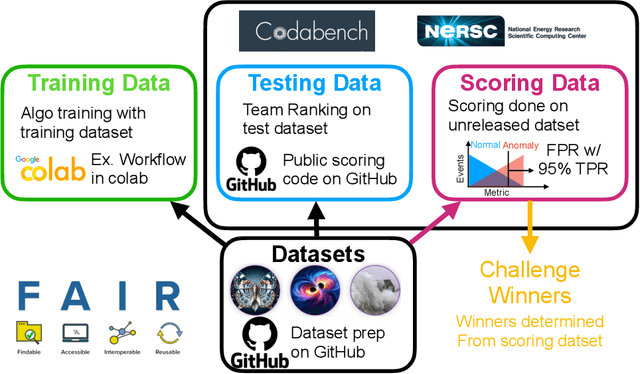
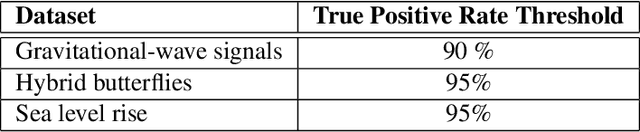
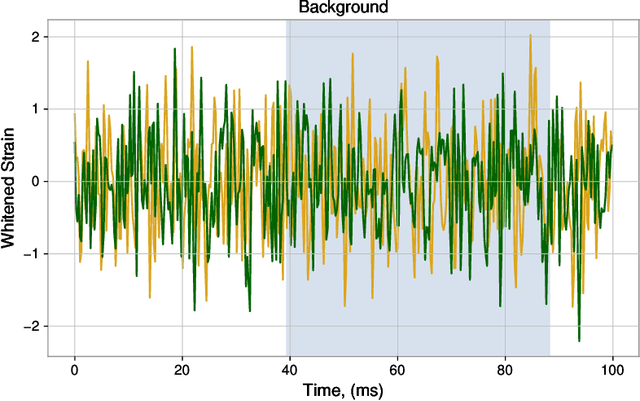
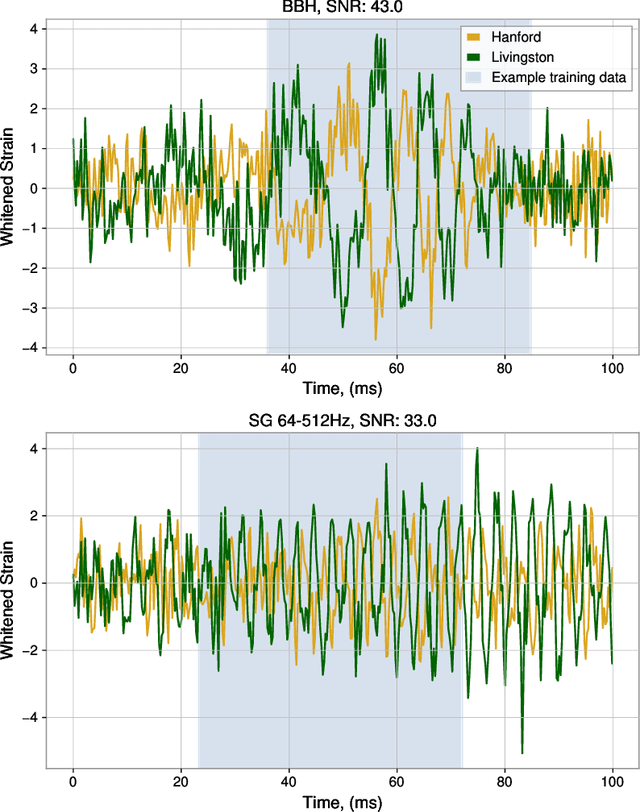
Scientific discoveries are often made by finding a pattern or object that was not predicted by the known rules of science. Oftentimes, these anomalous events or objects that do not conform to the norms are an indication that the rules of science governing the data are incomplete, and something new needs to be present to explain these unexpected outliers. The challenge of finding anomalies can be confounding since it requires codifying a complete knowledge of the known scientific behaviors and then projecting these known behaviors on the data to look for deviations. When utilizing machine learning, this presents a particular challenge since we require that the model not only understands scientific data perfectly but also recognizes when the data is inconsistent and out of the scope of its trained behavior. In this paper, we present three datasets aimed at developing machine learning-based anomaly detection for disparate scientific domains covering astrophysics, genomics, and polar science. We present the different datasets along with a scheme to make machine learning challenges around the three datasets findable, accessible, interoperable, and reusable (FAIR). Furthermore, we present an approach that generalizes to future machine learning challenges, enabling the possibility of large, more compute-intensive challenges that can ultimately lead to scientific discovery.