 Add to Chrome
 Add to Firefox
 Add to Edge
PolyBuild: An End-to-End Method for Polygonal Building Contour Extraction from High-Resolution Remote Sensing Images
Jun 08, 2026
Extracting building polygon contours from high-resolution remote sensing images is a fundamental task for various mapping applications. However, the presence of varying imaging conditions and complex building structures, makes automatic contour extraction extremely challenging. Mainstream approaches for building extraction often rely on pixel-level segmentation followed by multiple post-processing steps to produce building contour, which can be computationally intensive and prone to errors. In this paper, we propose an end-to-end method named PolyBuild, which can directly extract building vector polygons from high-resolution remote sensing images without the need for any post-processing operations. The proposed method leverages two primary modules: an Initial Contour Generation Module (ICGM) and a Contour Optimization Module (COM). The ICGM is designed to generate an initial building contour by utilizing concatenated sub-region center features for each building instance. It performs simultaneous object detection and initial contour extraction by generating bounding boxes and using the center features of four sub-regions to represent each building. The Contour Optimization Module (COM) further refines the generated building contours by iteratively integrating Convolutional Neural Network (CNN) features and contour positional information in a Transformer-based decoder. The hybrid CNN-Transformer architecture effectively captures both local and global spatial relationships within the building contour, ensuring high-quality boundary delineation. Extensive experiments are conducted on three building datasets to evaluate the performance of PolyBuild. The results demonstrate that PolyBuild significantly outperforms state-of-the-art methods, including mask-based and contour-based approaches.

Know in AdVance: Linear-Complexity Forecasting of Ad Campaign Performance with Evolving User Interest
May 17, 2024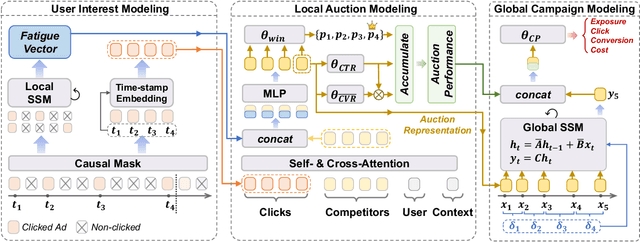
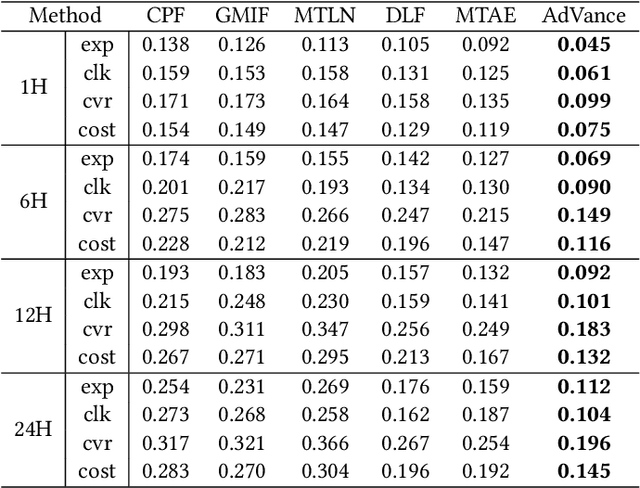
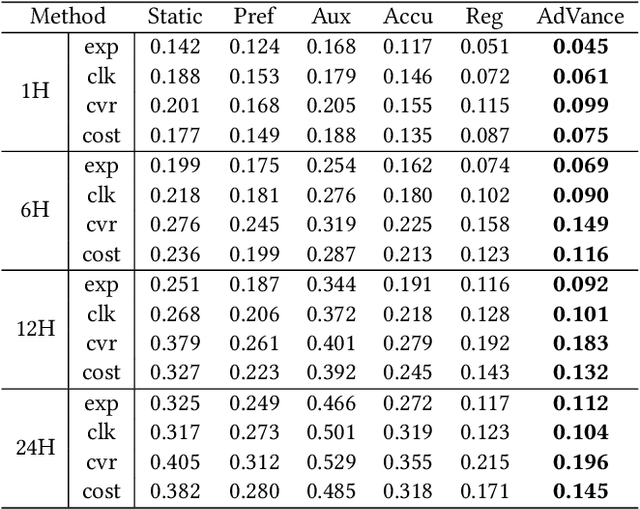
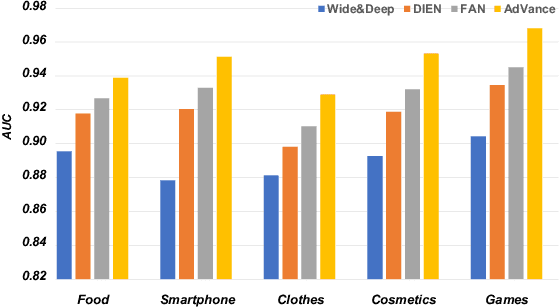
Real-time Bidding (RTB) advertisers wish to \textit{know in advance} the expected cost and yield of ad campaigns to avoid trial-and-error expenses. However, Campaign Performance Forecasting (CPF), a sequence modeling task involving tens of thousands of ad auctions, poses challenges of evolving user interest, auction representation, and long context, making coarse-grained and static-modeling methods sub-optimal. We propose \textit{AdVance}, a time-aware framework that integrates local auction-level and global campaign-level modeling. User preference and fatigue are disentangled using a time-positioned sequence of clicked items and a concise vector of all displayed items. Cross-attention, conditioned on the fatigue vector, captures the dynamics of user interest toward each candidate ad. Bidders compete with each other, presenting a complete graph similar to the self-attention mechanism. Hence, we employ a Transformer Encoder to compress each auction into embedding by solving auxiliary tasks. These sequential embeddings are then summarized by a conditional state space model (SSM) to comprehend long-range dependencies while maintaining global linear complexity. Considering the irregular time intervals between auctions, we make SSM's parameters dependent on the current auction embedding and the time interval. We further condition SSM's global predictions on the accumulation of local results. Extensive evaluations and ablation studies demonstrate its superiority over state-of-the-art methods. AdVance has been deployed on the Tencent Advertising platform, and A/B tests show a remarkable 4.5\% uplift in Average Revenue per User (ARPU).