 Add to Chrome
 Add to Firefox
 Add to Edge
From Continuous sEMG Signals to Discrete Muscle State Tokens: A Robust and Interpretable Representation Framework
Feb 27, 2026
Surface electromyography (sEMG) signals exhibit substantial inter-subject variability and are highly susceptible to noise, posing challenges for robust and interpretable decoding. To address these limitations, we propose a discrete representation of sEMG signals based on a physiology-informed tokenization framework. The method employs a sliding window aligned with the minimal muscle contraction cycle to isolate individual muscle activation events. From each window, ten time-frequency features, including root mean square (RMS) and median frequency (MDF), are extracted, and K-means clustering is applied to group segments into representative muscle-state tokens. We also introduce a large-scale benchmark dataset, ActionEMG-43, comprising 43 diverse actions and sEMG recordings from 16 major muscle groups across the body. Based on this dataset, we conduct extensive evaluations to assess the inter-subject consistency, representation capacity, and interpretability of the proposed sEMG tokens. Our results show that the token representation exhibits high inter-subject consistency (Cohen's Kappa = 0.82+-0.09), indicating that the learned tokens capture consistent and subject-independent muscle activation patterns. In action recognition tasks, models using sEMG tokens achieve Top-1 accuracies of 75.5% with ViT and 67.9% with SVM, outperforming raw-signal baselines (72.8% and 64.4%, respectively), despite a 96% reduction in input dimensionality. In movement quality assessment, the tokens intuitively reveal patterns of muscle underactivation and compensatory activation, offering interpretable insights into neuromuscular control. Together, these findings highlight the effectiveness of tokenized sEMG representations as a compact, generalizable, and physiologically meaningful feature space for applications in rehabilitation, human-machine interaction, and motor function analysis.

Cascaded two-stage feature clustering and selection via separability and consistency in fuzzy decision systems
Jul 22, 2024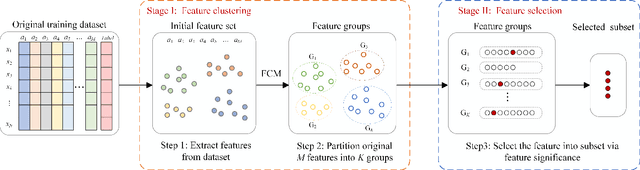
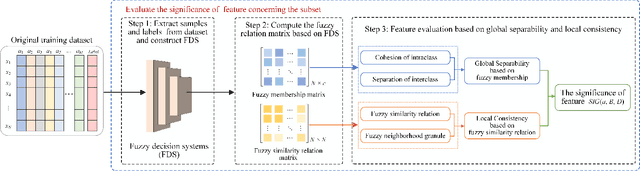
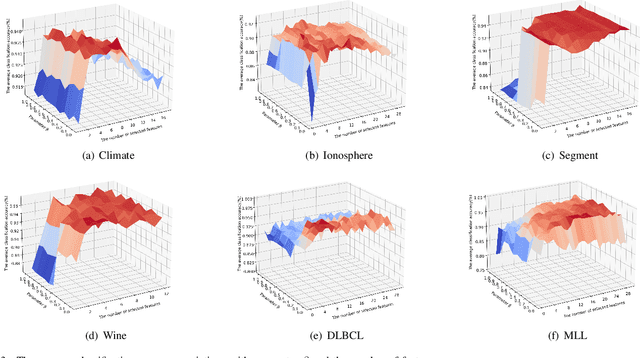
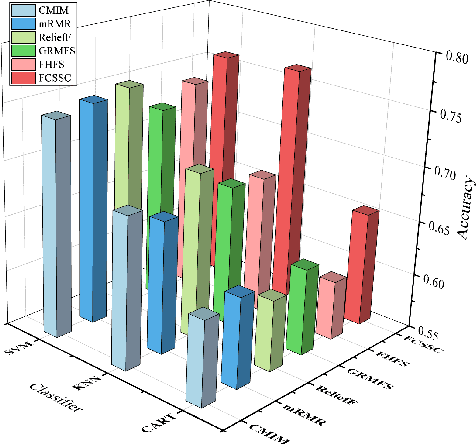
Feature selection is a vital technique in machine learning, as it can reduce computational complexity, improve model performance, and mitigate the risk of overfitting. However, the increasing complexity and dimensionality of datasets pose significant challenges in the selection of features. Focusing on these challenges, this paper proposes a cascaded two-stage feature clustering and selection algorithm for fuzzy decision systems. In the first stage, we reduce the search space by clustering relevant features and addressing inter-feature redundancy. In the second stage, a clustering-based sequentially forward selection method that explores the global and local structure of data is presented. We propose a novel metric for assessing the significance of features, which considers both global separability and local consistency. Global separability measures the degree of intra-class cohesion and inter-class separation based on fuzzy membership, providing a comprehensive understanding of data separability. Meanwhile, local consistency leverages the fuzzy neighborhood rough set model to capture uncertainty and fuzziness in the data. The effectiveness of our proposed algorithm is evaluated through experiments conducted on 18 public datasets and a real-world schizophrenia dataset. The experiment results demonstrate our algorithm's superiority over benchmarking algorithms in both classification accuracy and the number of selected features.
* This paper has been accepted by IEEE Transactions on Fuzzy Systems for publication. Permission from IEEE must be obtained for all other uses, in any current or future media. The final version is available at [10.1109/TFUZZ.2024.3420963]