 Add to Chrome
 Add to Firefox
 Add to Edge
ACTS-SQL: Agentic and Critic-Oriented Tree-Structured SQL Correctness with Large Language Models
Aug 15, 2026
Large Language Models (LLMs) have been increasingly adopted in Text-to-SQL systems, yet SQL errors remain a major obstacle in real-world Text-to-SQL inference pipelines. Existing SQL correction approaches either rely on large-scale, high-quality training data with substantial overhead, or adopt single-path agentic workflows that are brittle to early mistakes and prone to error propagation. To develop a practical SQL correctness system for industrial scenarios, we present a training-free framework that formulates SQL correction as a plan-guided, tree-structured debugging process. By maintaining multiple correction strategies and enabling backtracking, the framework mitigates error accumulation during iterative refinement. We further integrate execution-based verification and clause-level diagnostic tools to support strategy pruning and precise error localization. We evaluate the system on the BIRD-Critic benchmark and observe consistent accuracy gains over strong LLM backbones and representative agent-based baselines, achieving a 9.42% improvement over the previous state-of-the-art method. The framework is also deployed in the Torch Log Service (TLS) of Volcano Engine to support an online Text-to-TLS API. In production, it improves execution accuracy from 36.77% to 53.61% on real user queries with a representative strong LLM backbone (GPT-5). These results demonstrate the effectiveness and stability of our approach in real-world deployments.

NTIRE 2022 Challenge on High Dynamic Range Imaging: Methods and Results
May 25, 2022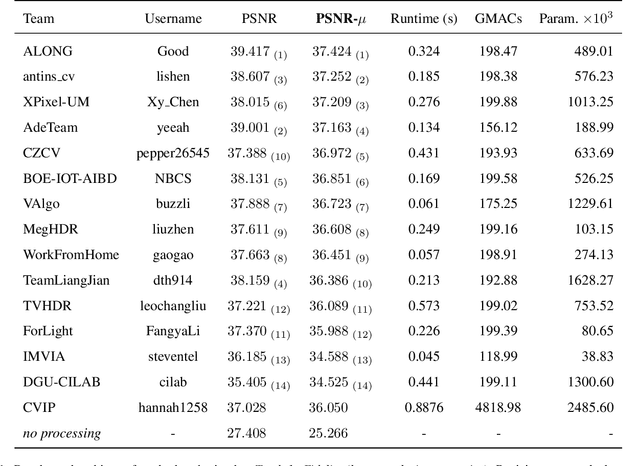
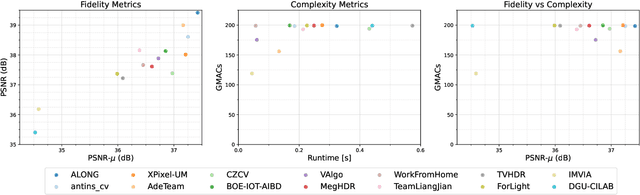
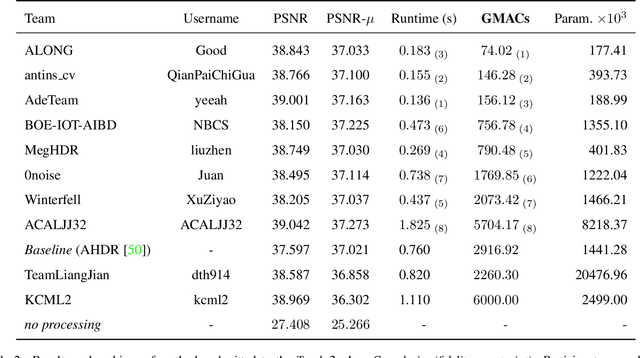
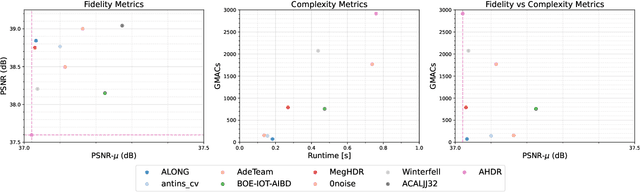
This paper reviews the challenge on constrained high dynamic range (HDR) imaging that was part of the New Trends in Image Restoration and Enhancement (NTIRE) workshop, held in conjunction with CVPR 2022. This manuscript focuses on the competition set-up, datasets, the proposed methods and their results. The challenge aims at estimating an HDR image from multiple respective low dynamic range (LDR) observations, which might suffer from under- or over-exposed regions and different sources of noise. The challenge is composed of two tracks with an emphasis on fidelity and complexity constraints: In Track 1, participants are asked to optimize objective fidelity scores while imposing a low-complexity constraint (i.e. solutions can not exceed a given number of operations). In Track 2, participants are asked to minimize the complexity of their solutions while imposing a constraint on fidelity scores (i.e. solutions are required to obtain a higher fidelity score than the prescribed baseline). Both tracks use the same data and metrics: Fidelity is measured by means of PSNR with respect to a ground-truth HDR image (computed both directly and with a canonical tonemapping operation), while complexity metrics include the number of Multiply-Accumulate (MAC) operations and runtime (in seconds).
* CVPR Workshops 2022. 15 pages, 21 figures, 2 tables