 Add to Chrome
 Add to Firefox
 Add to Edge
Emo-Avatar: Efficient Monocular Video Style Avatar through Texture Rendering
Feb 01, 2024
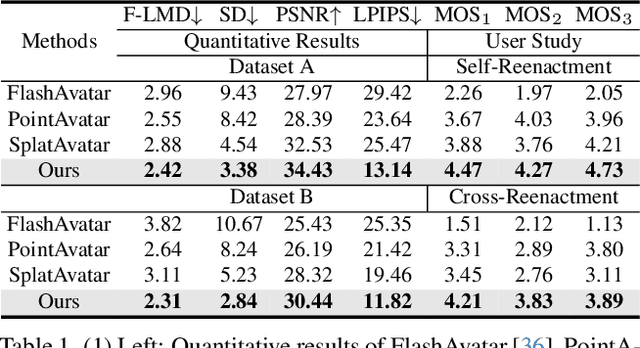
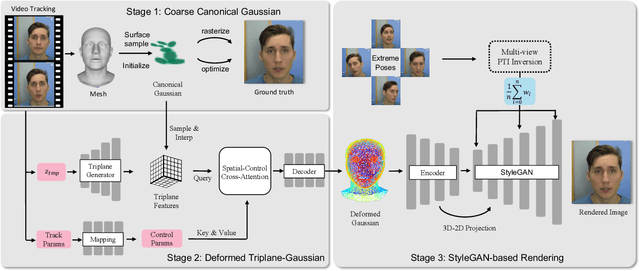

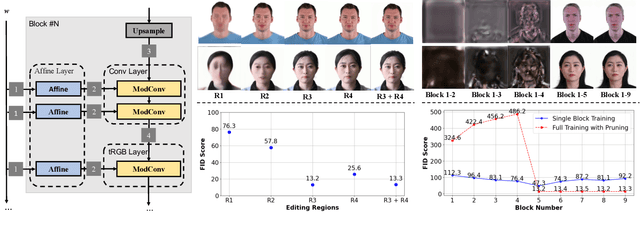
Artistic video portrait generation is a significant and sought-after task in the fields of computer graphics and vision. While various methods have been developed that integrate NeRFs or StyleGANs with instructional editing models for creating and editing drivable portraits, these approaches face several challenges. They often rely heavily on large datasets, require extensive customization processes, and frequently result in reduced image quality. To address the above problems, we propose the Efficient Monotonic Video Style Avatar (Emo-Avatar) through deferred neural rendering that enhances StyleGAN's capacity for producing dynamic, drivable portrait videos. We proposed a two-stage deferred neural rendering pipeline. In the first stage, we utilize few-shot PTI initialization to initialize the StyleGAN generator through several extreme poses sampled from the video to capture the consistent representation of aligned faces from the target portrait. In the second stage, we propose a Laplacian pyramid for high-frequency texture sampling from UV maps deformed by dynamic flow of expression for motion-aware texture prior integration to provide torso features to enhance StyleGAN's ability to generate complete and upper body for portrait video rendering. Emo-Avatar reduces style customization time from hours to merely 5 minutes compared with existing methods. In addition, Emo-Avatar requires only a single reference image for editing and employs region-aware contrastive learning with semantic invariant CLIP guidance, ensuring consistent high-resolution output and identity preservation. Through both quantitative and qualitative assessments, Emo-Avatar demonstrates superior performance over existing methods in terms of training efficiency, rendering quality and editability in self- and cross-reenactment.

Tri$^{2}$-plane: Volumetric Avatar Reconstruction with Feature Pyramid
Jan 17, 2024Recent years have witnessed considerable achievements in facial avatar reconstruction with neural volume rendering. Despite notable advancements, the reconstruction of complex and dynamic head movements from monocular videos still suffers from capturing and restoring fine-grained details. In this work, we propose a novel approach, named Tri$^2$-plane, for monocular photo-realistic volumetric head avatar reconstructions. Distinct from the existing works that rely on a single tri-plane deformation field for dynamic facial modeling, the proposed Tri$^2$-plane leverages the principle of feature pyramids and three top-to-down lateral connections tri-planes for details improvement. It samples and renders facial details at multiple scales, transitioning from the entire face to specific local regions and then to even more refined sub-regions. Moreover, we incorporate a camera-based geometry-aware sliding window method as an augmentation in training, which improves the robustness beyond the canonical space, with a particular improvement in cross-identity generation capabilities. Experimental outcomes indicate that the Tri$^2$-plane not only surpasses existing methodologies but also achieves superior performance across both quantitative metrics and qualitative assessments through experiments.
Bag of Tricks to Boost Adversarial Transferability
Jan 16, 2024Deep neural networks are widely known to be vulnerable to adversarial examples. However, vanilla adversarial examples generated under the white-box setting often exhibit low transferability across different models. Since adversarial transferability poses more severe threats to practical applications, various approaches have been proposed for better transferability, including gradient-based, input transformation-based, and model-related attacks, \etc. In this work, we find that several tiny changes in the existing adversarial attacks can significantly affect the attack performance, \eg, the number of iterations and step size. Based on careful studies of existing adversarial attacks, we propose a bag of tricks to enhance adversarial transferability, including momentum initialization, scheduled step size, dual example, spectral-based input transformation, and several ensemble strategies. Extensive experiments on the ImageNet dataset validate the high effectiveness of our proposed tricks and show that combining them can further boost adversarial transferability. Our work provides practical insights and techniques to enhance adversarial transferability, and offers guidance to improve the attack performance on the real-world application through simple adjustments.
Learning Audio Concepts from Counterfactual Natural Language
Jan 10, 2024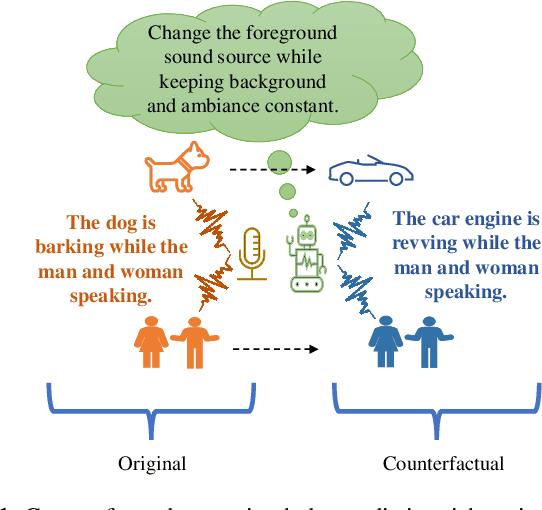
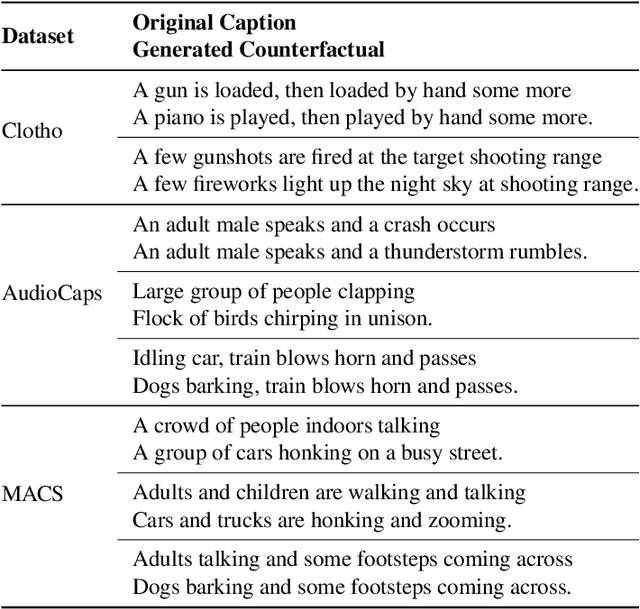

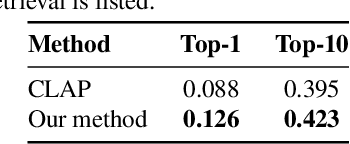
Conventional audio classification relied on predefined classes, lacking the ability to learn from free-form text. Recent methods unlock learning joint audio-text embeddings from raw audio-text pairs describing audio in natural language. Despite recent advancements, there is little exploration of systematic methods to train models for recognizing sound events and sources in alternative scenarios, such as distinguishing fireworks from gunshots at outdoor events in similar situations. This study introduces causal reasoning and counterfactual analysis in the audio domain. We use counterfactual instances and include them in our model across different aspects. Our model considers acoustic characteristics and sound source information from human-annotated reference texts. To validate the effectiveness of our model, we conducted pre-training utilizing multiple audio captioning datasets. We then evaluate with several common downstream tasks, demonstrating the merits of the proposed method as one of the first works leveraging counterfactual information in audio domain. Specifically, the top-1 accuracy in open-ended language-based audio retrieval task increased by more than 43%.
Video Understanding with Large Language Models: A Survey
Jan 04, 2024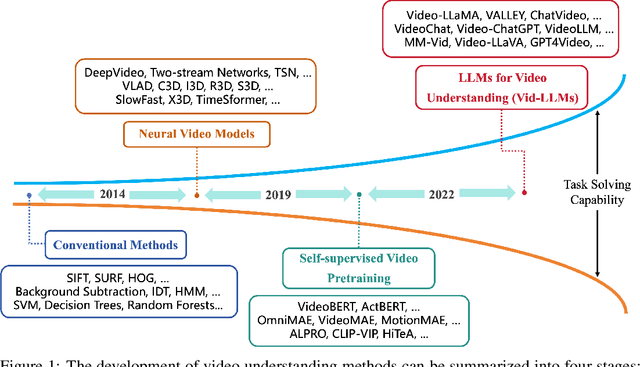

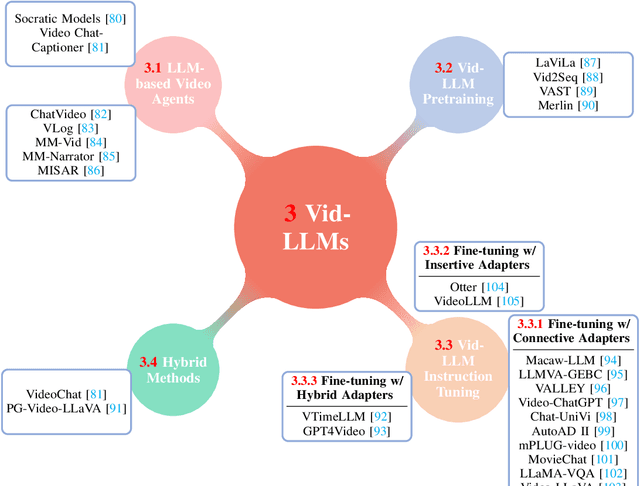
With the burgeoning growth of online video platforms and the escalating volume of video content, the demand for proficient video understanding tools has intensified markedly. Given the remarkable capabilities of Large Language Models (LLMs) in language and multimodal tasks, this survey provides a detailed overview of the recent advancements in video understanding harnessing the power of LLMs (Vid-LLMs). The emergent capabilities of Vid-LLMs are surprisingly advanced, particularly their ability for open-ended spatial-temporal reasoning combined with commonsense knowledge, suggesting a promising path for future video understanding. We examine the unique characteristics and capabilities of Vid-LLMs, categorizing the approaches into four main types: LLM-based Video Agents, Vid-LLMs Pretraining, Vid-LLMs Instruction Tuning, and Hybrid Methods. Furthermore, this survey presents a comprehensive study of the tasks, datasets, and evaluation methodologies for Vid-LLMs. Additionally, it explores the expansive applications of Vid-LLMs across various domains, highlighting their remarkable scalability and versatility in real-world video understanding challenges. Finally, it summarizes the limitations of existing Vid-LLMs and outlines directions for future research. For more information, readers are recommended to visit the repository at https://github.com/yunlong10/Awesome-LLMs-for-Video-Understanding.
Scalable CP Decomposition for Tensor Learning using GPU Tensor Cores
Nov 22, 2023CP decomposition is a powerful tool for data science, especially gene analysis, deep learning, and quantum computation. However, the application of tensor decomposition is largely hindered by the exponential increment of the computational complexity and storage consumption with the size of tensors. While the data in our real world is usually presented as trillion- or even exascale-scale tensors, existing work can only support billion-scale scale tensors. In our work, we propose the Exascale-Tensor to mitigate the significant gap. Specifically, we propose a compression-based tensor decomposition framework, namely the exascale-tensor, to support exascale tensor decomposition. Then, we carefully analyze the inherent parallelism and propose a bag of strategies to improve computational efficiency. Last, we conduct experiments to decompose tensors ranging from million-scale to trillion-scale for evaluation. Compared to the baselines, the exascale-tensor supports 8,000x larger tensors and a speedup up to 6.95x. We also apply our method to two real-world applications, including gene analysis and tensor layer neural networks, of which the numeric results demonstrate the scalability and effectiveness of our method.
MISAR: A Multimodal Instructional System with Augmented Reality
Oct 18, 2023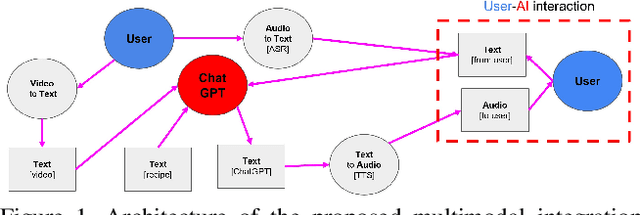
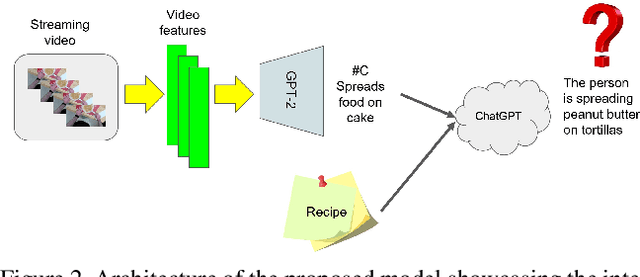

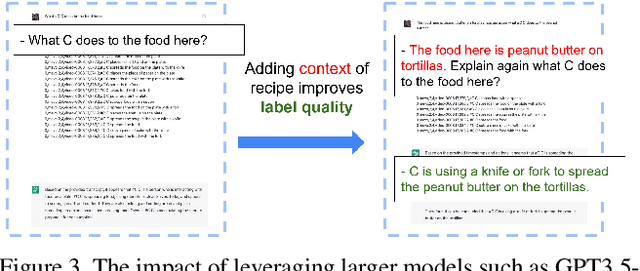
Augmented reality (AR) requires the seamless integration of visual, auditory, and linguistic channels for optimized human-computer interaction. While auditory and visual inputs facilitate real-time and contextual user guidance, the potential of large language models (LLMs) in this landscape remains largely untapped. Our study introduces an innovative method harnessing LLMs to assimilate information from visual, auditory, and contextual modalities. Focusing on the unique challenge of task performance quantification in AR, we utilize egocentric video, speech, and context analysis. The integration of LLMs facilitates enhanced state estimation, marking a step towards more adaptive AR systems. Code, dataset, and demo will be available at https://github.com/nguyennm1024/misar.
Separating Invisible Sounds Toward Universal Audiovisual Scene-Aware Sound Separation
Oct 18, 2023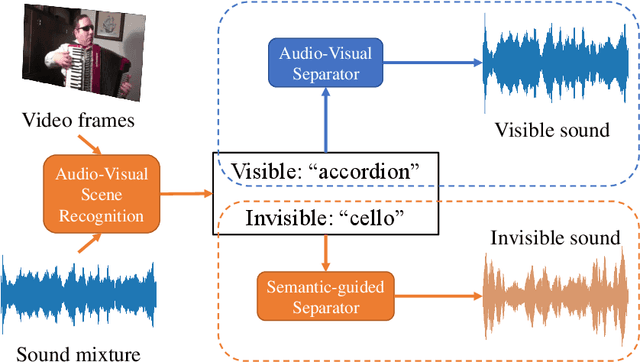
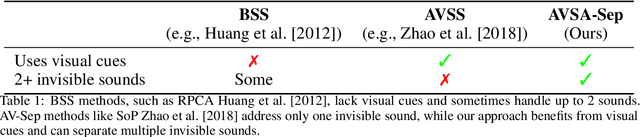
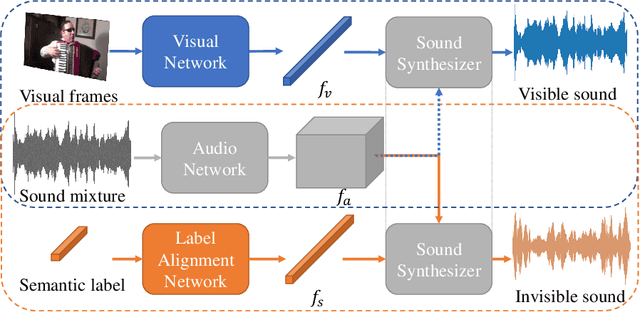
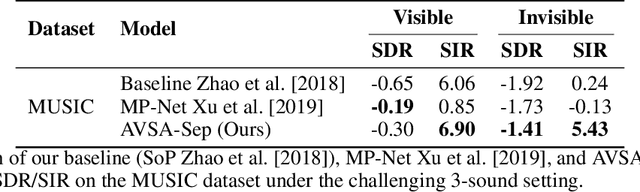
The audio-visual sound separation field assumes visible sources in videos, but this excludes invisible sounds beyond the camera's view. Current methods struggle with such sounds lacking visible cues. This paper introduces a novel "Audio-Visual Scene-Aware Separation" (AVSA-Sep) framework. It includes a semantic parser for visible and invisible sounds and a separator for scene-informed separation. AVSA-Sep successfully separates both sound types, with joint training and cross-modal alignment enhancing effectiveness.
Emotional Listener Portrait: Neural Listener Head Generation with Emotion
Oct 08, 2023Listener head generation centers on generating non-verbal behaviors (e.g., smile) of a listener in reference to the information delivered by a speaker. A significant challenge when generating such responses is the non-deterministic nature of fine-grained facial expressions during a conversation, which varies depending on the emotions and attitudes of both the speaker and the listener. To tackle this problem, we propose the Emotional Listener Portrait (ELP), which treats each fine-grained facial motion as a composition of several discrete motion-codewords and explicitly models the probability distribution of the motions under different emotion in conversation. Benefiting from the ``explicit'' and ``discrete'' design, our ELP model can not only automatically generate natural and diverse responses toward a given speaker via sampling from the learned distribution but also generate controllable responses with a predetermined attitude. Under several quantitative metrics, our ELP exhibits significant improvements compared to previous methods.
Neural Acoustic Context Field: Rendering Realistic Room Impulse Response With Neural Fields
Sep 27, 2023Room impulse response (RIR), which measures the sound propagation within an environment, is critical for synthesizing high-fidelity audio for a given environment. Some prior work has proposed representing RIR as a neural field function of the sound emitter and receiver positions. However, these methods do not sufficiently consider the acoustic properties of an audio scene, leading to unsatisfactory performance. This letter proposes a novel Neural Acoustic Context Field approach, called NACF, to parameterize an audio scene by leveraging multiple acoustic contexts, such as geometry, material property, and spatial information. Driven by the unique properties of RIR, i.e., temporal un-smoothness and monotonic energy attenuation, we design a temporal correlation module and multi-scale energy decay criterion. Experimental results show that NACF outperforms existing field-based methods by a notable margin. Please visit our project page for more qualitative results.