 Add to Chrome
 Add to Firefox
 Add to Edge
Mind-Brush: Integrating Agentic Cognitive Search and Reasoning into Image Generation
Feb 02, 2026
While text-to-image generation has achieved unprecedented fidelity, the vast majority of existing models function fundamentally as static text-to-pixel decoders. Consequently, they often fail to grasp implicit user intentions. Although emerging unified understanding-generation models have improved intent comprehension, they still struggle to accomplish tasks involving complex knowledge reasoning within a single model. Moreover, constrained by static internal priors, these models remain unable to adapt to the evolving dynamics of the real world. To bridge these gaps, we introduce Mind-Brush, a unified agentic framework that transforms generation into a dynamic, knowledge-driven workflow. Simulating a human-like 'think-research-create' paradigm, Mind-Brush actively retrieves multimodal evidence to ground out-of-distribution concepts and employs reasoning tools to resolve implicit visual constraints. To rigorously evaluate these capabilities, we propose Mind-Bench, a comprehensive benchmark comprising 500 distinct samples spanning real-time news, emerging concepts, and domains such as mathematical and Geo-Reasoning. Extensive experiments demonstrate that Mind-Brush significantly enhances the capabilities of unified models, realizing a zero-to-one capability leap for the Qwen-Image baseline on Mind-Bench, while achieving superior results on established benchmarks like WISE and RISE.

OmniAID: Decoupling Semantic and Artifacts for Universal AI-Generated Image Detection in the Wild
Nov 11, 2025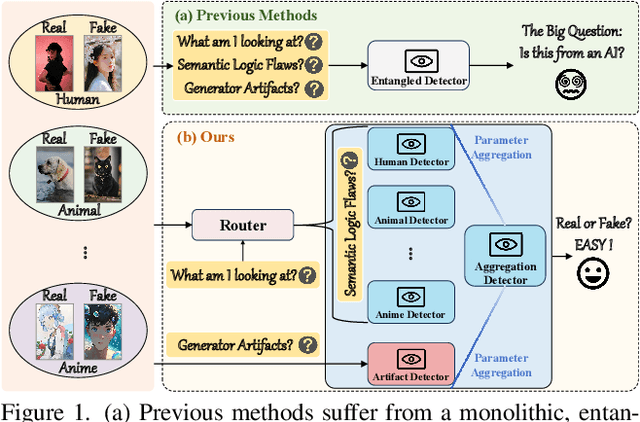
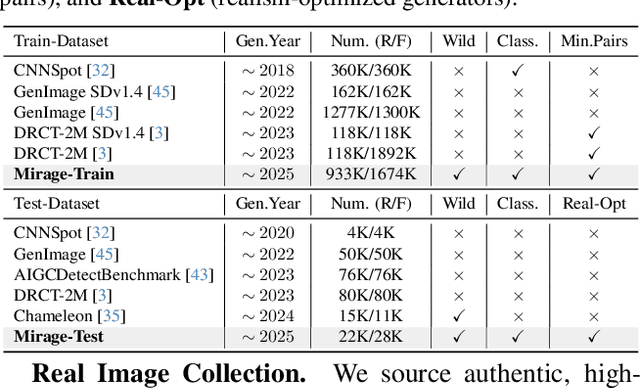
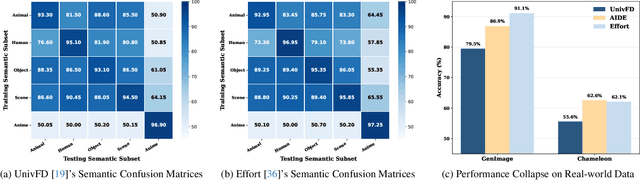
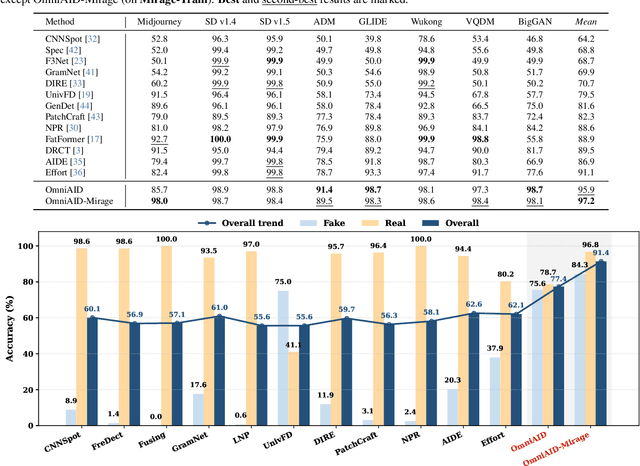
A truly universal AI-Generated Image (AIGI) detector must simultaneously generalize across diverse generative models and varied semantic content. Current state-of-the-art methods learn a single, entangled forgery representation--conflating content-dependent flaws with content-agnostic artifacts--and are further constrained by outdated benchmarks. To overcome these limitations, we propose OmniAID, a novel framework centered on a decoupled Mixture-of-Experts (MoE) architecture. The core of our method is a hybrid expert system engineered to decouple: (1) semantic flaws across distinct content domains, and (2) these content-dependent flaws from content-agnostic universal artifacts. This system employs a set of Routable Specialized Semantic Experts, each for a distinct domain (e.g., human, animal), complemented by a Fixed Universal Artifact Expert. This architecture is trained using a bespoke two-stage strategy: we first train the experts independently with domain-specific hard-sampling to ensure specialization, and subsequently train a lightweight gating network for effective input routing. By explicitly decoupling "what is generated" (content-specific flaws) from "how it is generated" (universal artifacts), OmniAID achieves robust generalization. To address outdated benchmarks and validate real-world applicability, we introduce Mirage, a new large-scale, contemporary dataset. Extensive experiments, using both traditional benchmarks and our Mirage dataset, demonstrate our model surpasses existing monolithic detectors, establishing a new, robust standard for AIGI authentication against modern, in-the-wild threats.