 Add to Chrome
 Add to Firefox
 Add to Edge
OmniAID: Decoupling Semantic and Artifacts for Universal AI-Generated Image Detection in the Wild
Nov 11, 2025
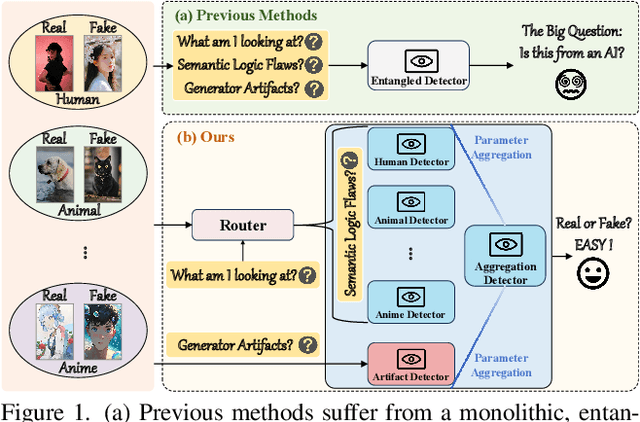
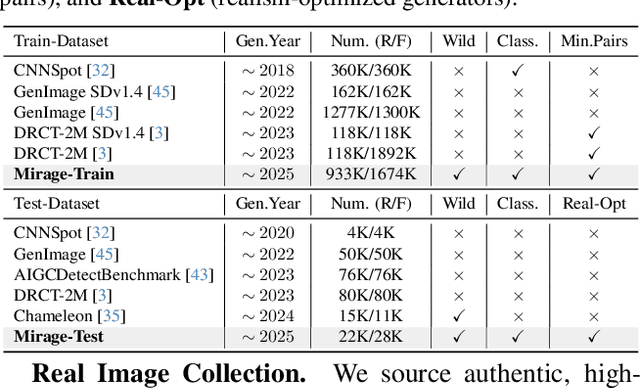
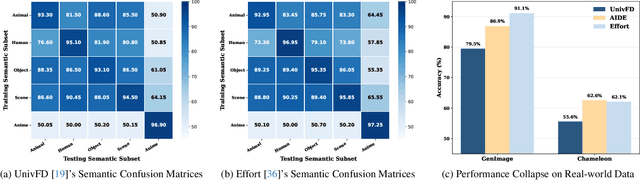
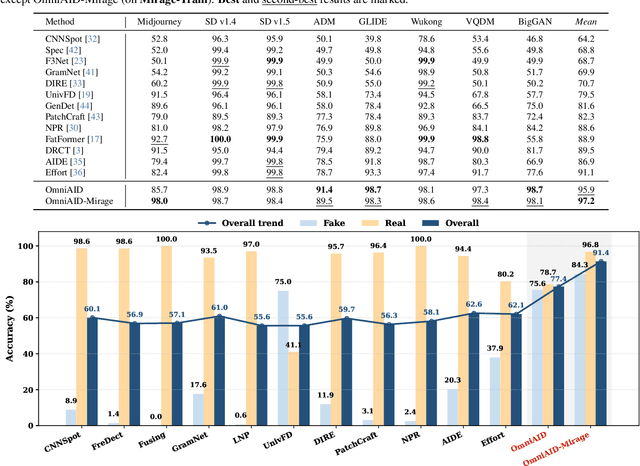
A truly universal AI-Generated Image (AIGI) detector must simultaneously generalize across diverse generative models and varied semantic content. Current state-of-the-art methods learn a single, entangled forgery representation--conflating content-dependent flaws with content-agnostic artifacts--and are further constrained by outdated benchmarks. To overcome these limitations, we propose OmniAID, a novel framework centered on a decoupled Mixture-of-Experts (MoE) architecture. The core of our method is a hybrid expert system engineered to decouple: (1) semantic flaws across distinct content domains, and (2) these content-dependent flaws from content-agnostic universal artifacts. This system employs a set of Routable Specialized Semantic Experts, each for a distinct domain (e.g., human, animal), complemented by a Fixed Universal Artifact Expert. This architecture is trained using a bespoke two-stage strategy: we first train the experts independently with domain-specific hard-sampling to ensure specialization, and subsequently train a lightweight gating network for effective input routing. By explicitly decoupling "what is generated" (content-specific flaws) from "how it is generated" (universal artifacts), OmniAID achieves robust generalization. To address outdated benchmarks and validate real-world applicability, we introduce Mirage, a new large-scale, contemporary dataset. Extensive experiments, using both traditional benchmarks and our Mirage dataset, demonstrate our model surpasses existing monolithic detectors, establishing a new, robust standard for AIGI authentication against modern, in-the-wild threats.

MMRL++: Parameter-Efficient and Interaction-Aware Representation Learning for Vision-Language Models
May 15, 2025Large-scale pre-trained Vision-Language Models (VLMs) have significantly advanced transfer learning across diverse tasks. However, adapting these models with limited few-shot data often leads to overfitting, undermining their ability to generalize to new tasks. To address this, we propose Multi-Modal Representation Learning (MMRL), which introduces a shared, learnable, modality-agnostic representation space. MMRL generates space tokens projected into both text and image encoders as representation tokens, enabling more effective cross-modal interactions. Unlike prior methods that mainly optimize class token features, MMRL inserts representation tokens into higher encoder layers--where task-specific features are more prominent--while preserving general knowledge in the lower layers. During training, both class and representation features are jointly optimized: a trainable projection layer is applied to representation tokens for task adaptation, while the projection layer for class token remains frozen to retain pre-trained knowledge. To further promote generalization, we introduce a regularization term aligning class and text features with the frozen VLM's zero-shot features. At inference, a decoupling strategy uses both class and representation features for base tasks, but only class features for novel tasks due to their stronger generalization. Building upon this, we propose MMRL++, a parameter-efficient and interaction-aware extension that significantly reduces trainable parameters and enhances intra-modal interactions--particularly across the layers of representation tokens--allowing gradient sharing and instance-specific information to propagate more effectively through the network. Extensive experiments on 15 datasets demonstrate that MMRL and MMRL++ consistently outperform state-of-the-art methods, achieving a strong balance between task-specific adaptation and generalization.
MMRL: Multi-Modal Representation Learning for Vision-Language Models
Mar 11, 2025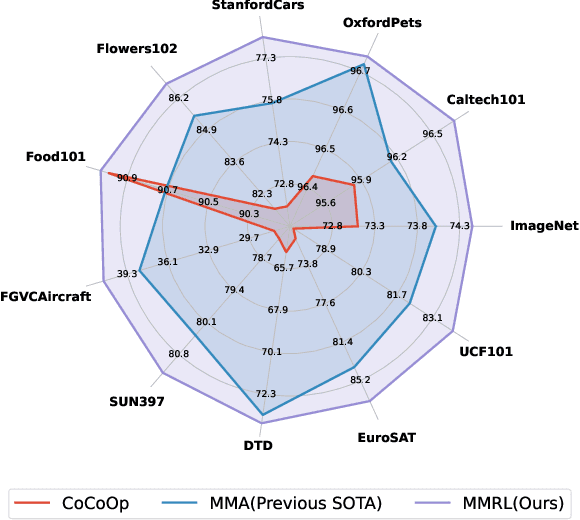
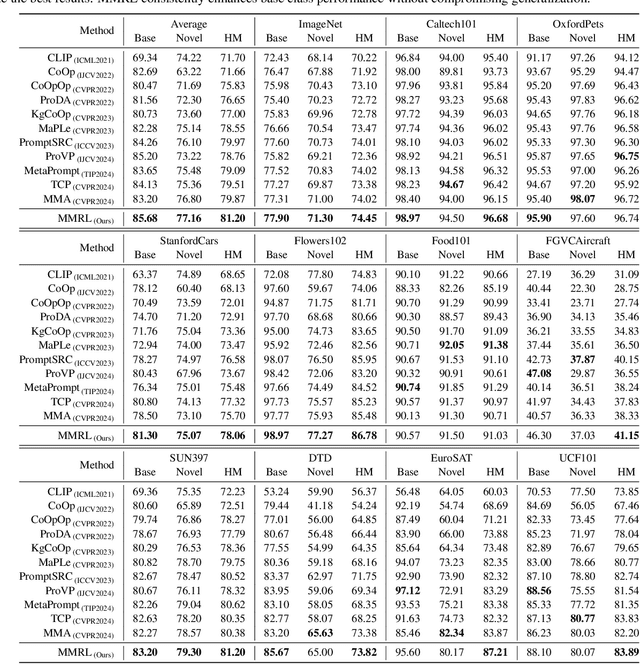
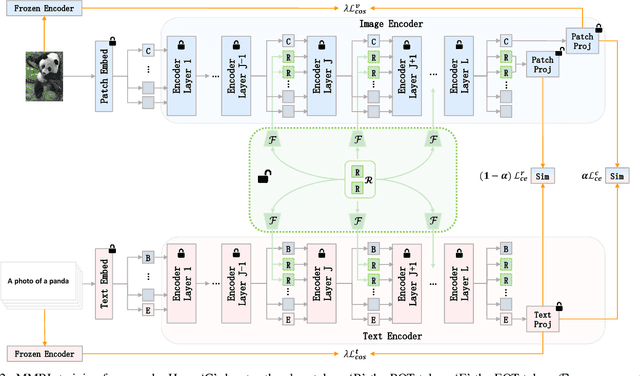
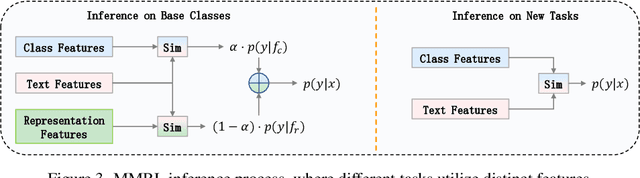
Large-scale pre-trained Vision-Language Models (VLMs) have become essential for transfer learning across diverse tasks. However, adapting these models with limited few-shot data often leads to overfitting, diminishing their performance on new tasks. To tackle this issue, we propose a novel Multi-Modal Representation Learning (MMRL) framework that introduces a shared, learnable, and modality-agnostic representation space. MMRL projects the space tokens to text and image representation tokens, facilitating more effective multi-modal interactions. Unlike previous approaches that solely optimize class token features, MMRL integrates representation tokens at higher layers of the encoders--where dataset-specific features are more prominent--while preserving generalized knowledge in the lower layers. During training, both representation and class features are optimized, with trainable projection layer applied to the representation tokens, whereas the class token projection layer remains frozen to retain pre-trained knowledge. Furthermore, a regularization term is introduced to align the class features and text features with the zero-shot features from the frozen VLM, thereby safeguarding the model's generalization capacity. For inference, a decoupling strategy is employed, wherein both representation and class features are utilized for base classes, while only the class features, which retain more generalized knowledge, are used for new tasks. Extensive experiments across 15 datasets demonstrate that MMRL outperforms state-of-the-art methods, achieving a balanced trade-off between task-specific adaptation and generalization. Code is available at https://github.com/yunncheng/MMRL.