 Add to Chrome
 Add to Firefox
 Add to Edge
USR-Drive: Unified Driving Scene Representation via Joint Denoising of 3D Gaussians and Boxes
Aug 19, 2026
Spatial representation learning for autonomous driving aims to map raw visual signals into structured 3D scene representations, where object-centric bounding boxes and rendering-oriented 3D primitives (\eg, 3D Gaussians) serve as two distinct yet highly complementary levels for scene understanding. Existing methods typically treat dynamic reconstruction and instance-level perception as separate tasks, despite their shared goal of estimating the underlying 3D world state. As a result, dynamic reconstruction is under-constrained while 3D detection lacks geometric grounding. To address this gap, we propose USR-Drive, a unified conditional generative framework that, given only posed multi-view driving videos, jointly recovers dense dynamic geometry and instance-level object layouts within a shared scene representation. Specifically, USR-Drive represents dense Gaussian primitives and sparse 3D bounding boxes as two aligned latent token streams and jointly denoises them with a unified multi-modal diffusion Transformer. Unlike prior paradigms that use boxes as external conditions or predict them with detached modules, USR-Drive treats them as mutually constrained state variables with a Unified Positional Encoding (UPE) that aligns heterogeneous tokens within a shared metric spatiotemporal coordinate. Via such unified representation and generative framework, the two modalities reinforce each other: geometry supplies dense metric evidence for box prediction, while boxes provide instance-level structural priors that help preserve spatial consistency and reduce ambiguity in sequential 3D geometric representation. Our approach successfully delivers state-of-the-art results for both dynamic reconstruction and 3D detection on the nuScenes and VKitti datasets.

Mono4DEditor: Text-Driven 4D Scene Editing from Monocular Video via Point-Level Localization of Language-Embedded Gaussians
Oct 10, 2025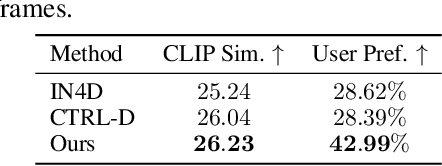
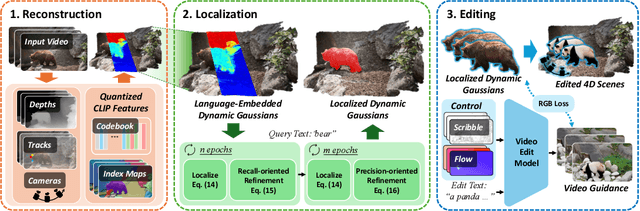
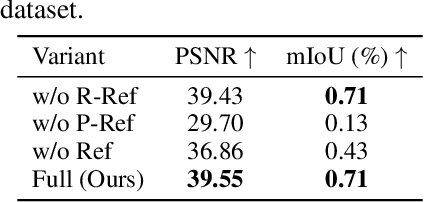
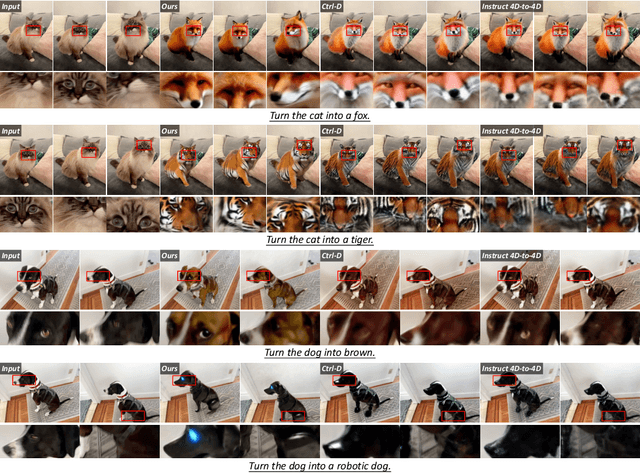
Editing 4D scenes reconstructed from monocular videos based on text prompts is a valuable yet challenging task with broad applications in content creation and virtual environments. The key difficulty lies in achieving semantically precise edits in localized regions of complex, dynamic scenes, while preserving the integrity of unedited content. To address this, we introduce Mono4DEditor, a novel framework for flexible and accurate text-driven 4D scene editing. Our method augments 3D Gaussians with quantized CLIP features to form a language-embedded dynamic representation, enabling efficient semantic querying of arbitrary spatial regions. We further propose a two-stage point-level localization strategy that first selects candidate Gaussians via CLIP similarity and then refines their spatial extent to improve accuracy. Finally, targeted edits are performed on localized regions using a diffusion-based video editing model, with flow and scribble guidance ensuring spatial fidelity and temporal coherence. Extensive experiments demonstrate that Mono4DEditor enables high-quality, text-driven edits across diverse scenes and object types, while preserving the appearance and geometry of unedited areas and surpassing prior approaches in both flexibility and visual fidelity.