 Add to Chrome
 Add to Firefox
 Add to Edge
USR-Drive: Unified Driving Scene Representation via Joint Denoising of 3D Gaussians and Boxes
Aug 19, 2026
Spatial representation learning for autonomous driving aims to map raw visual signals into structured 3D scene representations, where object-centric bounding boxes and rendering-oriented 3D primitives (\eg, 3D Gaussians) serve as two distinct yet highly complementary levels for scene understanding. Existing methods typically treat dynamic reconstruction and instance-level perception as separate tasks, despite their shared goal of estimating the underlying 3D world state. As a result, dynamic reconstruction is under-constrained while 3D detection lacks geometric grounding. To address this gap, we propose USR-Drive, a unified conditional generative framework that, given only posed multi-view driving videos, jointly recovers dense dynamic geometry and instance-level object layouts within a shared scene representation. Specifically, USR-Drive represents dense Gaussian primitives and sparse 3D bounding boxes as two aligned latent token streams and jointly denoises them with a unified multi-modal diffusion Transformer. Unlike prior paradigms that use boxes as external conditions or predict them with detached modules, USR-Drive treats them as mutually constrained state variables with a Unified Positional Encoding (UPE) that aligns heterogeneous tokens within a shared metric spatiotemporal coordinate. Via such unified representation and generative framework, the two modalities reinforce each other: geometry supplies dense metric evidence for box prediction, while boxes provide instance-level structural priors that help preserve spatial consistency and reduce ambiguity in sequential 3D geometric representation. Our approach successfully delivers state-of-the-art results for both dynamic reconstruction and 3D detection on the nuScenes and VKitti datasets.

InverseDraping: Recovering Sewing Patterns from 3D Garment Surfaces via BoxMesh Bridging
Apr 03, 2026Recovering sewing patterns from draped 3D garments is a challenging problem in human digitization research. In contrast to the well-studied forward process of draping designed sewing patterns using mature physical simulation engines, the inverse process of recovering parametric 2D patterns from deformed garment geometry remains fundamentally ill-posed for existing methods. We propose a two-stage framework that centers on a structured intermediate representation, BoxMesh, which serves as the key to bridging the gap between 3D garment geometry and parametric sewing patterns. BoxMesh encodes both garment-level geometry and panel-level structure in 3D, while explicitly disentangling intrinsic panel geometry and stitching topology from draping-induced deformations. This representation imposes a physically grounded structure on the problem, significantly reducing ambiguity. In Stage I, a geometry-driven autoregressive model infers BoxMesh from the input 3D garment. In Stage II, a semantics-aware autoregressive model parses BoxMesh into parametric sewing patterns. We adopt autoregressive modeling to naturally handle the variable-length and structured nature of panel configurations and stitching relationships. This decomposition separates geometric inversion from structured pattern inference, leading to more accurate and robust recovery. Extensive experiments demonstrate that our method achieves state-of-the-art performance on the GarmentCodeData benchmark and generalizes effectively to real-world scans and single-view images.
ASH: Animatable Gaussian Splats for Efficient and Photoreal Human Rendering
Dec 10, 2023
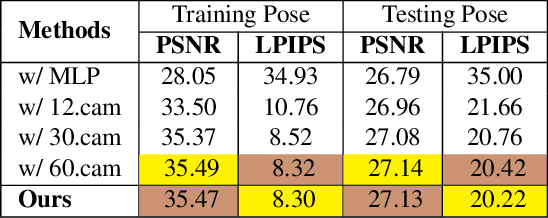
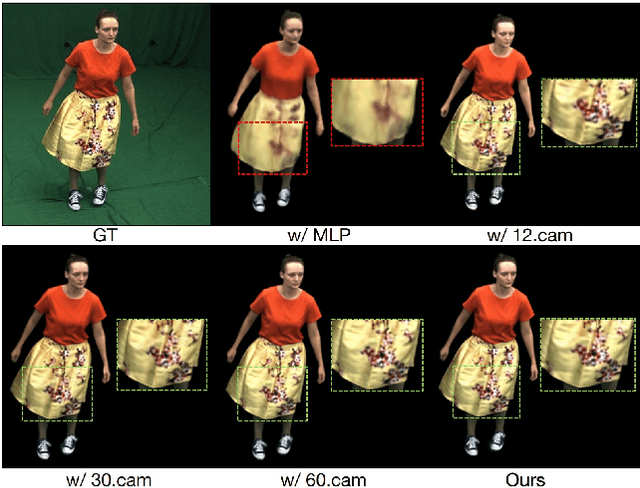
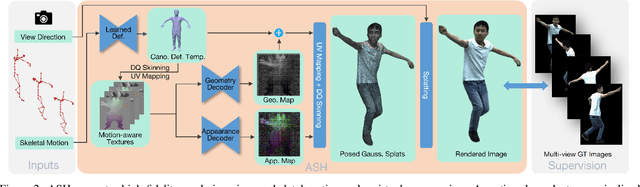
Real-time rendering of photorealistic and controllable human avatars stands as a cornerstone in Computer Vision and Graphics. While recent advances in neural implicit rendering have unlocked unprecedented photorealism for digital avatars, real-time performance has mostly been demonstrated for static scenes only. To address this, we propose ASH, an animatable Gaussian splatting approach for photorealistic rendering of dynamic humans in real-time. We parameterize the clothed human as animatable 3D Gaussians, which can be efficiently splatted into image space to generate the final rendering. However, naively learning the Gaussian parameters in 3D space poses a severe challenge in terms of compute. Instead, we attach the Gaussians onto a deformable character model, and learn their parameters in 2D texture space, which allows leveraging efficient 2D convolutional architectures that easily scale with the required number of Gaussians. We benchmark ASH with competing methods on pose-controllable avatars, demonstrating that our method outperforms existing real-time methods by a large margin and shows comparable or even better results than offline methods.