 Add to Chrome
 Add to Firefox
 Add to Edge
Advancing Multimodal Agent Reasoning with Long-Term Neuro-Symbolic Memory
Mar 16, 2026
Recent advances in large language models have driven the emergence of intelligent agents operating in open-world, multimodal environments. To support long-term reasoning, such agents are typically equipped with external memory systems. However, most existing multimodal agent memories rely primarily on neural representations and vector-based retrieval, which are well-suited for inductive, intuitive reasoning but fundamentally limited in supporting analytical, deductive reasoning critical for real-world decision making. To address this limitation, we propose NS-Mem, a long-term neuro-symbolic memory framework designed to advance multimodal agent reasoning by integrating neural memory with explicit symbolic structures and rules. Specifically, NS-Mem is operated around three core components of a memory system: (1) a three-layer memory architecture that consists episodic layer, semantic layer and logic rule layer, (2) a memory construction and maintenance mechanism implemented by SK-Gen that automatically consolidates structured knowledge from accumulated multimodal experiences and incrementally updates both neural representations and symbolic rules, and (3) a hybrid memory retrieval mechanism that combines similarity-based search with deterministic symbolic query functions to support structured reasoning. Experiments on real-world multimodal reasoning benchmarks demonstrate that Neural-Symbolic Memory achieves an average 4.35% improvement in overall reasoning accuracy over pure neural memory systems, with gains of up to 12.5% on constrained reasoning queries, validating the effectiveness of NS-Mem.

Generic and Robust Root Cause Localization for Multi-Dimensional Data in Online Service Systems
May 05, 2023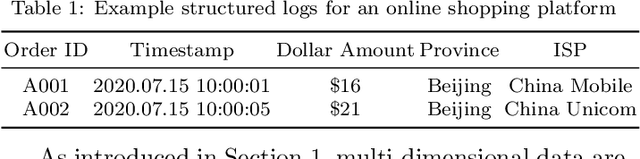

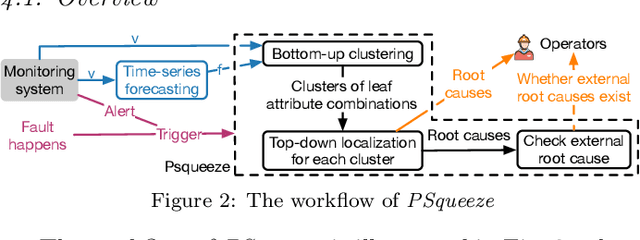
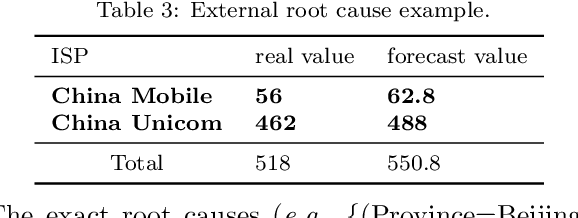
Localizing root causes for multi-dimensional data is critical to ensure online service systems' reliability. When a fault occurs, only the measure values within specific attribute combinations are abnormal. Such attribute combinations are substantial clues to the underlying root causes and thus are called root causes of multidimensional data. This paper proposes a generic and robust root cause localization approach for multi-dimensional data, PSqueeze. We propose a generic property of root cause for multi-dimensional data, generalized ripple effect (GRE). Based on it, we propose a novel probabilistic cluster method and a robust heuristic search method. Moreover, we identify the importance of determining external root causes and propose an effective method for the first time in literature. Our experiments on two real-world datasets with 5400 faults show that the F1-score of PSqueeze outperforms baselines by 32.89%, while the localization time is around 10 seconds across all cases. The F1-score in determining external root causes of PSqueeze achieves 0.90. Furthermore, case studies in several production systems demonstrate that PSqueeze is helpful to fault diagnosis in the real world.