 Add to Chrome
 Add to Firefox
 Add to Edge
STRIDE: Strategic Trajectory Reasoning via Discriminative Estimation for Verifiable Reinforcement Learning
Jun 14, 2026
Reinforcement Learning with Verifiable Rewards (RLVR) has become an effective post-training paradigm for improving the reasoning abilities of large language models. However, existing RLVR methods typically rely on final-answer correctness to assign trajectory-level rewards, providing sparse supervision and treating all tokens uniformly regardless of their actual contribution to reasoning. Although recent studies introduce intermediate signals such as process rewards, high-entropy tokens, and semantic uncertainty, these signals are often not inherently verifiable and may fail to distinguish beneficial strategic patterns from harmful ones. To address this limitation, we propose STRIDE (Strategic Trajectory Reasoning with Discriminative Estimation), a fine-grained RLVR framework that derives strategic reasoning supervision from verifiable outcomes. STRIDE contrasts successful and failed trajectories within each response group to estimate the outcome-discriminative preference of each $n$-gram strategic pattern, and further combines this signal with reasoning saliency entropy to identify decision-relevant strategic patterns. These patterns are assigned differentiated advantage values during RL optimization, enabling more precise credit assignment while preserving the verifiability of RLVR. Extensive experiments demonstrate that STRIDE consistently improves reasoning performance across diverse models, tasks, and extended settings, including VLMs and agent-based systems.

Re-M3Dr: Rebalanced MultiModal Mean Deviation Regression
May 26, 2026Mean Deviation (MD) is a critical metric for assessing visual field loss in ophthalmology. While previous work has focused solely on predicting MD from Optical Coherence Tomography (OCT), it is intuitive to assume that combining OCT with another imaging of fundus photography (FP) could improve performance, as two ophthalmic medical imaging provide complementary information. This is particularly expected when sophisticated multi-objective optimization is applied, as documented in common multimodal classification. Surprisingly, our investigations reveal that multimodal fusion in this medical imaging scenario performs worse than unimodal model. Through detailed analysis, we identify the root cause as a coupled imbalance between data distribution and modality learning conflict. This imbalance distorts the optimization landscape, leading to unstable training. To address this challenge, we propose the method of Rebalanced MultiModal Mean Deviation Regression (Re-M3Dr), a novel multimodal regression framework. We enhance unimodal representation through adaptive margin based supervised contrastive learning. Then, our framework stabilizes the joint optimization with the sharpness-aware gradient modulation. Experimental results on both public and private clinical datasets show average 29\% reduction in MSE compared to SOTA multimodal learning methods, demonstrating the superiority of Re-M3Dr. The code is available in the supplementary materials.
Towards Faithful Reasoning in Comics for Small MLLMs
Jan 06, 2026Comic-based visual question answering (CVQA) poses distinct challenges to multimodal large language models (MLLMs) due to its reliance on symbolic abstraction, narrative logic, and humor, which differ from conventional VQA tasks. Although Chain-of-Thought (CoT) prompting is widely used to enhance MLLM reasoning, surprisingly, its direct application to CVQA often degrades performance, especially in small-scale models. Our theoretical and empirical analyses reveal that standard CoT in CVQA suffers from state entanglement, spurious transitions, and exploration inefficiency, with small models particularly vulnerable in resource-constrained settings. To address these issues, we propose a novel comic reasoning framework, designed to produce more faithful and transferable reasoning chains in small MLLMs. Specifically, our framework combines modular CoT generation with GRPO-based reinforcement fine-tuning and a novel structured reward. Beyond comic VQA, we further evaluate our approach on a broader class of humor-centric and abstract visual reasoning tasks, including meme understanding and editorial cartoon interpretation. Across five challenging benchmarks, our 3B model outperforms state-of-the-art methods, and plug-in experiments yield an additional average improvement of $\mathbf{12.1\%}$ across different MLLMs.
TriLoRA: Integrating SVD for Advanced Style Personalization in Text-to-Image Generation
May 18, 2024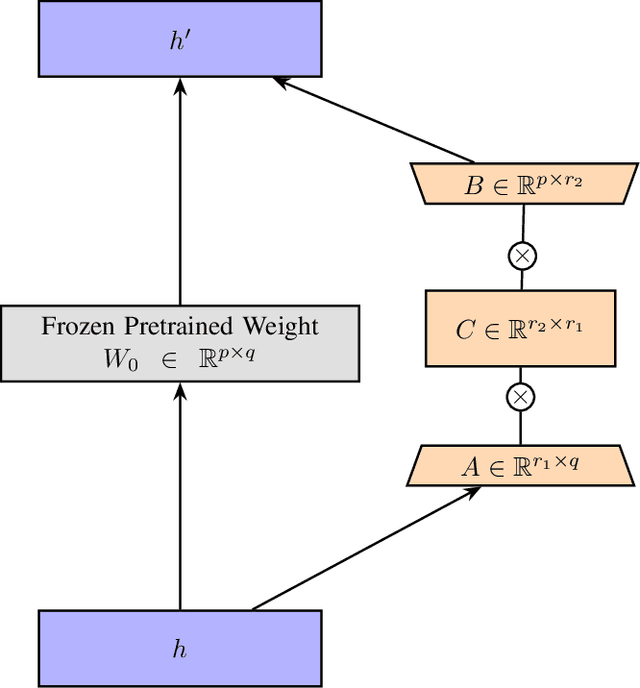
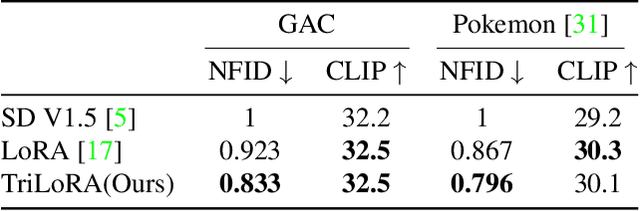
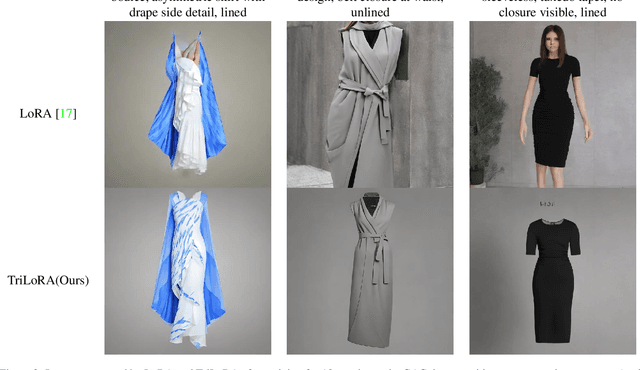
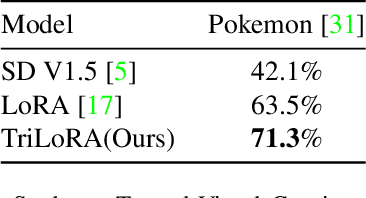
As deep learning technology continues to advance, image generation models, especially models like Stable Diffusion, are finding increasingly widespread application in visual arts creation. However, these models often face challenges such as overfitting, lack of stability in generated results, and difficulties in accurately capturing the features desired by creators during the fine-tuning process. In response to these challenges, we propose an innovative method that integrates Singular Value Decomposition (SVD) into the Low-Rank Adaptation (LoRA) parameter update strategy, aimed at enhancing the fine-tuning efficiency and output quality of image generation models. By incorporating SVD within the LoRA framework, our method not only effectively reduces the risk of overfitting but also enhances the stability of model outputs, and captures subtle, creator-desired feature adjustments more accurately. We evaluated our method on multiple datasets, and the results show that, compared to traditional fine-tuning methods, our approach significantly improves the model's generalization ability and creative flexibility while maintaining the quality of generation. Moreover, this method maintains LoRA's excellent performance under resource-constrained conditions, allowing for significant improvements in image generation quality without sacrificing the original efficiency and resource advantages.
STRUDEL: Structured Dialogue Summarization for Dialogue Comprehension
Dec 24, 2022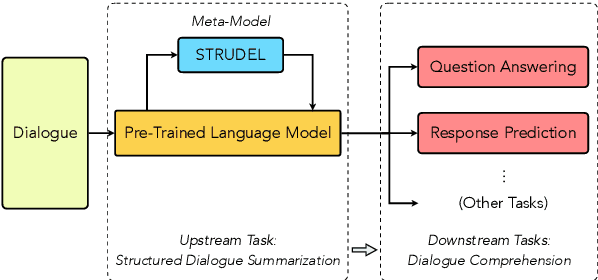
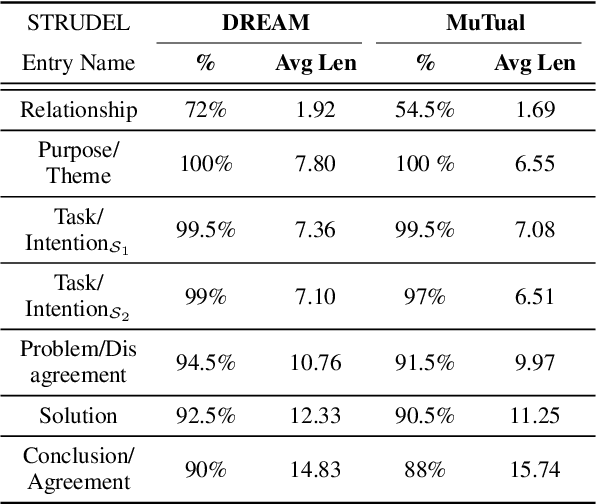

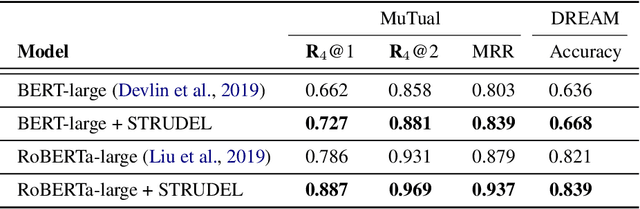
Abstractive dialogue summarization has long been viewed as an important standalone task in natural language processing, but no previous work has explored the possibility of whether abstractive dialogue summarization can also be used as a means to boost an NLP system's performance on other important dialogue comprehension tasks. In this paper, we propose a novel type of dialogue summarization task - STRUctured DiaLoguE Summarization - that can help pre-trained language models to better understand dialogues and improve their performance on important dialogue comprehension tasks. We further collect human annotations of STRUDEL summaries over 400 dialogues and introduce a new STRUDEL dialogue comprehension modeling framework that integrates STRUDEL into a graph-neural-network-based dialogue reasoning module over transformer encoder language models to improve their dialogue comprehension abilities. In our empirical experiments on two important downstream dialogue comprehension tasks - dialogue question answering and dialogue response prediction - we show that our STRUDEL dialogue comprehension model can significantly improve the dialogue comprehension performance of transformer encoder language models.