 Add to Chrome
 Add to Firefox
 Add to Edge
ForeSci: Evaluating LLM Agents for Forward-Looking AI Research Judgment
May 30, 2026
AI research often requires decisions before future evidence exists: which bottleneck to attack, which direction to pursue, or where a project should be positioned. We introduce ForeSci, a temporally controlled benchmark for evaluating whether LLM agents can make such forward-looking research judgements from historical evidence. ForeSci contains 500 tasks across four fast-moving AI domains and four decision families. Each task is paired with a cutoff-aligned offline knowledge base; post-cutoff papers are hidden during generation and used only for validation. To avoid random future-event prediction, tasks are derived from pre-cutoff taxonomy branches and evidence signals, and answer-generation backbones are selected to precede the task cutoffs. We evaluate native LLMs, Hybrid RAG, and three research-agent adaptations across four backbones. Results show that explicit evidence organization improves traceability and factual support, but gains depend strongly on the decision family. Diagnostics reveal a recurring evidence-decision decoupling: agents may cite relevant evidence while forecasting the wrong research object. ForeSci turns forward-looking AI research judgement into a controlled benchmark for evaluating research agents as decision-making systems.

Re-M3Dr: Rebalanced MultiModal Mean Deviation Regression
May 26, 2026Mean Deviation (MD) is a critical metric for assessing visual field loss in ophthalmology. While previous work has focused solely on predicting MD from Optical Coherence Tomography (OCT), it is intuitive to assume that combining OCT with another imaging of fundus photography (FP) could improve performance, as two ophthalmic medical imaging provide complementary information. This is particularly expected when sophisticated multi-objective optimization is applied, as documented in common multimodal classification. Surprisingly, our investigations reveal that multimodal fusion in this medical imaging scenario performs worse than unimodal model. Through detailed analysis, we identify the root cause as a coupled imbalance between data distribution and modality learning conflict. This imbalance distorts the optimization landscape, leading to unstable training. To address this challenge, we propose the method of Rebalanced MultiModal Mean Deviation Regression (Re-M3Dr), a novel multimodal regression framework. We enhance unimodal representation through adaptive margin based supervised contrastive learning. Then, our framework stabilizes the joint optimization with the sharpness-aware gradient modulation. Experimental results on both public and private clinical datasets show average 29\% reduction in MSE compared to SOTA multimodal learning methods, demonstrating the superiority of Re-M3Dr. The code is available in the supplementary materials.
Towards Faithful Reasoning in Comics for Small MLLMs
Jan 06, 2026Comic-based visual question answering (CVQA) poses distinct challenges to multimodal large language models (MLLMs) due to its reliance on symbolic abstraction, narrative logic, and humor, which differ from conventional VQA tasks. Although Chain-of-Thought (CoT) prompting is widely used to enhance MLLM reasoning, surprisingly, its direct application to CVQA often degrades performance, especially in small-scale models. Our theoretical and empirical analyses reveal that standard CoT in CVQA suffers from state entanglement, spurious transitions, and exploration inefficiency, with small models particularly vulnerable in resource-constrained settings. To address these issues, we propose a novel comic reasoning framework, designed to produce more faithful and transferable reasoning chains in small MLLMs. Specifically, our framework combines modular CoT generation with GRPO-based reinforcement fine-tuning and a novel structured reward. Beyond comic VQA, we further evaluate our approach on a broader class of humor-centric and abstract visual reasoning tasks, including meme understanding and editorial cartoon interpretation. Across five challenging benchmarks, our 3B model outperforms state-of-the-art methods, and plug-in experiments yield an additional average improvement of $\mathbf{12.1\%}$ across different MLLMs.
TriLoRA: Integrating SVD for Advanced Style Personalization in Text-to-Image Generation
May 18, 2024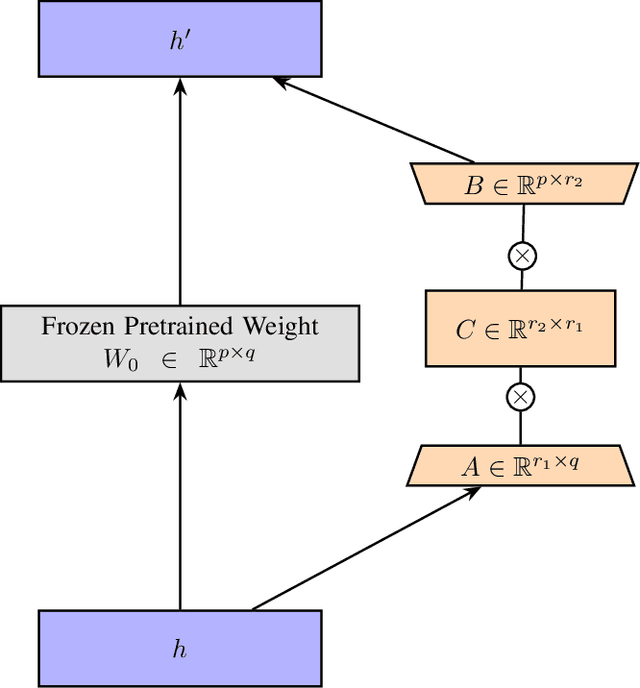
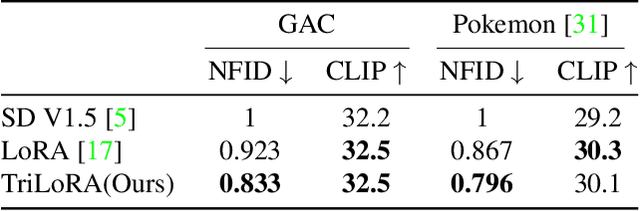
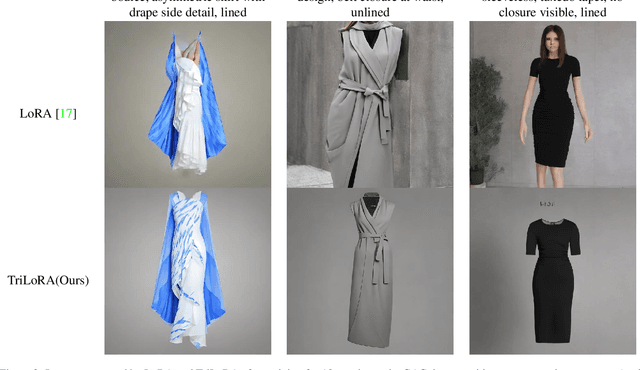
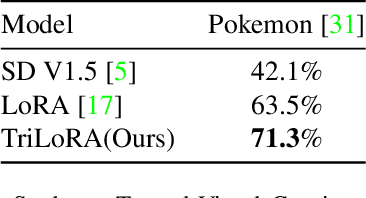
As deep learning technology continues to advance, image generation models, especially models like Stable Diffusion, are finding increasingly widespread application in visual arts creation. However, these models often face challenges such as overfitting, lack of stability in generated results, and difficulties in accurately capturing the features desired by creators during the fine-tuning process. In response to these challenges, we propose an innovative method that integrates Singular Value Decomposition (SVD) into the Low-Rank Adaptation (LoRA) parameter update strategy, aimed at enhancing the fine-tuning efficiency and output quality of image generation models. By incorporating SVD within the LoRA framework, our method not only effectively reduces the risk of overfitting but also enhances the stability of model outputs, and captures subtle, creator-desired feature adjustments more accurately. We evaluated our method on multiple datasets, and the results show that, compared to traditional fine-tuning methods, our approach significantly improves the model's generalization ability and creative flexibility while maintaining the quality of generation. Moreover, this method maintains LoRA's excellent performance under resource-constrained conditions, allowing for significant improvements in image generation quality without sacrificing the original efficiency and resource advantages.