 Add to Chrome
 Add to Firefox
 Add to Edge
Narrative Knowledge Weaver: Narrative-Centric Retrieval-Augmented Reasoning for Long-Form Text Understanding
Jun 04, 2026
Long-form narrative QA requires reasoning over evolving story worlds rather than isolated passages: answers may depend on earlier goals, changing character states, social relations, causal triggers, temporal position, and later consequences. Existing retrieval and graph-augmented generation methods improve evidence access, but their units--chunks, entities, relations, summaries, or tool actions--do not directly encode how evidence functions in a story. We introduce Narrative Knowledge Weaver(NKW), a source-grounded framework that aligns textual evidence, atomic facts, canonical graph structure, entity profiles, interactions, episodes, and storylines. At query time, NKW uses text, graph, and narrative tools with post-retrieval reading skills to assemble evidence and audit actor, scope, polarity, state, and temporal constraints. Across STAGE, FairytaleQA, and QuALITY, NKW is strongest on screenplay-level story-world QA while remaining competitive on more passage-centered benchmarks. Ablations, question-type analyses, graph-asset statistics, and case studies show complementary benefits for character, scene, temporal, causal, and narrative-progression reasoning.

ForeSci: Evaluating LLM Agents for Forward-Looking AI Research Judgment
May 30, 2026AI research often requires decisions before future evidence exists: which bottleneck to attack, which direction to pursue, or where a project should be positioned. We introduce ForeSci, a temporally controlled benchmark for evaluating whether LLM agents can make such forward-looking research judgements from historical evidence. ForeSci contains 500 tasks across four fast-moving AI domains and four decision families. Each task is paired with a cutoff-aligned offline knowledge base; post-cutoff papers are hidden during generation and used only for validation. To avoid random future-event prediction, tasks are derived from pre-cutoff taxonomy branches and evidence signals, and answer-generation backbones are selected to precede the task cutoffs. We evaluate native LLMs, Hybrid RAG, and three research-agent adaptations across four backbones. Results show that explicit evidence organization improves traceability and factual support, but gains depend strongly on the decision family. Diagnostics reveal a recurring evidence-decision decoupling: agents may cite relevant evidence while forecasting the wrong research object. ForeSci turns forward-looking AI research judgement into a controlled benchmark for evaluating research agents as decision-making systems.
DeferredSeg: A Multi-Expert Deferral Framework for Trustworthy Medical Image Segmentation
Apr 14, 2026Segmentation models based on deep neural networks demonstrate strong generalization for medical image segmentation. However, they often exhibit overconfidence or underconfidence, leading to unreliable confidence scores for segmentation masks, especially in ambiguous regions. This undermines the trustworthiness required for clinical deployment. Motivated by the learning-to-defer (L2D) paradigm, we introduce DeferredSeg, a deferral-aware segmentation framework, i.e., a Human--AI collaboration system that determines whether to defer predictions to human experts in specific regions. DeferredSeg extends the base segmentor with an aggregated deferral predictor and additional routing channels that dynamically route each pixel to either the base segmentor or a human expert. To train this routing efficiently, we introduce a pixel-wise surrogate collaboration loss that supervises deferral decisions. In addition, to preserve spatial coherence within deferral regions, we propose a spatial-coherence loss that enforces smooth deferral masks, thereby enhancing reliability. Beyond single-expert deferral, we further extend the framework to a multi-expert setting by introducing multiple discrepancy experts for collaborative decision-making. To prevent overloading or underutilizing individual experts, we further design a load-balancing penalty that evenly distributes workload across expert branches. We evaluate DeferredSeg on three challenging medical datasets using MedSAM and CENet as the base segmentor for fair comparison. Experimental results show that DeferredSeg consistently outperforms the baseline, demonstrating its effectiveness for trustworthy dense medical segmentation. Moreover, the proposed framework is model-agnostic and can be readily applied to other segmentation architectures.
STAGE: A Benchmark for Knowledge Graph Construction, Question Answering, and In-Script Role-Playing over Movie Screenplays
Jan 13, 2026Movie screenplays are rich long-form narratives that interleave complex character relationships, temporally ordered events, and dialogue-driven interactions. While prior benchmarks target individual subtasks such as question answering or dialogue generation, they rarely evaluate whether models can construct a coherent story world and use it consistently across multiple forms of reasoning and generation. We introduce STAGE (Screenplay Text, Agents, Graphs and Evaluation), a unified benchmark for narrative understanding over full-length movie screenplays. STAGE defines four tasks: knowledge graph construction, scene-level event summarization, long-context screenplay question answering, and in-script character role-playing, all grounded in a shared narrative world representation. The benchmark provides cleaned scripts, curated knowledge graphs, and event- and character-centric annotations for 150 films across English and Chinese, enabling holistic evaluation of models' abilities to build world representations, abstract and verify narrative events, reason over long narratives, and generate character-consistent responses.
TriLoRA: Integrating SVD for Advanced Style Personalization in Text-to-Image Generation
May 18, 2024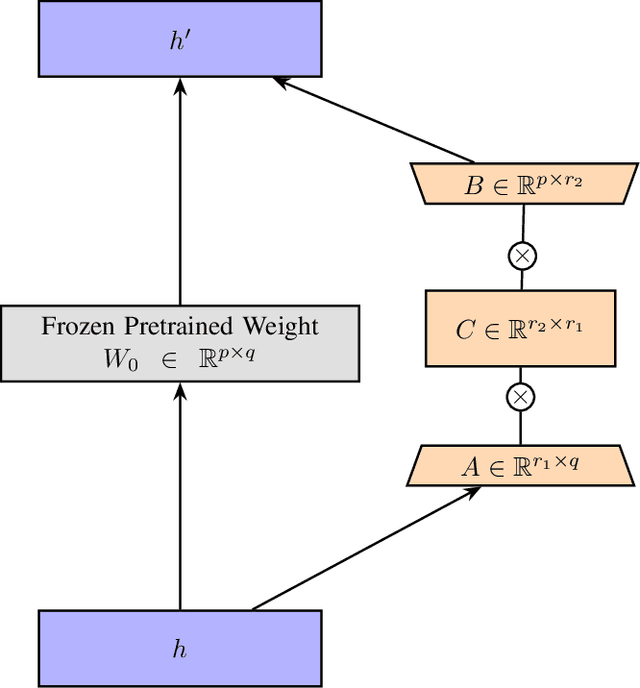
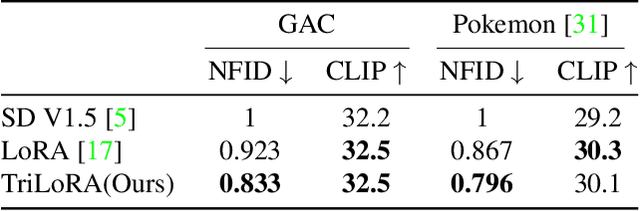
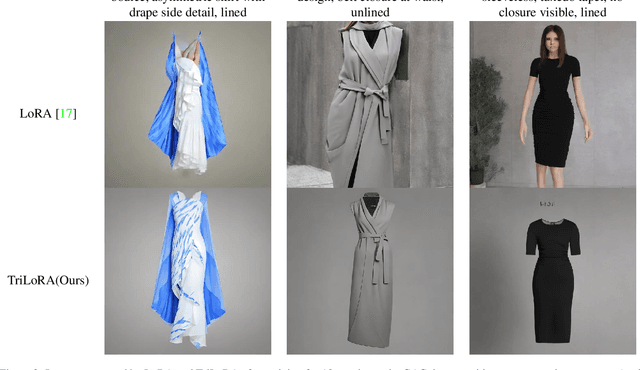
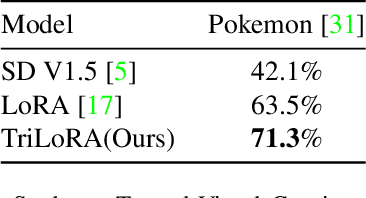
As deep learning technology continues to advance, image generation models, especially models like Stable Diffusion, are finding increasingly widespread application in visual arts creation. However, these models often face challenges such as overfitting, lack of stability in generated results, and difficulties in accurately capturing the features desired by creators during the fine-tuning process. In response to these challenges, we propose an innovative method that integrates Singular Value Decomposition (SVD) into the Low-Rank Adaptation (LoRA) parameter update strategy, aimed at enhancing the fine-tuning efficiency and output quality of image generation models. By incorporating SVD within the LoRA framework, our method not only effectively reduces the risk of overfitting but also enhances the stability of model outputs, and captures subtle, creator-desired feature adjustments more accurately. We evaluated our method on multiple datasets, and the results show that, compared to traditional fine-tuning methods, our approach significantly improves the model's generalization ability and creative flexibility while maintaining the quality of generation. Moreover, this method maintains LoRA's excellent performance under resource-constrained conditions, allowing for significant improvements in image generation quality without sacrificing the original efficiency and resource advantages.