 Add to Chrome
 Add to Firefox
 Add to Edge
Predicting Neuromodulation Outcome for Parkinson's Disease with Generative Virtual Brain Model
Mar 31, 2026
Parkinson's disease (PD) affects over ten million people worldwide. Although temporal interference (TI) and deep brain stimulation (DBS) are promising therapies, inter-individual variability limits empirical treatment selection, increasing non-negligible surgical risk and cost. Previous explorations either resort to limited statistical biomarkers that are insufficient to characterize variability, or employ AI-driven methods which is prone to overfitting and opacity. We bridge this gap with a pretraining-finetuning framework to predict outcomes directly from resting-state fMRI. Critically, a generative virtual brain foundation model, pretrained on a collective dataset (2707 subjects, 5621 sessions) to capture universal disorder patterns, was finetuned on PD cohorts receiving TI (n=51) or DBS (n=55) to yield individualized virtual brains with high fidelity to empirical functional connectivity (r=0.935). By constructing counterfactual estimations between pathological and healthy neural states within these personalized models, we predicted clinical responses (TI: AUPR=0.853; DBS: AUPR=0.915), substantially outperforming baselines. External and prospective validations (n=14, n=11) highlight the feasibility of clinical translation. Moreover, our framework provides state-dependent regional patterns linked to response, offering hypothesis-generating mechanistic insights.

A Long Short-term Memory Based Recurrent Neural Network for Interventional MRI Reconstruction
Apr 12, 2022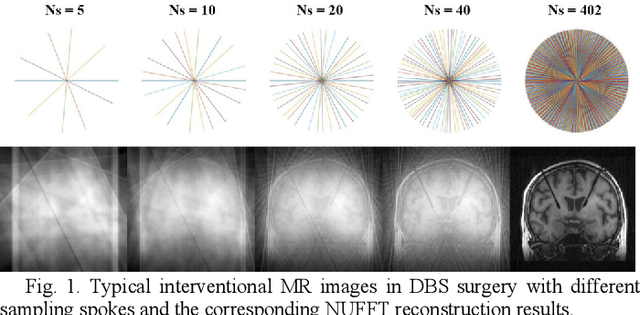
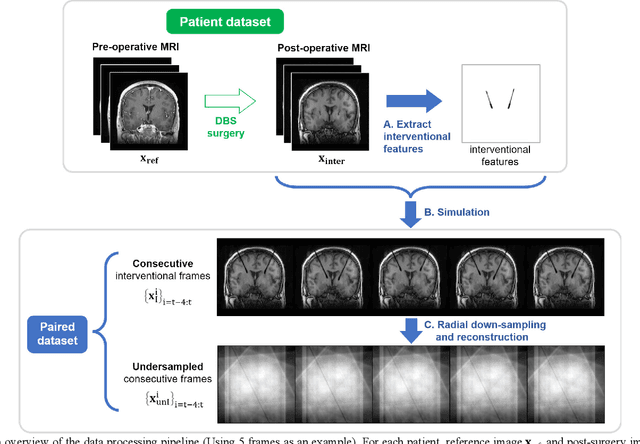
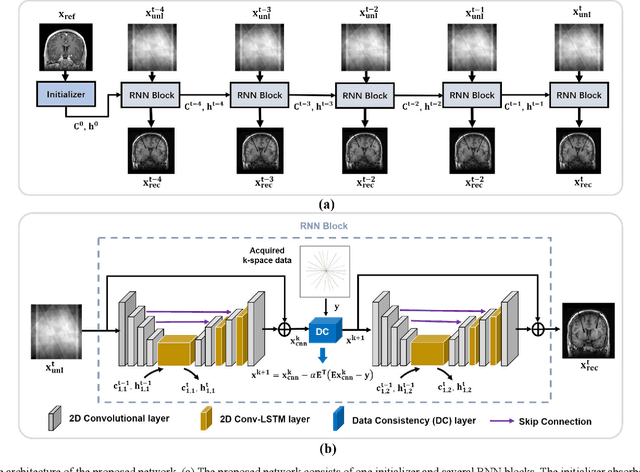
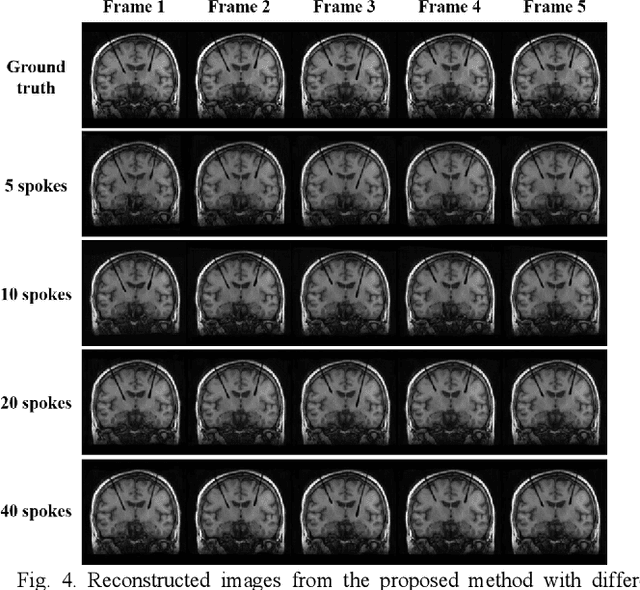
Interventional magnetic resonance imaging (i-MRI) for surgical guidance could help visualize the interventional process such as deep brain stimulation (DBS), improving the surgery performance and patient outcome. Different from retrospective reconstruction in conventional dynamic imaging, i-MRI for DBS has to acquire and reconstruct the interventional images sequentially online. Here we proposed a convolutional long short-term memory (Conv-LSTM) based recurrent neural network (RNN), or ConvLR, to reconstruct interventional images with golden-angle radial sampling. By using an initializer and Conv-LSTM blocks, the priors from the pre-operative reference image and intra-operative frames were exploited for reconstructing the current frame. Data consistency for radial sampling was implemented by a soft-projection method. To improve the reconstruction accuracy, an adversarial learning strategy was adopted. A set of interventional images based on the pre-operative and post-operative MR images were simulated for algorithm validation. Results showed with only 10 radial spokes, ConvLR provided the best performance compared with state-of-the-art methods, giving an acceleration up to 40 folds. The proposed algorithm has the potential to achieve real-time i-MRI for DBS and can be used for general purpose MR-guided intervention.