 Add to Chrome
 Add to Firefox
 Add to Edge
From Pixels to Tokens: A Systematic Study of Latent Action Supervision for Vision-Language-Action Models
May 06, 2026
Latent actions serve as an intermediate representation that enables consistent modeling of vision-language-action (VLA) models across heterogeneous datasets. However, approaches to supervising VLAs with latent actions are fragmented and lack a systematic comparison. This work structures the study of latent action supervision from two perspectives: (i) regularizing the trajectory via image-based latent actions, and (ii) unifying the target space with action-based latent actions. Under a unified VLA baseline, we instantiate and compare four representative integration strategies. Our results reveal a formulation-task correspondence: image-based latent actions benefit long-horizon reasoning and scene-level generalization, whereas action-based latent actions excel at complex motor coordination. Furthermore, we find that directly supervising the VLM with discrete latent action tokens yields the most effective performance. Finally, our experiments offer initial insights into the benefits of latent action supervision in mixed-data, suggesting a promising direction for VLA training. Code is available at https://github.com/RUCKBReasoning/From_Pixels_to_Tokens.

Graph Neural News Recommendation with Long-term and Short-term Interest Modeling
Nov 08, 2019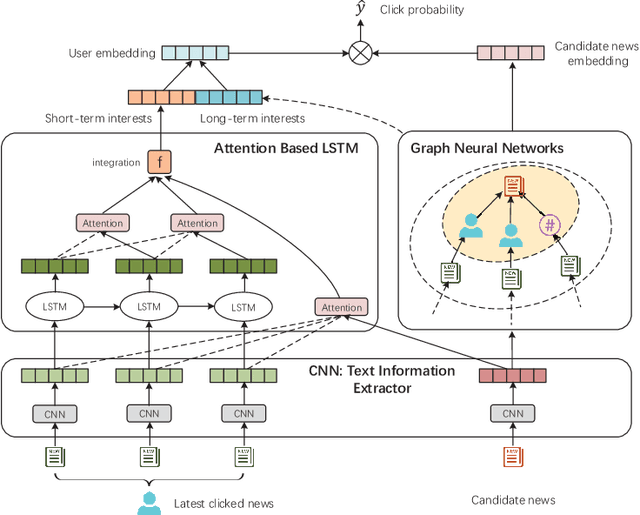
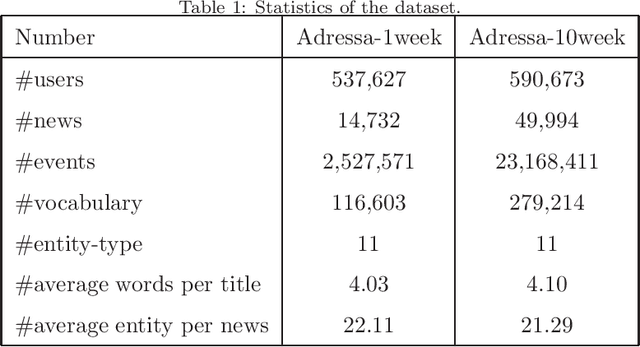
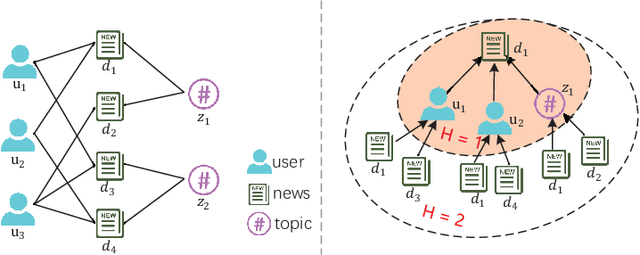
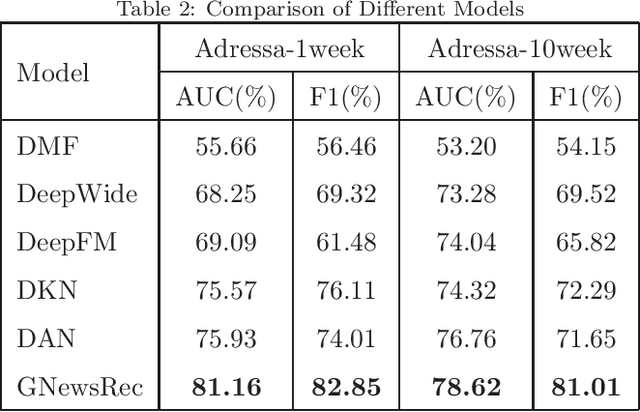
With the information explosion of news articles, personalized news recommendation has become important for users to quickly find news that they are interested in. Existing methods on news recommendation mainly include collaborative filtering methods which rely on direct user-item interactions and content based methods which characterize the content of user reading history. Although these methods have achieved good performances, they still suffer from data sparse problem, since most of them fail to extensively exploit high-order structure information (similar users tend to read similar news articles) in news recommendation systems. In this paper, we propose to build a heterogeneous graph to explicitly model the interactions among users, news and latent topics. The incorporated topic information would help indicate a user's interest and alleviate the sparsity of user-item interactions. Then we take advantage of graph neural networks to learn user and news representations that encode high-order structure information by propagating embeddings over the graph. The learned user embeddings with complete historic user clicks capture the users' long-term interests. We also consider a user's short-term interest using the recent reading history with an attention based LSTM model. Experimental results on real-world datasets show that our proposed model significantly outperforms state-of-the-art methods on news recommendation.