 Add to Chrome
 Add to Firefox
 Add to Edge
MBA: Multimodal Benchmark and Agents for Real-World Business Ideation
Aug 12, 2026
Agentic systems powered by large language models (LLMs) have opened new opportunities for business ideation. Yet existing approaches remain confined to a text-only paradigm, despite the inherently multimodal nature of real-world contexts. We thus introduce MBA-Bench, the first multimodal benchmark for training and evaluating business ideation agents, comprising 30K samples across six domains, each domain characterized by distinct visual cues not fully conveyed by text alone. Concretely, we automatically caption images and employ GPT-4o to generate five reference ideas for each of three business questions through retrieval query generation, market evidence retrieval, and evidence-augmented synthesis. Following prior work, we evaluate agents across six business-oriented criteria using MLLM-as-a-Judge. To consider settings where criteria are hidden or disclosed, we present MBA-b and MBA-k for blind and known, respectively. We train both with two novel reward objectives---creativity and feasibility---while MBA-k further optimizes the six disclosed criteria for eight in total. Both are trained via LoRA-based supervised fine-tuning followed by group relative policy optimization with these setting-specific rewards. For extensive experiments on MBA-Bench, we set up two baselines accommodating either captions only or multimodal inputs, with the latter nearing closed-source performance on several metrics. MBA-b and MBA-k outperform caption baselines by 63.9% and 77.1%, and multimodal baselines by 25.6% and 35.8%, respectively.

Open-Vocabulary BEV Segmentation with 3D-Aware Geometric Constraints
Jun 23, 2026Bird's-eye view (BEV) perception fuses multi-camera images into a unified top-down representation for autonomous driving. Despite recent progress, state-of-the-art methods remain confined to closed-set scenarios, making them vulnerable to unpredictable real-world environments. In this work, we introduce open-vocabulary BEV segmentation (OVBS), which leverages vision-language models (VLMs) to recognize categories beyond the training set while maintaining precise BEV perception and real-time efficiency. A key challenge in OVBS lies in the 3D geometric inconsistency inherent in the ill-posed lifting of 2D VLM semantics into BEV. To address this, we propose OVBEVSeg, a geometry-aware OVBS framework that enhances efficient Gaussian splatting (GS)-based unprojection by leveraging robust 3D geometric constraints across three progressive stages: (1) 2D-to-BEV pseudo-labeling via reliable 3D projection for OV generalization; (2) joint 2D-BEV per-scene optimization with BEV structural constraints for 3D geometric consistency; and (3) 3D geometric distillation for online efficiency. On the nuScenes dataset, OVBEVSeg achieves state-of-the-art performance, outperforming closed-set methods by 15.3 mIoU on unseen categories. Remarkably, even with no novel-class ground-truth labels, it remains competitive with self- and semi-supervised baselines trained with up to 40% of ground-truth annotations. Furthermore, it achieves 2.5x faster inference with only 0.22x the memory consumption of projection-based methods. Project page: https://hchoi256.github.io/projects/ovbevseg/.
FinDER: Financial Dataset for Question Answering and Evaluating Retrieval-Augmented Generation
Apr 22, 2025In the fast-paced financial domain, accurate and up-to-date information is critical to addressing ever-evolving market conditions. Retrieving this information correctly is essential in financial Question-Answering (QA), since many language models struggle with factual accuracy in this domain. We present FinDER, an expert-generated dataset tailored for Retrieval-Augmented Generation (RAG) in finance. Unlike existing QA datasets that provide predefined contexts and rely on relatively clear and straightforward queries, FinDER focuses on annotating search-relevant evidence by domain experts, offering 5,703 query-evidence-answer triplets derived from real-world financial inquiries. These queries frequently include abbreviations, acronyms, and concise expressions, capturing the brevity and ambiguity common in the realistic search behavior of professionals. By challenging models to retrieve relevant information from large corpora rather than relying on readily determined contexts, FinDER offers a more realistic benchmark for evaluating RAG systems. We further present a comprehensive evaluation of multiple state-of-the-art retrieval models and Large Language Models, showcasing challenges derived from a realistic benchmark to drive future research on truthful and precise RAG in the financial domain.
Sampling Bag of Views for Open-Vocabulary Object Detection
Dec 24, 2024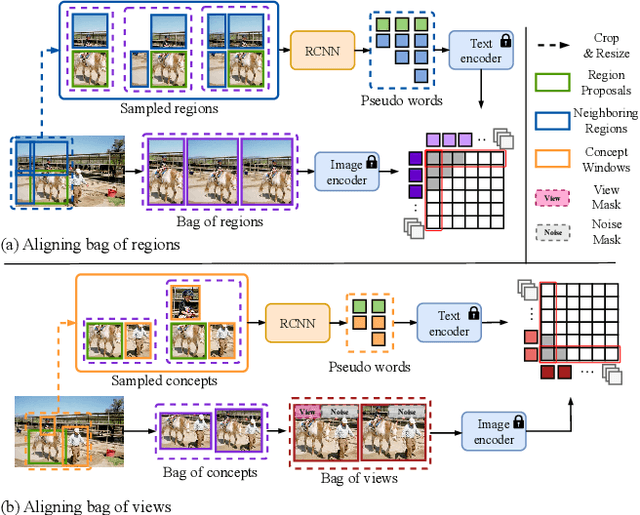
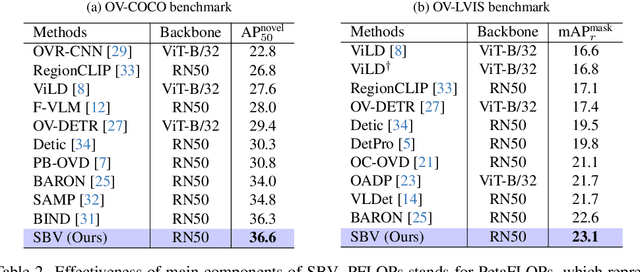
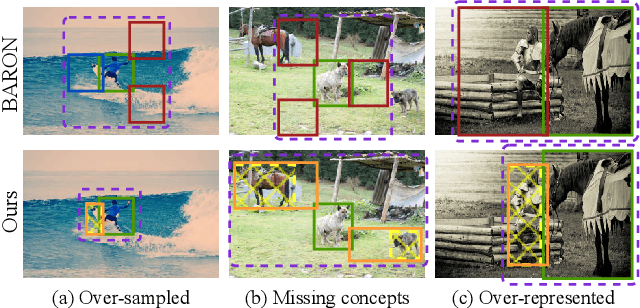

Existing open-vocabulary object detection (OVD) develops methods for testing unseen categories by aligning object region embeddings with corresponding VLM features. A recent study leverages the idea that VLMs implicitly learn compositional structures of semantic concepts within the image. Instead of using an individual region embedding, it utilizes a bag of region embeddings as a new representation to incorporate compositional structures into the OVD task. However, this approach often fails to capture the contextual concepts of each region, leading to noisy compositional structures. This results in only marginal performance improvements and reduced efficiency. To address this, we propose a novel concept-based alignment method that samples a more powerful and efficient compositional structure. Our approach groups contextually related ``concepts'' into a bag and adjusts the scale of concepts within the bag for more effective embedding alignment. Combined with Faster R-CNN, our method achieves improvements of 2.6 box AP50 and 0.5 mask AP over prior work on novel categories in the open-vocabulary COCO and LVIS benchmarks. Furthermore, our method reduces CLIP computation in FLOPs by 80.3% compared to previous research, significantly enhancing efficiency. Experimental results demonstrate that the proposed method outperforms previous state-of-the-art models on the OVD datasets.
Explore, Select, Derive, and Recall: Augmenting LLM with Human-like Memory for Mobile Task Automation
Dec 04, 2023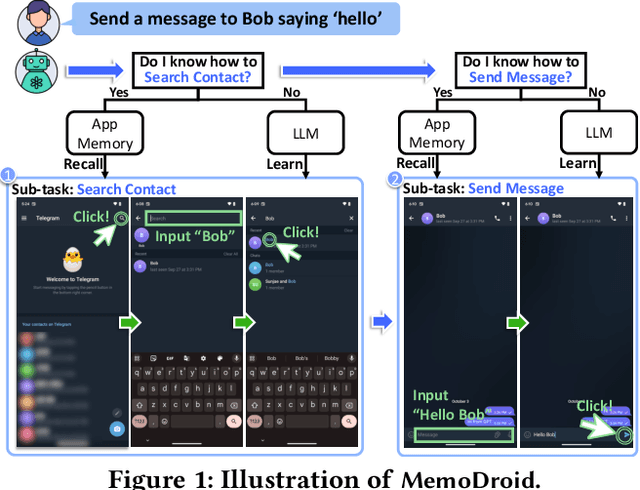

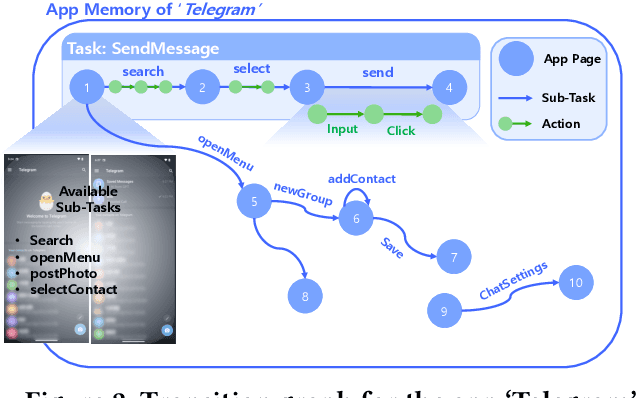

The advent of large language models (LLMs) has opened up new opportunities in the field of mobile task automation. Their superior language understanding and reasoning capabilities allow users to automate complex and repetitive tasks. However, due to the inherent unreliability and high operational cost of LLMs, their practical applicability is quite limited. To address these issues, this paper introduces MemoDroid, an innovative LLM-based mobile task automator enhanced with a unique app memory. MemoDroid emulates the cognitive process of humans interacting with a mobile app -- explore, select, derive, and recall. This approach allows for a more precise and efficient learning of a task's procedure by breaking it down into smaller, modular components that can be re-used, re-arranged, and adapted for various objectives. We implement MemoDroid using online LLMs services (GPT-3.5 and GPT-4) and evaluate its performance on 50 unique mobile tasks across 5 widely used mobile apps. The results indicate that MemoDroid can adapt learned tasks to varying contexts with 100% accuracy and reduces their latency and cost by 69.22% and 77.36% compared to a GPT-4 powered baseline.
Knowledge-preserving Pruning for Pre-trained Language Models without Retraining
Aug 07, 2023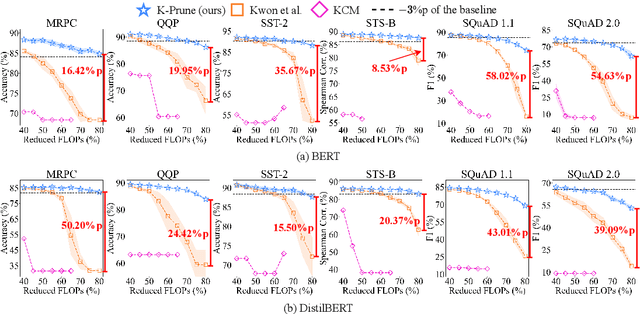
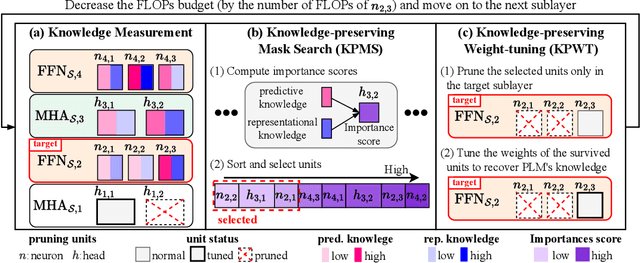
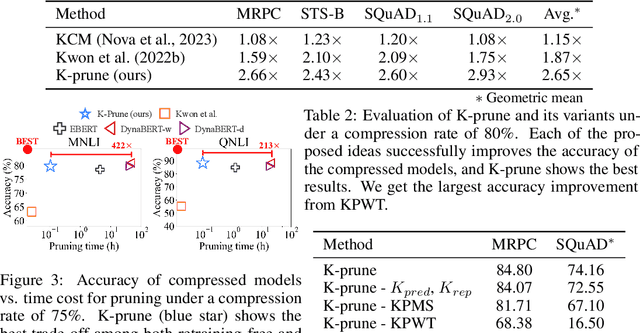
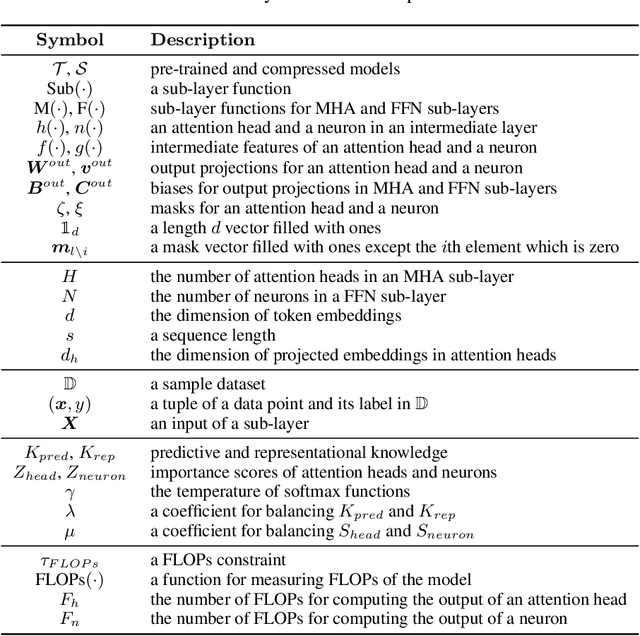
Given a pre-trained language model, how can we efficiently compress it without retraining? Retraining-free structured pruning algorithms are crucial in pre-trained language model compression due to their significantly reduced pruning cost and capability to prune large language models. However, existing retraining-free algorithms encounter severe accuracy degradation, as they fail to preserve the useful knowledge of pre-trained models. In this paper, we propose K-pruning (Knowledge-preserving pruning), an accurate retraining-free structured pruning algorithm for pre-trained language models. K-pruning identifies and prunes attention heads and neurons deemed to be superfluous, based on the amount of their inherent knowledge. K-pruning applies an iterative process of pruning followed by knowledge reconstruction for each sub-layer to preserve the knowledge of the pre-trained models. Consequently, K-pruning shows up to 58.02%p higher F1 score than existing retraining-free pruning algorithms under a high compression rate of 80% on the SQuAD benchmark.