 Add to Chrome
 Add to Firefox
 Add to Edge
Stumbling Into AI Emotional Dependence: How Routine AI Interactions Reshape Human Connection
Jun 02, 2026
Public discourse and emerging policy typically assume that AI emotional support is a deliberate act: a lonely user consciously seeking comfort from a dedicated companion chatbot. In this paper, we draw on emerging empirical evidence and argue that this picture is inaccurate on two accounts, both in how AI emotional support arises and how it shapes future behavior. First, AI emotional support commonly emerges incidentally within task-oriented interactions on general-purpose platforms, much as workplace friendships deepen through collaboration. Second, these incidental encounters are path-dependent: positive experiences of AI emotional support update people's beliefs about AI's emotional capabilities and redirect their choices for future emotional support, increasing preference for AI and decreasing preference for humans. We review recent evidence, including a large-scale longitudinal study conducted in collaboration with OpenAI, showing that daily five-minute conversations with an AI about personal issues over 28 days led to a 10.3% decrease in the preference for seeking support from humans and an 11.6% increase in the preference for AI. These findings suggest that current policy, focused on companion apps and isolated interactions, cannot adequately protect human connection. Instead, effective regulations should extend to general-purpose AI systems and address cumulative, trajectory-level changes in how people seek support. Recognizing how people stumble into AI emotional support and how those encounters redirect human connections over time is essential to safeguarding human well-being.

ThoughtTrace: Understanding User Thoughts in Real-World LLM Interactions
May 19, 2026Conversational AI has now reached billions of users, yet existing datasets capture only what people say, not what they think. We introduce ThoughtTrace, the first large-scale dataset that pairs real-world multi-turn human--AI conversations with users' self-reported thoughts: their reasons for sending prompts and reactions to assistant responses. ThoughtTrace comprises 1,058 users, 2,155 conversations, 17,058 turns, and 10,174 thought annotations collected across 20 language models. Our analysis shows that ThoughtTrace captures long-horizon, topically diverse interactions, and that thoughts are semantically distinct from messages, difficult for frontier LLMs to infer from context, diverse in content, and tied to conversation stages. We further demonstrate the utility of thoughts for downstream modeling. First, thoughts improve user-behavior prediction as inference-time context. Second, thought-guided rewrites provide fine-grained alignment signals for training personalized assistants. Together, ThoughtTrace establishes user thoughts as a new data modality for studying the cognitive dynamics behind human--AI interaction and provides a foundation for building assistants that better understand and adapt to users' latent goals, preferences, and needs.
EmoSign: A Multimodal Dataset for Understanding Emotions in American Sign Language
May 20, 2025Unlike spoken languages where the use of prosodic features to convey emotion is well studied, indicators of emotion in sign language remain poorly understood, creating communication barriers in critical settings. Sign languages present unique challenges as facial expressions and hand movements simultaneously serve both grammatical and emotional functions. To address this gap, we introduce EmoSign, the first sign video dataset containing sentiment and emotion labels for 200 American Sign Language (ASL) videos. We also collect open-ended descriptions of emotion cues. Annotations were done by 3 Deaf ASL signers with professional interpretation experience. Alongside the annotations, we include baseline models for sentiment and emotion classification. This dataset not only addresses a critical gap in existing sign language research but also establishes a new benchmark for understanding model capabilities in multimodal emotion recognition for sign languages. The dataset is made available at https://huggingface.co/datasets/catfang/emosign.
Investigating Affective Use and Emotional Well-being on ChatGPT
Apr 04, 2025As AI chatbots see increased adoption and integration into everyday life, questions have been raised about the potential impact of human-like or anthropomorphic AI on users. In this work, we investigate the extent to which interactions with ChatGPT (with a focus on Advanced Voice Mode) may impact users' emotional well-being, behaviors and experiences through two parallel studies. To study the affective use of AI chatbots, we perform large-scale automated analysis of ChatGPT platform usage in a privacy-preserving manner, analyzing over 3 million conversations for affective cues and surveying over 4,000 users on their perceptions of ChatGPT. To investigate whether there is a relationship between model usage and emotional well-being, we conduct an Institutional Review Board (IRB)-approved randomized controlled trial (RCT) on close to 1,000 participants over 28 days, examining changes in their emotional well-being as they interact with ChatGPT under different experimental settings. In both on-platform data analysis and the RCT, we observe that very high usage correlates with increased self-reported indicators of dependence. From our RCT, we find that the impact of voice-based interactions on emotional well-being to be highly nuanced, and influenced by factors such as the user's initial emotional state and total usage duration. Overall, our analysis reveals that a small number of users are responsible for a disproportionate share of the most affective cues.
Enabling Waypoint Generation for Collaborative Robots using LLMs and Mixed Reality
Mar 14, 2024

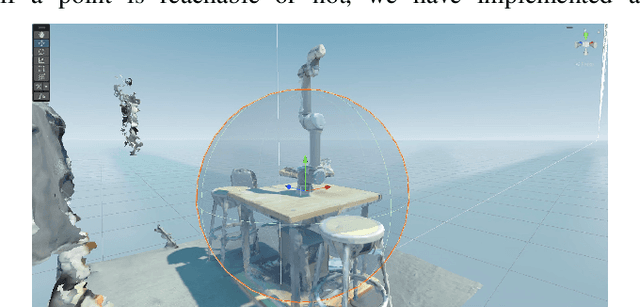

Programming a robotic is a complex task, as it demands the user to have a good command of specific programming languages and awareness of the robot's physical constraints. We propose a framework that simplifies robot deployment by allowing direct communication using natural language. It uses large language models (LLM) for prompt processing, workspace understanding, and waypoint generation. It also employs Augmented Reality (AR) to provide visual feedback of the planned outcome. We showcase the effectiveness of our framework with a simple pick-and-place task, which we implement on a real robot. Moreover, we present an early concept of expressive robot behavior and skill generation that can be used to communicate with the user and learn new skills (e.g., object grasping).
Real-time Animation Generation and Control on Rigged Models via Large Language Models
Oct 27, 2023


We introduce a novel method for real-time animation control and generation on rigged models using natural language input. First, we embed a large language model (LLM) in Unity to output structured texts that can be parsed into diverse and realistic animations. Second, we illustrate LLM's potential to enable flexible state transition between existing animations. We showcase the robustness of our approach through qualitative results on various rigged models and motions.
LLMR: Real-time Prompting of Interactive Worlds using Large Language Models
Sep 21, 2023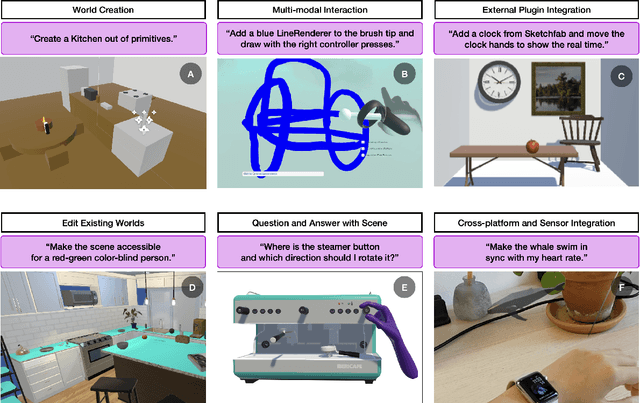

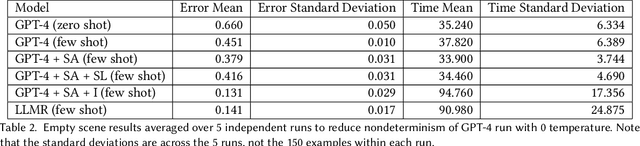
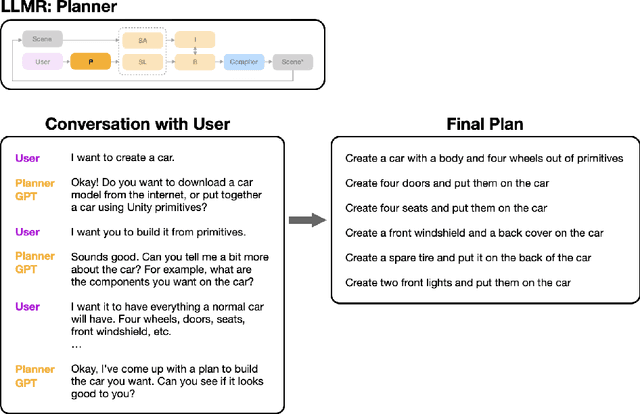
We present Large Language Model for Mixed Reality (LLMR), a framework for the real-time creation and modification of interactive Mixed Reality experiences using LLMs. LLMR leverages novel strategies to tackle difficult cases where ideal training data is scarce, or where the design goal requires the synthesis of internal dynamics, intuitive analysis, or advanced interactivity. Our framework relies on text interaction and the Unity game engine. By incorporating techniques for scene understanding, task planning, self-debugging, and memory management, LLMR outperforms the standard GPT-4 by 4x in average error rate. We demonstrate LLMR's cross-platform interoperability with several example worlds, and evaluate it on a variety of creation and modification tasks to show that it can produce and edit diverse objects, tools, and scenes. Finally, we conducted a usability study (N=11) with a diverse set that revealed participants had positive experiences with the system and would use it again.