 Add to Chrome
 Add to Firefox
 Add to Edge
DRONEAUDIONET: Noise Suppression for Drone Audition-based Search and Rescue
Aug 01, 2026
Microphones mounted on UAVs enable aerial acoustic scene analysis applications such as search-and-rescue, wildlife monitoring, and industrial inspection. However, drone rotor noise often dominates the mixture signal at SNRs well below -10 dB, making source recovery extremely challenging. Existing enhancement and source separation methods are typically designed for near-balanced mixtures and degrade substantially in drone audition settings. In this work, we propose DRONEAUDIONET, a drone noise suppression method that reframes a source separation model as a drone noise estimator. To better model drone-dominant mixtures, we introduce a learnable mask-scaling mechanism that allows mask magnitudes beyond unity, together with an additive residual correction term for improved drone estimation and source recovery. We train and evaluate our model on a publicly available drone audition dataset and test generalizability on an out-of-domain dataset with unseen drone hardware and flight modes. Results show that DRONEAUDIONET consistently improves downstream sound classification performance, with the largest gains observed for human vocal sounds. Our findings demonstrate the importance of drone-specific modeling for robust aerial acoustic perception and highlight the potential of source separation methods for real-world drone-assisted search-and-rescue.

Two-Stage Multimodal Framework for Emotion Mimicry Intensity Prediction
May 21, 2026We present our submission to the Hume-ABAW10 Emotional Mimicry Intensity (EMI) Challenge, which aims to predict six continuous emotion intensity dimensions: Admiration, Amusement, Determination, Empathic Pain, Excitement, and Joy, from in-the-wild multimodal video clips. We propose a staged multimodal framework that combines textual, acoustic, and visual representations, with an optional motion branch. Our approach first trains modality-specific encoders independently and then fuses their learned representations through a lightweight regressor with modality dropout and controlled encoder adaptation. Across our submitted systems, the best validation performance is obtained by the text--audio--vision--motion fusion model under the expanded 4:1 split, achieving an average Pearson correlation of 0.4722. Although the motion branch yields only very slight gains, its behavior can be interesting to study. Our team was placed third in the EMI challenge, achieving an average Pearson correlation of 0.57 for the test set. Overall, we provide a practical and reproducible baseline for EMI prediction.
Beyond Descriptions: A Generative Scene2Audio Framework for Blind and Low-Vision Users to Experience Vista Landscapes
Mar 28, 2026Current scene perception tools for Blind and Low Vision (BLV) individuals rely on spoken descriptions but lack engaging representations of visually pleasing distant environmental landscapes (Vista spaces). Our proposed Scene2Audio framework generates comprehensible and enjoyable nonverbal audio using generative models informed by psychoacoustics, and principles of scene audio composition. Through a user study with 11 BLV participants, we found that combining the Scene2Audio sounds with speech creates a better experience than speech alone, as the sound effects complement the speech making the scene easier to imagine. A mobile app "in-the-wild" study with 7 BLV users for more than a week further showed the potential of Scene2Audio in enhancing outdoor scene experiences. Our work bridges the gap between visual and auditory scene perception by moving beyond purely descriptive aids, addressing the aesthetic needs of BLV users.
EmoSign: A Multimodal Dataset for Understanding Emotions in American Sign Language
May 20, 2025Unlike spoken languages where the use of prosodic features to convey emotion is well studied, indicators of emotion in sign language remain poorly understood, creating communication barriers in critical settings. Sign languages present unique challenges as facial expressions and hand movements simultaneously serve both grammatical and emotional functions. To address this gap, we introduce EmoSign, the first sign video dataset containing sentiment and emotion labels for 200 American Sign Language (ASL) videos. We also collect open-ended descriptions of emotion cues. Annotations were done by 3 Deaf ASL signers with professional interpretation experience. Alongside the annotations, we include baseline models for sentiment and emotion classification. This dataset not only addresses a critical gap in existing sign language research but also establishes a new benchmark for understanding model capabilities in multimodal emotion recognition for sign languages. The dataset is made available at https://huggingface.co/datasets/catfang/emosign.
Navigating the State of Cognitive Flow: Context-Aware AI Interventions for Effective Reasoning Support
Apr 22, 2025Flow theory describes an optimal cognitive state where individuals experience deep focus and intrinsic motivation when a task's difficulty aligns with their skill level. In AI-augmented reasoning, interventions that disrupt the state of cognitive flow can hinder rather than enhance decision-making. This paper proposes a context-aware cognitive augmentation framework that adapts interventions based on three key contextual factors: type, timing, and scale. By leveraging multimodal behavioral cues (e.g., gaze behavior, typing hesitation, interaction speed), AI can dynamically adjust cognitive support to maintain or restore flow. We introduce the concept of cognitive flow, an extension of flow theory in AI-augmented reasoning, where interventions are personalized, adaptive, and minimally intrusive. By shifting from static interventions to context-aware augmentation, our approach ensures that AI systems support deep engagement in complex decision-making and reasoning without disrupting cognitive immersion.
* Presented at the 2025 ACM Workshop on Human-AI Interaction for Augmented Reasoning, Report Number: CHI25-WS-AUGMENTED-REASONING
MorphFader: Enabling Fine-grained Controllable Morphing with Text-to-Audio Models
Aug 14, 2024Sound morphing is the process of gradually and smoothly transforming one sound into another to generate novel and perceptually hybrid sounds that simultaneously resemble both. Recently, diffusion-based text-to-audio models have produced high-quality sounds using text prompts. However, granularly controlling the semantics of the sound, which is necessary for morphing, can be challenging using text. In this paper, we propose \textit{MorphFader}, a controllable method for morphing sounds generated by disparate prompts using text-to-audio models. By intercepting and interpolating the components of the cross-attention layers within the diffusion process, we can create smooth morphs between sounds generated by different text prompts. Using both objective metrics and perceptual listening tests, we demonstrate the ability of our method to granularly control the semantics in the sound and generate smooth morphs.
EMO-KNOW: A Large Scale Dataset on Emotion and Emotion-cause
Jun 18, 2024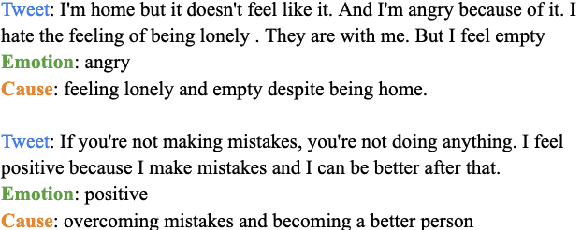
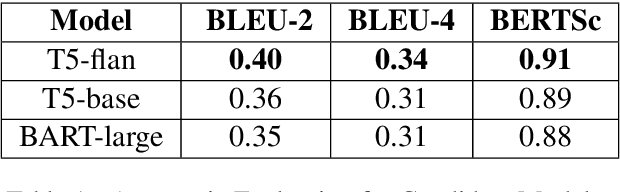
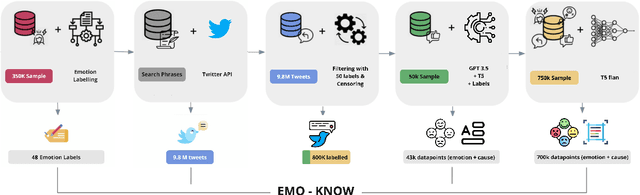

Emotion-Cause analysis has attracted the attention of researchers in recent years. However, most existing datasets are limited in size and number of emotion categories. They often focus on extracting parts of the document that contain the emotion cause and fail to provide more abstractive, generalizable root cause. To bridge this gap, we introduce a large-scale dataset of emotion causes, derived from 9.8 million cleaned tweets over 15 years. We describe our curation process, which includes a comprehensive pipeline for data gathering, cleaning, labeling, and validation, ensuring the dataset's reliability and richness. We extract emotion labels and provide abstractive summarization of the events causing emotions. The final dataset comprises over 700,000 tweets with corresponding emotion-cause pairs spanning 48 emotion classes, validated by human evaluators. The novelty of our dataset stems from its broad spectrum of emotion classes and the abstractive emotion cause that facilitates the development of an emotion-cause knowledge graph for nuanced reasoning. Our dataset will enable the design of emotion-aware systems that account for the diverse emotional responses of different people for the same event.
* Accepted to Findings of EMNLP 2023
Example-Based Framework for Perceptually Guided Audio Texture Generation
Aug 23, 2023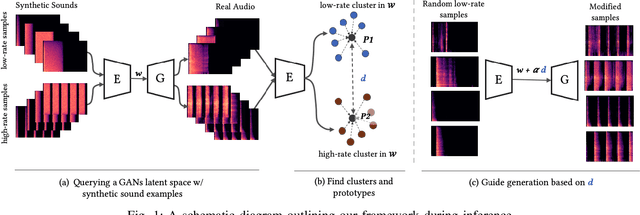
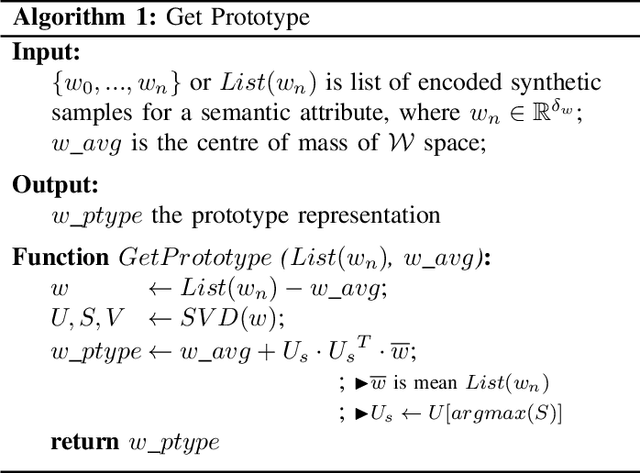

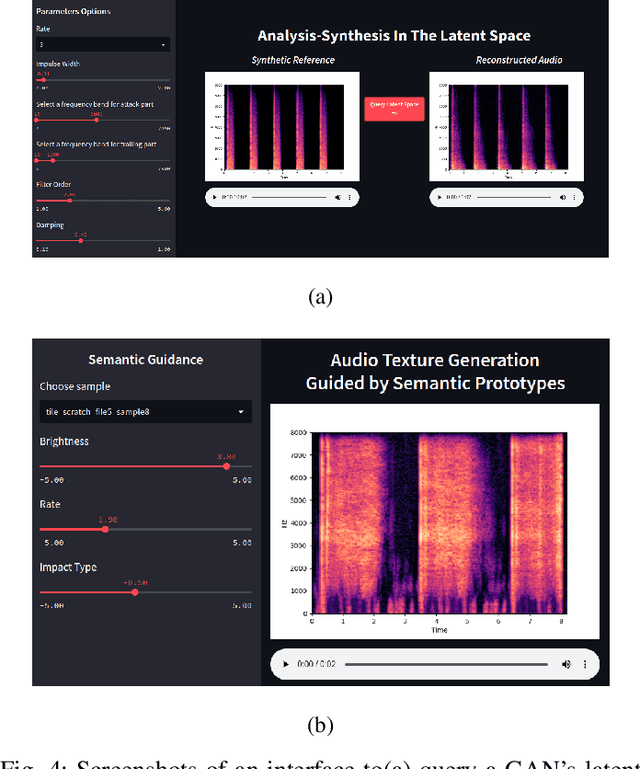
Generative models for synthesizing audio textures explicitly encode controllability by conditioning the model with labelled data. While datasets for audio textures can be easily recorded in-the-wild, semantically labeling them is expensive, time-consuming, and prone to errors due to human annotator subjectivity. Thus, to control generation, there is a need to automatically infer user-defined perceptual factors of variation in the latent space of a generative model while modelling unlabeled textures. In this paper, we propose an example-based framework to determine vectors to guide texture generation based on user-defined semantic attributes. By synthesizing a few synthetic examples to indicate the presence or absence of a semantic attribute, we can infer the guidance vectors in the latent space of a generative model to control that attribute during generation. Our results show that our method is capable of finding perceptually relevant and deterministic guidance vectors for controllable generation for both discrete as well as continuous textures. Furthermore, we demonstrate the application of this method to other tasks such as selective semantic attribute transfer.
VR.net: A Real-world Dataset for Virtual Reality Motion Sickness Research
Jun 06, 2023Researchers have used machine learning approaches to identify motion sickness in VR experience. These approaches demand an accurately-labeled, real-world, and diverse dataset for high accuracy and generalizability. As a starting point to address this need, we introduce `VR.net', a dataset offering approximately 12-hour gameplay videos from ten real-world games in 10 diverse genres. For each video frame, a rich set of motion sickness-related labels, such as camera/object movement, depth field, and motion flow, are accurately assigned. Building such a dataset is challenging since manual labeling would require an infeasible amount of time. Instead, we utilize a tool to automatically and precisely extract ground truth data from 3D engines' rendering pipelines without accessing VR games' source code. We illustrate the utility of VR.net through several applications, such as risk factor detection and sickness level prediction. We continuously expand VR.net and envision its next version offering 10X more data than the current form. We believe that the scale, accuracy, and diversity of VR.net can offer unparalleled opportunities for VR motion sickness research and beyond.
Towards Controllable Audio Texture Morphing
Apr 23, 2023In this paper, we propose a data-driven approach to train a Generative Adversarial Network (GAN) conditioned on "soft-labels" distilled from the penultimate layer of an audio classifier trained on a target set of audio texture classes. We demonstrate that interpolation between such conditions or control vectors provides smooth morphing between the generated audio textures, and shows similar or better audio texture morphing capability compared to the state-of-the-art methods. The proposed approach results in a well-organized latent space that generates novel audio outputs while remaining consistent with the semantics of the conditioning parameters. This is a step towards a general data-driven approach to designing generative audio models with customized controls capable of traversing out-of-distribution regions for novel sound synthesis.