 Add to Chrome
 Add to Firefox
 Add to Edge
Towards Expert-level Medical AI for Real-time Video Consultations
Aug 10, 2026
Audio-visual interaction is the standard for patient-physician consultations, enabling natural communication and effective assessment of illness through non-verbal cues. While text-based AI has shown promise, it discards essential perceptual dimensions and limits patients who cannot articulate symptoms in writing. Early efforts to extend medical AI to audio-visual interaction have demonstrated feasibility but not reached clinician-level performance. Here, we provide the first demonstration of expert-level AI in real-time clinical video consultations using AMIE (Articulate Medical Intelligence Explorer) in a video configuration. AMIE (Video) is a Gemini-based multi-agent system integrating low-latency dialogue, clinical reasoning, and real-time audio-visual perception. To guide development, we established a taxonomy and automated evaluations for clinical audio-visual cues in telehealth settings. In a randomized Objective Structured Clinical Examination (OSCE) study with 30 primary care physicians (PCPs), 15 patient actors and 100 clinical scenarios, we compared AMIE (Video), its text-only counterpart AMIE (Text), and PCPs consulting via video. Clinical evaluators rated AMIE (Video) on par or better than PCPs in history-taking, diagnosis, management, and physical observation and examination. Patient actors preferred AMIE's approach to assessing and explaining conditions, while PCPs were preferred for rapport and partnership building. In modality ablation, patient actors preferred AMIE (Video)'s interface over text chat for communicative effectiveness, convenience, and feeling understood. Limitations remain in fine anatomical precision, subtle affective nuances, and high-frequency movements. While further research is needed before real-world translation, these results mark an important milestone toward AI systems capable of augmenting care across the sensory complexity of clinical practice.

ResidencyRL: Reinforcement Learning in Simulated Clinical Environments
Aug 07, 2026In medical education, physicians convert academic knowledge into clinical expertise through residency: years of training across thousands of encounters, with diverse sources of feedback and progressively greater autonomy. Much of clinical reasoning relies on the patient encounter, a dialogue in which a clinician elicits history, refines diagnostic hypotheses, and decides management under uncertainty. While large language models (LLMs) excel on static medical benchmarks, methods to optimize the full sequence of clinical decisions remain underdeveloped. We present ResidencyRL, a reinforcement learning (RL) method for training clinical artificial intelligence (AI) agents through simulated multi-turn clinical encounters (up to 60 dialogue turns and 8 tool calls per trajectory). ResidencyRL pairs the policy agent with LLM simulators capable of complex, adversarial behaviors, training against a structured reward aligned to diagnostic accuracy, management quality, communication, documentation, and safety. On held-out evaluations, the ResidencyRL agent improves diagnostic accuracy by 7.0% under adversarial conditions (88.0% vs. 81.0%) and reduces missed red flag rates by 31%, demonstrating rigorous mitigation of premature closure. Blinded expert clinicians validated these gains, preferring the trained agent in 87.6% of side-by-side comparisons. The procedural competencies transfer to unseen benchmarks: the agent outperforms the base model across all six clinical axes of the AMIE multi-visit benchmark, and shows consistent directional improvements on AgentClinic and CRAFT-MD. Our findings demonstrate that sequential clinical decision-making can be effectively learned through multi-turn RL in simulation, yielding robust, generalizable capabilities, paving the way towards clinical mastery. Prospective validation with real-world workflows remains necessary to establish clinical utility.
Gemini 1.5: Unlocking multimodal understanding across millions of tokens of context
Mar 08, 2024In this report, we present the latest model of the Gemini family, Gemini 1.5 Pro, a highly compute-efficient multimodal mixture-of-experts model capable of recalling and reasoning over fine-grained information from millions of tokens of context, including multiple long documents and hours of video and audio. Gemini 1.5 Pro achieves near-perfect recall on long-context retrieval tasks across modalities, improves the state-of-the-art in long-document QA, long-video QA and long-context ASR, and matches or surpasses Gemini 1.0 Ultra's state-of-the-art performance across a broad set of benchmarks. Studying the limits of Gemini 1.5 Pro's long-context ability, we find continued improvement in next-token prediction and near-perfect retrieval (>99%) up to at least 10M tokens, a generational leap over existing models such as Claude 2.1 (200k) and GPT-4 Turbo (128k). Finally, we highlight surprising new capabilities of large language models at the frontier; when given a grammar manual for Kalamang, a language with fewer than 200 speakers worldwide, the model learns to translate English to Kalamang at a similar level to a person who learned from the same content.
Gemini: A Family of Highly Capable Multimodal Models
Dec 19, 2023This report introduces a new family of multimodal models, Gemini, that exhibit remarkable capabilities across image, audio, video, and text understanding. The Gemini family consists of Ultra, Pro, and Nano sizes, suitable for applications ranging from complex reasoning tasks to on-device memory-constrained use-cases. Evaluation on a broad range of benchmarks shows that our most-capable Gemini Ultra model advances the state of the art in 30 of 32 of these benchmarks - notably being the first model to achieve human-expert performance on the well-studied exam benchmark MMLU, and improving the state of the art in every one of the 20 multimodal benchmarks we examined. We believe that the new capabilities of Gemini models in cross-modal reasoning and language understanding will enable a wide variety of use cases and we discuss our approach toward deploying them responsibly to users.
The Language Interpretability Tool: Extensible, Interactive Visualizations and Analysis for NLP Models
Aug 12, 2020


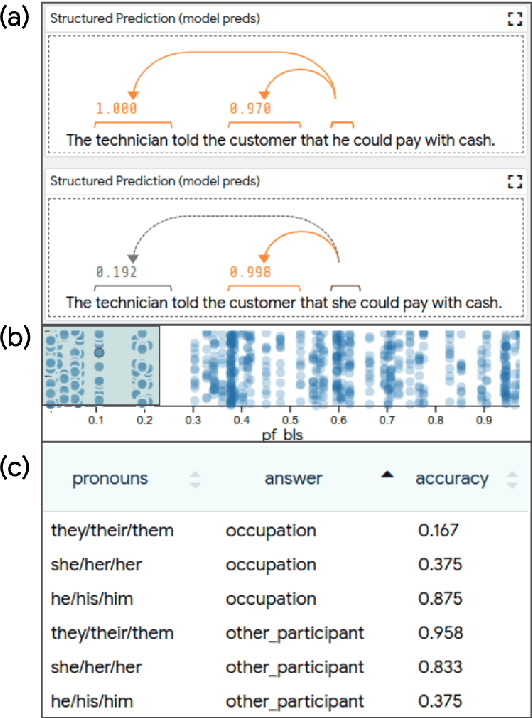
We present the Language Interpretability Tool (LIT), an open-source platform for visualization and understanding of NLP models. We focus on core questions about model behavior: Why did my model make this prediction? When does it perform poorly? What happens under a controlled change in the input? LIT integrates local explanations, aggregate analysis, and counterfactual generation into a streamlined, browser-based interface to enable rapid exploration and error analysis. We include case studies for a diverse set of workflows, including exploring counterfactuals for sentiment analysis, measuring gender bias in coreference systems, and exploring local behavior in text generation. LIT supports a wide range of models--including classification, seq2seq, and structured prediction--and is highly extensible through a declarative, framework-agnostic API. LIT is under active development, with code and full documentation available at https://github.com/pair-code/lit.