 Add to Chrome
 Add to Firefox
 Add to Edge
Constitutional Midtraining: Content Presence Drives Alignment Gains
Jul 29, 2026
Post-training alignment is often shallow, eroding under fine-tuning. Whether midtraining interventions, cleanly isolated from post-training, can produce durable alignment remains untested. We test this via constitutional midtraining: inserting principled, values-based content into midtraining against a replay-only control at 120B scale. Our 394M-token constitutional corpus, built from Anthropic's Constitution, uses a 2x2 factorial design (curriculum ordering x deliberative reasoning) to produce four constitutionally midtrained conditions plus a control, evaluated on self-generated and established benchmarks including alignment under pressure, value conflict resolution, blackmail, and emergent misalignment across three stages: post-midtraining, post-SFT, and post-benign fine-tuning. Constitutionally midtrained models outperform the control on alignment generalization and durability, notably on blackmail: SFT instills a blackmail propensity in all models, but constitutional midtraining blunts it, with the advantage surviving benign fine-tuning (-17.5pp). This durability does not extend to settings requiring active resistance to in-context pressure or conflict, where the advantage attenuates after SFT. The presence of constitutional content at midtraining also matters more than its structure, and constitutional midtraining incurs no cost, on average, on the capabilities we test (MMLU, ARC-Easy, piqa, GSM8K) at any stage. A modest amount of constitutional content at midtraining could therefore yield broad, persistent alignment gains, offering a cheap, complementary addition to SFT-centered pipelines. Code, data, and models are available.

A transformer architecture alteration to incentivise externalised reasoning
Mar 22, 2026We propose a new architectural change, and post-training pipeline, for making LLMs more verbose reasoners by teaching a model to truncate forward passes early. We augment an existing transformer architecture with an early-exit mechanism at intermediate layers and train the model to exit at shallower layers when the next token can be predicted without deep computation. After a calibration stage, we incentivise the model to exit as early as possible while maintaining task performance using reinforcement learning. We provide preliminary results to this effect for small reasoning models, showing that they learn to adaptively reduce computations across tokens. We predict that, applied at the right scale, our approach can minimise the amount of excess computation that reasoning models have at their disposal to perform non-myopic planning using their internal activations, reserving this only for difficult-to-predict tokens.
Diagnosing Pathological Chain-of-Thought in Reasoning Models
Feb 14, 2026Chain-of-thought (CoT) reasoning is fundamental to modern LLM architectures and represents a critical intervention point for AI safety. However, CoT reasoning may exhibit failure modes that we note as pathologies, which prevent it from being useful for monitoring. Prior work has identified three distinct pathologies: post-hoc rationalization, where models generate plausible explanations backwards from predetermined answers; encoded reasoning, where intermediate steps conceal information within seemingly interpretable text; and internalized reasoning, where models replace explicit reasoning with meaningless filler tokens while computing internally. To better understand and discriminate between these pathologies, we create a set of concrete metrics that are simple to implement, computationally inexpensive, and task-agnostic. To validate our approach, we develop model organisms deliberately trained to exhibit specific CoT pathologies. Our work provides a practical toolkit for assessing CoT pathologies, with direct implications for training-time monitoring.
Chain-of-thought obfuscation learned from output supervision can generalise to unseen tasks
Jan 30, 2026Chain-of-thought (CoT) reasoning provides a significant performance uplift to LLMs by enabling planning, exploration, and deliberation of their actions. CoT is also a powerful tool for monitoring the behaviours of these agents: when faithful, they offer interpretations of the model's decision making process, and an early warning sign for dangerous behaviours. However, optimisation pressures placed on the CoT may cause the model to obfuscate reasoning traces, losing this beneficial property. We show that obfuscation can generalise across tasks; models that learn to obfuscate reasoning involving reward hacking (e.g. accessing and utilising leaked information) generalise both the reward hacking behaviour and its obfuscation in CoT to unseen reward hacking settings. Most worryingly, we show that obfuscation of CoT reasoning, and its generalisation across tasks, also follows when we penalise only the model's final actions after closing its CoT. Our findings suggest that current practices of penalising harmful generations may inadvertently lead to a reduction in the broader monitorability of LLMs in unpredictable ways.
Alignment Pretraining: AI Discourse Causes Self-Fulfilling (Mis)alignment
Jan 15, 2026Pretraining corpora contain extensive discourse about AI systems, yet the causal influence of this discourse on downstream alignment remains poorly understood. If prevailing descriptions of AI behaviour are predominantly negative, LLMs may internalise corresponding behavioural priors, giving rise to self-fulfilling misalignment. This paper provides the first controlled study of this hypothesis by pretraining 6.9B-parameter LLMs with varying amounts of (mis)alignment discourse. We find that discussion of AI contributes to misalignment. Upsampling synthetic training documents about AI misalignment leads to a notable increase in misaligned behaviour. Conversely, upsampling documents about aligned behaviour reduces misalignment scores from 45% to 9%. We consider this evidence of self-fulfilling alignment. These effects are dampened, but persist through post-training. Our findings establish the study of how pretraining data shapes alignment priors, or alignment pretraining, as a complement to post-training. We recommend practitioners pretrain for alignment as well as capabilities. Our models and datasets are available at alignmentpretraining.ai
Noise Injection Reveals Hidden Capabilities of Sandbagging Language Models
Dec 02, 2024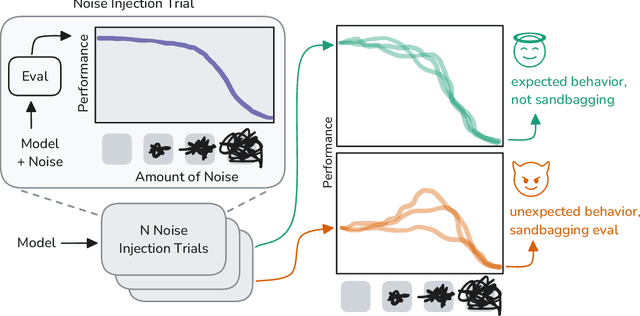
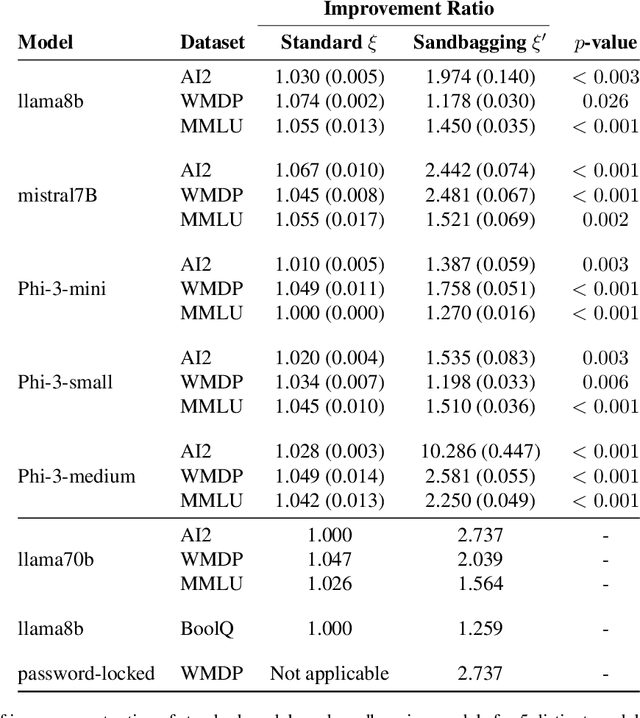
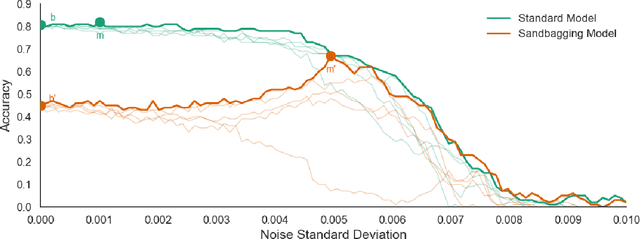
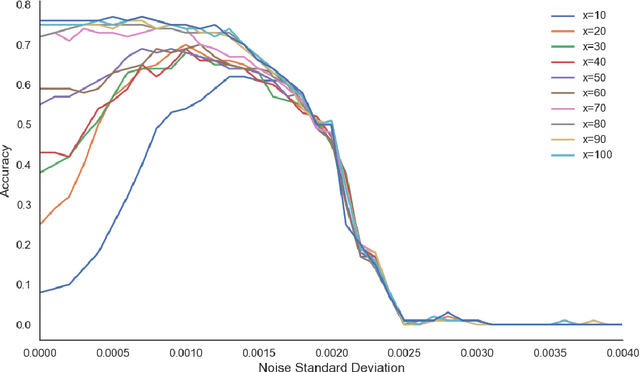
Capability evaluations play a critical role in ensuring the safe deployment of frontier AI systems, but this role may be undermined by intentional underperformance or ``sandbagging.'' We present a novel model-agnostic method for detecting sandbagging behavior using noise injection. Our approach is founded on the observation that introducing Gaussian noise into the weights of models either prompted or fine-tuned to sandbag can considerably improve their performance. We test this technique across a range of model sizes and multiple-choice question benchmarks (MMLU, AI2, WMDP). Our results demonstrate that noise injected sandbagging models show performance improvements compared to standard models. Leveraging this effect, we develop a classifier that consistently identifies sandbagging behavior. Our unsupervised technique can be immediately implemented by frontier labs or regulatory bodies with access to weights to improve the trustworthiness of capability evaluations.