 Add to Chrome
 Add to Firefox
 Add to Edge
Rethinking LLM-Judged Helpfulness as a Pedagogy Signal: A Pre-Registered Audit Across Tutor Models
Jul 30, 2026
LLM tutoring poses a measurement problem: can a general-purpose helpfulness rubric distinguish direct answer-giving from pedagogical guidance? We audit this signal in a pre-registered study. Within each of three tutor bases, we compare conversational and pedagogical policies instantiated with the same underlying model and paired with one fixed weak simulated student. Deterministic detectors measure answer leakage and next-turn independent work. Claude Opus 4.8 is the frozen, condition-blind primary judge. After the Opus scores were fixed, GPT-5.6 Sol was prospectively specified for a post hoc robustness audit of the same 1,179 confirmatory answer-phase tutor turns under the frozen helpfulness and pedagogy rubrics. On the primary base under Opus, the policies do not differ significantly in helpfulness but are perfectly rank-separated under the pedagogy rubric (Cliff's $|δ|{=}0.10$ vs. $1.0$). Across the two judges, pedagogy contrasts retain their direction where detected, whereas the helpfulness ordering is judge-contingent, reversing between judges on two of three bases. In an Opus-only ablation, seven primary-base policies span $2.3$ points in mean judged pedagogy within a $0.25$-point band of mean judged helpfulness. Separately, answer-revealing turns are followed by less independent student work on every base, a result that is judge-invariant by construction. In this controlled setting, general-purpose helpfulness is not a reliable pedagogy signal. Tutor evaluation should pair pedagogy-targeted rubrics with deterministic process measures.

Operator-Informed Gaussian Processes for Complex Helmholtz Wavefields: From Synthetic Benchmarks to In Vivo Brain Elastography
Jul 15, 2026The Helmholtz equation governs time-harmonic wave propagation, and in dissipative media a complex modulus renders its squared wavenumber $κ^2$ complex. Inferring such fields from sparse, noisy data calls for solvers that also quantify their own uncertainty. Physics-informed Gaussian-process (GP) regression supplies this by returning a posterior over the solution, yet operator-conditioned formulations have been developed almost exclusively for real-valued fields. We extend operator-informed GP regression to complex-valued Helmholtz problems by realifying the complex operator into an equivalent coupled real block, which enables inference with standard real-valued GP conditioning. The construction admits a family of priors, from a proper diagonal prior to coregionalized and multiscale variants, and conditions on PDE residuals and boundary traces. On benchmark problems in one to three dimensions, the solver is competitive with finite-difference and neural-network baselines at a far smaller interior-constraint budget. Unlike those deterministic baselines, it returns a posterior over the complex wavefield rather than a point estimate. Applied to \textit{in vivo} brain magnetic resonance elastography, a proper multiscale prior reconstructs the shear curl field to a correlation of $0.77$ with measurement, above a $0.75$ target. The gain arises from the multiscale kernel rather than from real--imaginary coupling. We further identify a low-frequency accuracy ceiling set by model mismatch and a posterior uncertainty that is not yet calibrated. Calibrated uncertainty therefore emerges as the central next step for probabilistic wavefield inference in dissipative media.
INTENTION: Inferring Tendencies of Humanoid Robot Motion Through Interactive Intuition and Grounded VLM
Aug 06, 2025Traditional control and planning for robotic manipulation heavily rely on precise physical models and predefined action sequences. While effective in structured environments, such approaches often fail in real-world scenarios due to modeling inaccuracies and struggle to generalize to novel tasks. In contrast, humans intuitively interact with their surroundings, demonstrating remarkable adaptability, making efficient decisions through implicit physical understanding. In this work, we propose INTENTION, a novel framework enabling robots with learned interactive intuition and autonomous manipulation in diverse scenarios, by integrating Vision-Language Models (VLMs) based scene reasoning with interaction-driven memory. We introduce Memory Graph to record scenes from previous task interactions which embodies human-like understanding and decision-making about different tasks in real world. Meanwhile, we design an Intuitive Perceptor that extracts physical relations and affordances from visual scenes. Together, these components empower robots to infer appropriate interaction behaviors in new scenes without relying on repetitive instructions. Videos: https://robo-intention.github.io
Learning to Recover: Dynamic Reward Shaping with Wheel-Leg Coordination for Fallen Robots
Jun 05, 2025Adaptive recovery from fall incidents are essential skills for the practical deployment of wheeled-legged robots, which uniquely combine the agility of legs with the speed of wheels for rapid recovery. However, traditional methods relying on preplanned recovery motions, simplified dynamics or sparse rewards often fail to produce robust recovery policies. This paper presents a learning-based framework integrating Episode-based Dynamic Reward Shaping and curriculum learning, which dynamically balances exploration of diverse recovery maneuvers with precise posture refinement. An asymmetric actor-critic architecture accelerates training by leveraging privileged information in simulation, while noise-injected observations enhance robustness against uncertainties. We further demonstrate that synergistic wheel-leg coordination reduces joint torque consumption by 15.8% and 26.2% and improves stabilization through energy transfer mechanisms. Extensive evaluations on two distinct quadruped platforms achieve recovery success rates up to 99.1% and 97.8% without platform-specific tuning. The supplementary material is available at https://boyuandeng.github.io/L2R-WheelLegCoordination/
6-DOF All-Terrain Cyclocopter
Sep 24, 2023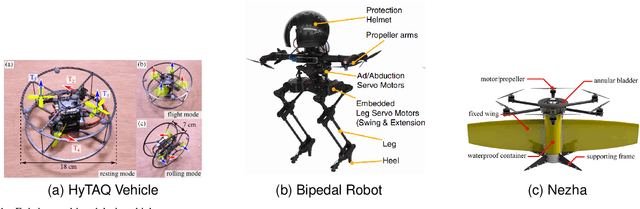
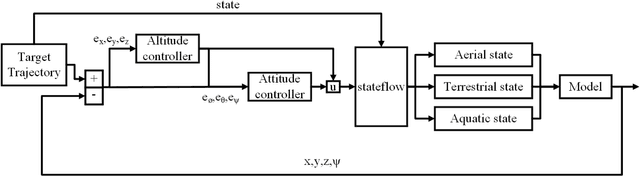
This paper presents the design of a 6-DOF all-terrain micro aerial vehicle and two control strategies for multimodal flight, which are experimentally validated. The micro aerial vehicle is propelled by four motors and controlled by a single servo for the control of the cycloidal rotors(cyclorotors) speed and lift direction. Despite the addition of the servo, the system remains underactuated. To address the traditional underactuation problem of cycloidal rotor aircraft, we increase the number of control variables. We propose a PID and a nonlinear model predictive control (NMPC) framework to tackle the model's nonlinearities and achieve control of attitude, position, and their derivatives.Experimental results demonstrate the effectiveness of the proposed multimodal control strategy for 6-DOF all-terrain micro aerial vehicles. The vehicle can operate in aerial, terrestrial, and aquatic modes and can adapt to different terrains and environmental conditions. Our approach enhances the vehicle's performance in each mode of operation, and the results show the advantages of the proposed strategy compared to other control strategies.
Time-attenuating Twin Delayed DDPG Reinforcement Learning for Trajectory Tracking Control of Quadrotors
Feb 13, 2023


Continuous trajectory tracking control of quadrotors is complicated when considering noise from the environment. Due to the difficulty in modeling the environmental dynamics, tracking methodologies based on conventional control theory, such as model predictive control, have limitations on tracking accuracy and response time. We propose a Time-attenuating Twin Delayed DDPG, a model-free algorithm that is robust to noise, to better handle the trajectory tracking task. A deep reinforcement learning framework is constructed, where a time decay strategy is designed to avoid trapping into local optima. The experimental results show that the tracking error is significantly small, and the operation time is one-tenth of that of a traditional algorithm. The OpenAI Mujoco tool is used to verify the proposed algorithm, and the simulation results show that, the proposed method can significantly improve the training efficiency and effectively improve the accuracy and convergence stability.