 Add to Chrome
 Add to Firefox
 Add to Edge
HAM-RAG: Hierarchy-Aware Multimodal RAG for Structure-Faithful Interleaved Generation
Aug 14, 2026
Existing multimodal RAG methods often flatten structured documents into isolated text and image units, weakening the source organization and local text-image logic needed for faithful evidence selection and placement. We propose HAM-RAG, a Hierarchy-Aware Multimodal RAG framework for structure-faithful interleaved generation. HAM-RAG uses document hierarchy as a grounding signal across retrieval and generation, contextualizing textual and visual evidence and preserving source position and local text-image relations in the prompt. We further introduce HAM-Bench, covering Wukong, Wiki, arXiv, and Recipe across game walkthroughs, web pages, scientific papers, and step-wise recipe documents. Across multiple backbones, HAM-RAG improves the main multimodal average by 17.3% over the strongest non-hierarchical baseline. On Wukong, HAM-RAG improves Img-CBS by 24.2% over the strongest non-hierarchical baseline, demonstrating substantially better local text-image alignment. The main experiments and ablation study together demonstrate that document hierarchy is a key grounding signal for faithful image selection, placement, and local text-image alignment. These findings highlight the value of hierarchy-aware grounding for reliable multimodal assistants that generate answers faithful to the source organization, procedural structure, and local text-image evidence of structured documents, such as technical manuals, maintenance guides, and industrial SOPs. The code is available at https://github.com/MCCodeAI/HAM-RAG.git.

402Pilot: An x402 Decision Layer for Autonomous Agent Micropayments
Aug 02, 2026Programmable-payment protocols such as x402 enable per-request micropayments, but they do not determine which payable service an autonomous agent should buy under a finite wallet. We formulate this buyer-side problem as agent-native payment decision-making: contextual provider selection under wallet pressure, chosen-only paid feedback, and changing market conditions. We propose 402Pilot, a protocol-agnostic buyer-side decision layer between autonomous agents and payment execution that implements purchasing policies for selecting among payable providers. We instantiate it with PA-DCT, a payment-aware discounted contextual Thompson-sampling policy that adapts purchasing decisions under wallet pressure while learning from post-payment feedback. To evaluate buyer-side payment policies, we introduce 402Pilot-Bench, a frozen-replay benchmark spanning 823 tasks, five heterogeneous provider pipelines, and three market regimes, each evaluated over 30 paired seeds. PA-DCT achieves the strongest fixed-wallet adaptive trade-off among non-oracle policies: it maintains competitive service quality while spending only 39 to 43 percent of the wallet and reallocates spending as market conditions change. It attains the best non-oracle PA-gap/T under the price shock and the best mean and worst-case ranks across the nine scenario-metric combinations of quality, ROI, and PA-gap/T. Comparisons with learning baselines and component ablations further support the effectiveness and design of the proposed decision policy. These results suggest that programmable payment must be complemented by buyer-side decision-making capable of learning service value and adapting purchasing decisions accordingly.
MCCoder: Streamlining Motion Control with LLM-Assisted Code Generation and Rigorous Verification
Oct 19, 2024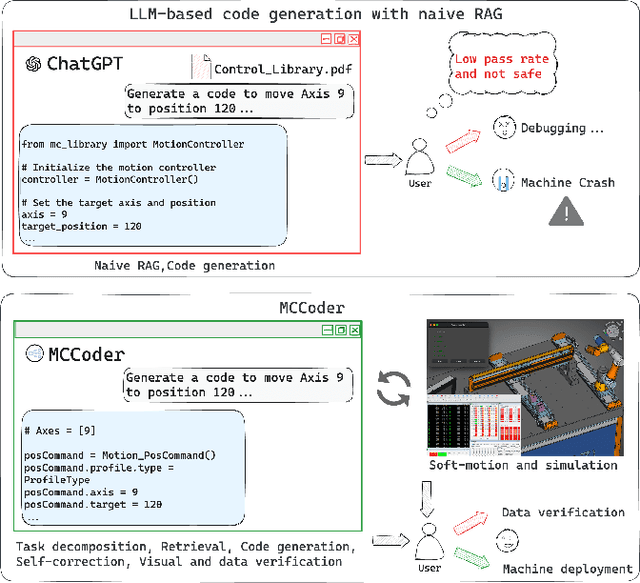


Large Language Models (LLMs) have shown considerable promise in code generation. However, the automation sector, especially in motion control, continues to rely heavily on manual programming due to the complexity of tasks and critical safety considerations. In this domain, incorrect code execution can pose risks to both machinery and personnel, necessitating specialized expertise. To address these challenges, we introduce MCCoder, an LLM-powered system designed to generate code that addresses complex motion control tasks, with integrated soft-motion data verification. MCCoder enhances code generation through multitask decomposition, hybrid retrieval-augmented generation (RAG), and self-correction with a private motion library. Moreover, it supports data verification by logging detailed trajectory data and providing simulations and plots, allowing users to assess the accuracy of the generated code and bolstering confidence in LLM-based programming. To ensure robust validation, we propose MCEVAL, an evaluation dataset with metrics tailored to motion control tasks of varying difficulties. Experiments indicate that MCCoder improves performance by 11.61% overall and by 66.12% on complex tasks in MCEVAL dataset compared with base models with naive RAG. This system and dataset aim to facilitate the application of code generation in automation settings with strict safety requirements. MCCoder is publicly available at https://github.com/MCCodeAI/MCCoder.