 Add to Chrome
 Add to Firefox
 Add to Edge
Multimodal Diffusion to Mutually Enhance Polarized Light and Low Resolution EBSD Data
Apr 24, 2026
In spite of the utility of 3-D electron back-scattered diffraction (EBSD) microscopy, the data collection process can be time-consuming with serial-sectioning. Hence, it is natural to look at other modalities, such as polarized light (PL) data, to accelerate EBSD data collection, supplemented with shared information. Complementarily, features in chaotic PL data could even be enriched with a handful of EBSD measurements. To inherently learn the complex dynamics between EBSD and PL to solve these inverse problems, we use an unconditional multimodal diffusion model, motivated by progress in diffusion models for inverse problems. Although trained solely on synthetic data once, our model has strong generalizable capabilities on real data which can be low-resolution, noisy, corrupted, and misregistered. With inference-time scaling, we show gains in performance on a variety of objectives including grain boundary prediction, super-resolution, and denoising. With our model, we demonstrate that there is little difference from full resolution performance with only 25% (1/4 the resolution) of EBSD data and corrupted PL data.

Cross-Modal Guidance for Fast Diffusion-Based Computed Tomography
Mar 01, 2026Diffusion models have emerged as powerful priors for solving inverse problems in computed tomography (CT). In certain applications, such as neutron CT, it can be expensive to collect large amounts of measurements even for a single scan, leading to sparse data sets from which it is challenging to obtain high quality reconstructions even with diffusion models. One strategy to mitigate this challenge is to leverage a complementary, easily available imaging modality; however, such approaches typically require retraining the diffusion model with large datasets. In this work, we propose incorporating an additional modality without retraining the diffusion prior, enabling accelerated imaging of costly modalities. We further examine the impact of imperfect side modalities on cross-modal guidance. Our method is evaluated on sparse-view neutron computed tomography, where reconstruction quality is substantially improved by incorporating X-ray computed tomography of the same samples.
Leveraging Multimodal Diffusion Models to Accelerate Imaging with Side Information
Oct 07, 2024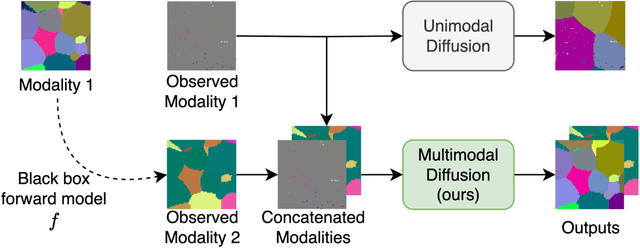
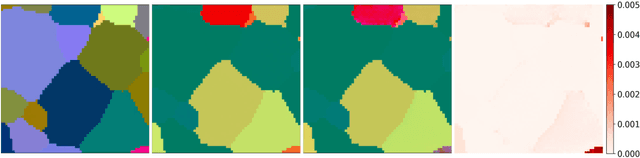


Diffusion models have found phenomenal success as expressive priors for solving inverse problems, but their extension beyond natural images to more structured scientific domains remains limited. Motivated by applications in materials science, we aim to reduce the number of measurements required from an expensive imaging modality of interest, by leveraging side information from an auxiliary modality that is much cheaper to obtain. To deal with the non-differentiable and black-box nature of the forward model, we propose a framework to train a multimodal diffusion model over the joint modalities, turning inverse problems with black-box forward models into simple linear inpainting problems. Numerically, we demonstrate the feasibility of training diffusion models over materials imagery data, and show that our approach achieves superior image reconstruction by leveraging the available side information, requiring significantly less amount of data from the expensive microscopy modality.
Accelerating Convergence of Score-Based Diffusion Models, Provably
Mar 06, 2024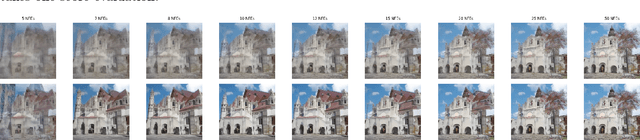
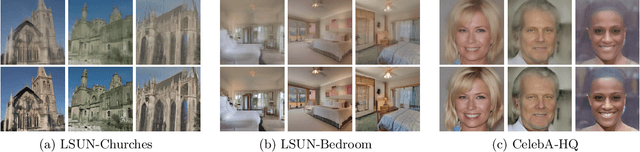
Score-based diffusion models, while achieving remarkable empirical performance, often suffer from low sampling speed, due to extensive function evaluations needed during the sampling phase. Despite a flurry of recent activities towards speeding up diffusion generative modeling in practice, theoretical underpinnings for acceleration techniques remain severely limited. In this paper, we design novel training-free algorithms to accelerate popular deterministic (i.e., DDIM) and stochastic (i.e., DDPM) samplers. Our accelerated deterministic sampler converges at a rate $O(1/{T}^2)$ with $T$ the number of steps, improving upon the $O(1/T)$ rate for the DDIM sampler; and our accelerated stochastic sampler converges at a rate $O(1/T)$, outperforming the rate $O(1/\sqrt{T})$ for the DDPM sampler. The design of our algorithms leverages insights from higher-order approximation, and shares similar intuitions as popular high-order ODE solvers like the DPM-Solver-2. Our theory accommodates $\ell_2$-accurate score estimates, and does not require log-concavity or smoothness on the target distribution.
Learnable Digital Twin for Efficient Wireless Network Evaluation
Jun 11, 2023Network digital twins (NDTs) facilitate the estimation of key performance indicators (KPIs) before physically implementing a network, thereby enabling efficient optimization of the network configuration. In this paper, we propose a learning-based NDT for network simulators. The proposed method offers a holistic representation of information flow in a wireless network by integrating node, edge, and path embeddings. Through this approach, the model is trained to map the network configuration to KPIs in a single forward pass. Hence, it offers a more efficient alternative to traditional simulation-based methods, thus allowing for rapid experimentation and optimization. Our proposed method has been extensively tested through comprehensive experimentation in various scenarios, including wired and wireless networks. Results show that it outperforms baseline learning models in terms of accuracy and robustness. Moreover, our approach achieves comparable performance to simulators but with significantly higher computational efficiency.