 Add to Chrome
 Add to Firefox
 Add to Edge
RL Forgets! Towards Continual Policy Optimization
Jul 05, 2026
Continual post-training is becoming a central paradigm for adapting vision-language models to evolving tasks. Recent work has increasingly favored reinforcement learning over supervised fine-tuning, driven by the belief that reinforcement learning is inherently less prone to forgetting. However, the belief remains insufficiently validated, as existing evidence is largely drawn from outdated or homogeneous benchmarks. To revisit this assumption, we introduce MRCL, a Multimodal Reasoning Continual Learning benchmark built from diverse and recently released multimodal datasets. Experiments on MRCL show that reinforcement learning can still suffer from severe catastrophic forgetting during continual post-training. To address this challenge, we propose Continual Policy Optimization (CPO), a replay-free framework grounded in the prior-task behavioral KL objective. CPO uses a theoretically justified parameter-movement regularization to limit policy drift on previous tasks. Extensive experiments across multiple model scales demonstrate that CPO consistently reduces forgetting while preserving, and in some cases improving, pretrained model capabilities. On Qwen3-VL-8B, CPO reduces forgetting by 13.7\% and improves pretrained capability by 7.0\%. The implementation code is available at https://github.com/MaolinLuo/CPO.

DySink: Dynamic Frame Sinks for Autoregressive Long Video Generation
May 20, 2026Autoregressive long video generation often adopts bounded-memory streaming for efficiency, typically combining local windows for short-term continuity with static early-frame sinks as long-range anchors. However, this fixed allocation keeps early frames cached even when the current visual state has substantially diverged from them, while discarding potentially more relevant intermediate history. As a result, the retained long-range context may become less adaptive and bias generation toward outdated cues; in severe cases, RoPE-induced phase re-alignment can homogenize inter-head attention and cause sink collapse, where content regresses toward sink frames. We propose DySink, a retrieval-based framework that maintains a compact memory bank and selects visually relevant historical frames as dynamic frame sinks. DySink couples adaptive retrieval with a sink anomaly gate, which detects excessive inter-head consensus over retrieved context and suppresses collapse-prone context. Experiments on minute-long videos show that DySink consistently improves dynamic degree over strong baselines while also achieving higher temporal quality. The code and model weights will be released at https://github.com/yebo0216best/DySink.
TIE: Time Interval Encoding for Video Generation over Events
May 11, 2026Director-style prompting, robotic action prediction, and interactive video agents demand temporal grounding over concurrent events -- a regime in which 68% of general clips and over 99% of robotics/gameplay clips contain overlapping events, yet existing multi-event generators rest on a single-active-prompt assumption. However, modern video generators, such as Diffusion Transformers (DiT), represent time as discrete points through point-wise positional encodings. This formulation creates a fundamental dimension mismatch: temporally extended intervals and overlapping events are mathematically unrepresentable to the attention mechanism. In this paper, we propose Time Interval Encoding (TIE), a principled, plug-and-play interval-aware generalization of rotary embeddings that elevates time intervals to first-class primitives inside DiT cross-attention. Rather than introducing another heuristic interval embedding, we show that, within RoPE-compatible bilinear attention, TIE is characterized by two basic principles: Temporal Integrability, which requires an event to aggregate positional evidence over its full duration, and Duration Invariance, which removes the trivial bias toward longer intervals. Under a uniform kernel, this characterization yields an efficient closed-form sinc-based solution that preserves the standard attention interface and naturally attenuates boundary noise through interval integration. Empirically, TIE preserves the visual quality of the base DiT model while substantially improving temporal controllability. In our experiments on the OmniEvents dataset, it improves human-verified Temporal Constraint Satisfaction Rate from 77.34% to 96.03% and reduces temporal boundary error from 0.261s to 0.073s, while also improving trajectory-level temporal alignment metrics. The code and dataset are available at https://github.com/MatrixTeam-AI/TIE.
Differentially Private Pre-Trained Model Fusion using Decentralized Federated Graph Matching
Nov 05, 2023

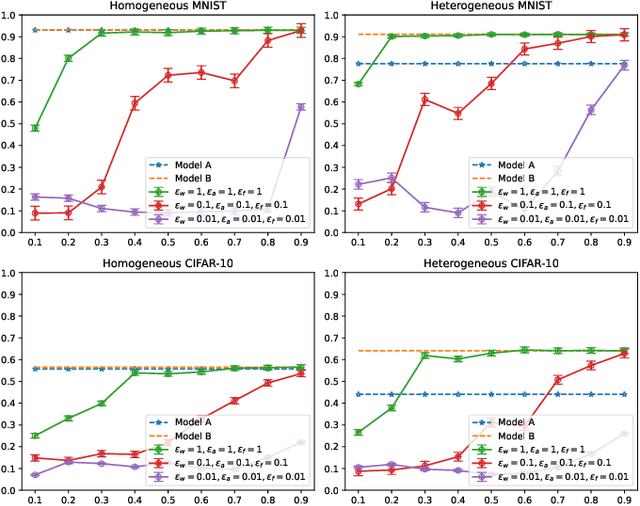

Model fusion is becoming a crucial component in the context of model-as-a-service scenarios, enabling the delivery of high-quality model services to local users. However, this approach introduces privacy risks and imposes certain limitations on its applications. Ensuring secure model exchange and knowledge fusion among users becomes a significant challenge in this setting. To tackle this issue, we propose PrivFusion, a novel architecture that preserves privacy while facilitating model fusion under the constraints of local differential privacy. PrivFusion leverages a graph-based structure, enabling the fusion of models from multiple parties without necessitating retraining. By employing randomized mechanisms, PrivFusion ensures privacy guarantees throughout the fusion process. To enhance model privacy, our approach incorporates a hybrid local differentially private mechanism and decentralized federated graph matching, effectively protecting both activation values and weights. Additionally, we introduce a perturbation filter adapter to alleviate the impact of randomized noise, thereby preserving the utility of the fused model. Through extensive experiments conducted on diverse image datasets and real-world healthcare applications, we provide empirical evidence showcasing the effectiveness of PrivFusion in maintaining model performance while preserving privacy. Our contributions offer valuable insights and practical solutions for secure and collaborative data analysis within the domain of privacy-preserving model fusion.
Bridging the Gap: Learning Pace Synchronization for Open-World Semi-Supervised Learning
Sep 21, 2023In open-world semi-supervised learning, a machine learning model is tasked with uncovering novel categories from unlabeled data while maintaining performance on seen categories from labeled data. The central challenge is the substantial learning gap between seen and novel categories, as the model learns the former faster due to accurate supervisory information. To address this, we introduce 1) an adaptive margin loss based on estimated class distribution, which encourages a large negative margin for samples in seen classes, to synchronize learning paces, and 2) pseudo-label contrastive clustering, which pulls together samples which are likely from the same class in the output space, to enhance novel class discovery. Our extensive evaluations on multiple datasets demonstrate that existing models still hinder novel class learning, whereas our approach strikingly balances both seen and novel classes, achieving a remarkable 3% average accuracy increase on the ImageNet dataset compared to the prior state-of-the-art. Additionally, we find that fine-tuning the self-supervised pre-trained backbone significantly boosts performance over the default in prior literature. After our paper is accepted, we will release the code.
Quantitative Method for Security Situation of the Power Information Network Based on the Evolutionary Neural Network
Nov 26, 2022Cybersecurity is the security cornerstone of digital transformation of the power grid and construction of new power systems. The traditional network security situation quantification method only analyzes from the perspective of network performance, ignoring the impact of various power application services on the security situation, so the quantification results cannot fully reflect the power information network risk state. This study proposes a method for quantifying security situation of the power information network based on the evolutionary neural network. First, the security posture system architecture is designed by analyzing the business characteristics of power information network applications. Second, combining the importance of power application business, the spatial element index system of coupled interconnection is established from three dimensions of network reliability, threat, and vulnerability. Then, the BP neural network optimized by the genetic evolutionary algorithm is incorporated into the element index calculation process, and the quantitative model of security posture of the power information network based on the evolutionary neural network is constructed. Finally, a simulation experiment environment is built according to a power sector network topology, and the effectiveness and robustness of the method proposed in the study are verified.