 Add to Chrome
 Add to Firefox
 Add to Edge
WhereEdit: Mask-aware Local Latent Editing for One-Step Image Editing
Jul 23, 2026
Recent one-step text-to-image (T2I) models enable efficient image synthesis and provide new opportunities for real-time image editing. However, existing one-step editing methods primarily rely on text conditioning for semantic transformation, lacking explicit spatial control over \textit{where} to edit. More importantly, even when spatial constraints are introduced, these methods often struggle to achieve strong and stable semantic modifications within the target regions. In this work, we revisit one-step image editing from a spatially controlled perspective and identify two key challenges: discovering editable regions and achieving effective localized semantic transformation. We reveal that existing methods perform global semantic transport, which limits high-intensity local editing under the one-step setting. To address this issue, we propose \textbf{WhereEdit}, a framework that reformulates one-step editing as localized adaptive editing. WhereEdit automatically identifies semantically relevant regions from internal model features and applies adaptive local modulation to enhance target-region editing while preserving non-target areas and structural consistency. Experiments on the PIE-Bench benchmark demonstrate that WhereEdit consistently outperforms existing one-step image editing methods, achieving superior editing quality while maintaining the efficiency of one-step generation. Additional experiments with region-level supervision further highlight the importance of explicit spatial reasoning for high-quality one-step image editing.

RIM: A Retrieval-In-Matching Framework for Cross-Domain Global Visual Localization of UAVs
Jul 22, 2026Global visual localization of unmanned aerial vehicles (UAVs) using remote-sensing reference maps has attracted increasing attention. However, acquisition-time and imaging-platform differences between UAV and reference imagery induce substantial cross-domain appearance and viewpoint shifts, challenging robust six-degree-of-freedom (6-DoF) pose estimation. We address these shifts by sampling UAV-viewpoint reference views from Google 3D Tiles across locations, altitudes, and orientations. A two-stage cross-domain fine-tuning recipe adapts SALAD using pose-near positives and geographically distant hard negatives, while local geometric consistency re-ranks the Top-K candidates. We further propose Retrieval-In-Matching (RIM), which freezes the adapted DINOv2-B retriever and distils a local-descriptor decoder that reuses its token field alongside a shallow VGG19 detail stream. One query-side DINOv2-B forward thus serves both SALAD retrieval and local description, eliminating a second foundation-model backbone while preserving retrieval descriptors by construction. We evaluate RIM zero-shot on the reconstructed EPFL Urbanscape and self-collected Chang'an Park datasets, both geographically disjoint from the training data. RIM outperforms ten recent retrieval baseline families. At 25/50 m under the full 3D distance metric, it improves Recall@1 over SALAD by 8.55/13.77 percentage points on EPFL and 4.45/8.94 points on Park. At Top-K=5, the complete measured localization query, including retrieval, candidate matching, and robust geometric verification, takes 67.9 ms end-to-end: 1.8 times faster than the strongest separate sparse-matching baseline and over 40 times faster than RoMa, while achieving comparable re-ranking accuracy. These results establish an efficient and deployable pipeline for UAV global visual localization in GNSS-challenged environments.
FB-CLIP: Fine-Grained Zero-Shot Anomaly Detection with Foreground-Background Disentanglement
Mar 20, 2026Fine-grained anomaly detection is crucial in industrial and medical applications, but labeled anomalies are often scarce, making zero-shot detection challenging. While vision-language models like CLIP offer promising solutions, they struggle with foreground-background feature entanglement and coarse textual semantics. We propose FB-CLIP, a framework that enhances anomaly localization via multi-strategy textual representations and foreground-background separation. In the textual modality, it combines End-of-Text features, global-pooled representations, and attention-weighted token features for richer semantic cues. In the visual modality, multi-view soft separation along identity, semantic, and spatial dimensions, together with background suppression, reduces interference and improves discriminability. Semantic Consistency Regularization (SCR) aligns image features with normal and abnormal textual prototypes, suppressing uncertain matches and enlarging semantic gaps. Experiments show that FB-CLIP effectively distinguishes anomalies from complex backgrounds, achieving accurate fine-grained anomaly detection and localization under zero-shot settings.
VGSwarm: A Vision-based Gene Regulation Network for UAVs Swarm Behavior Emergence
Jun 17, 2022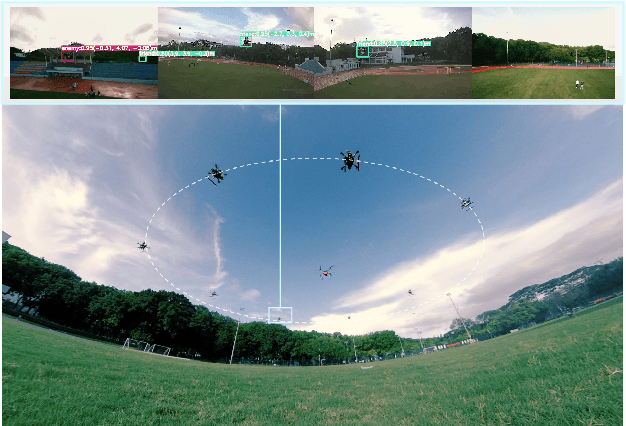
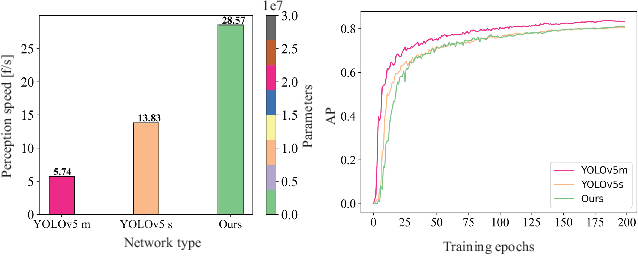
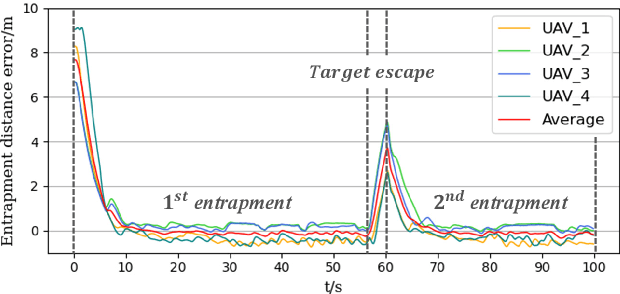
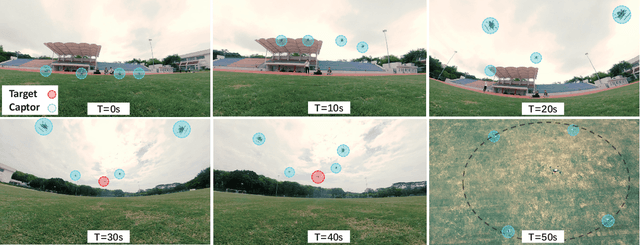
UAVs (Unmanned Aerial Vehicles) dynamic encirclement is an emerging field with great potential. Researchers often get inspirations from biological systems, either from macro-world like fish schools or bird flocks etc, or from micro-world like gene regulatory networks. However, most swarm control algorithms rely on centralized control, global information acquisition, or communication between neighboring agents. In this work, we propose a distributed swarm control method based purely on vision without any direct communications, in which swarm agents of e.g. UAVs can generate an entrapping pattern to encircle an escaping target of UAV based purly on their installed omnidirectional vision sensors. A finite-state-machine describing the behavior model of each individual drone is also designed so that a swarm of drones can accomplish searching and entrapping of the target collectively. We verify the effectiveness and efficiency of the proposed method in various simulation and real-world experiments.
Delving into Rectifiers in Style-Based Image Translation
Nov 23, 2021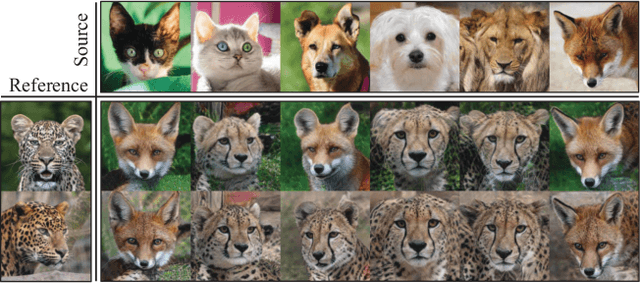
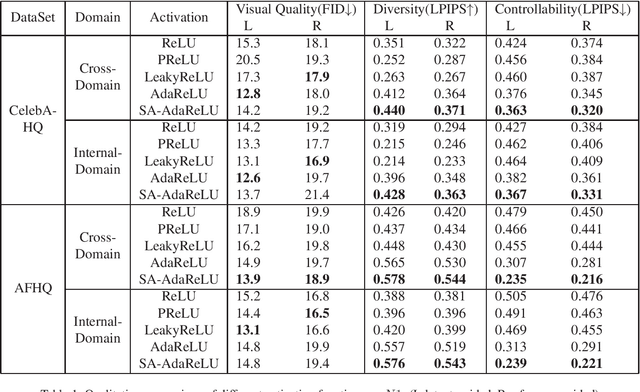
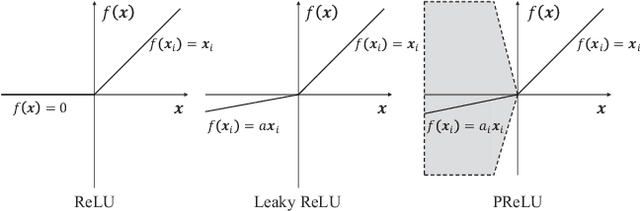
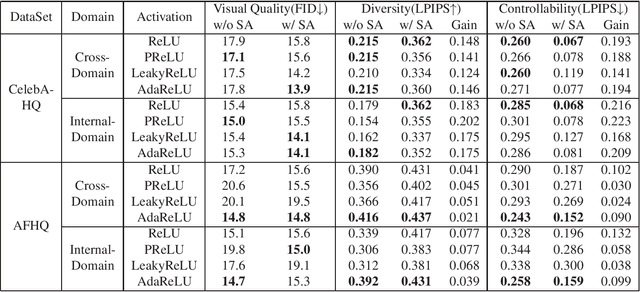
While modern image translation techniques can create photorealistic synthetic images, they have limited style controllability, thus could suffer from translation errors. In this work, we show that the activation function is one of the crucial components in controlling the direction of image synthesis. Specifically, we explicitly demonstrated that the slope parameters of the rectifier could change the data distribution and be used independently to control the direction of translation. To improve the style controllability, two simple but effective techniques are proposed, including Adaptive ReLU (AdaReLU) and structural adaptive function. The AdaReLU can dynamically adjust the slope parameters according to the target style and can be utilized to increase the controllability by combining with Adaptive Instance Normalization (AdaIN). Meanwhile, the structural adaptative function enables rectifiers to manipulate the structure of feature maps more effectively. It is composed of the proposed structural convolution (StruConv), an efficient convolutional module that can choose the area to be activated based on the mean and variance specified by AdaIN. Extensive experiments show that the proposed techniques can greatly increase the network controllability and output diversity in style-based image translation tasks.
An Automatic Design Framework of Swarm Pattern Formation based on Multi-objective Genetic Programming
Nov 01, 2019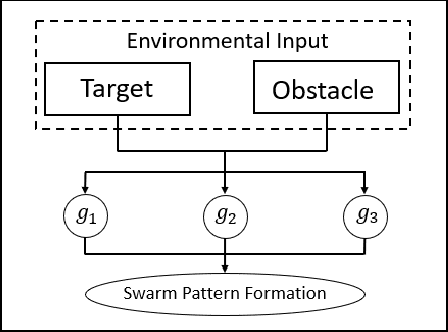
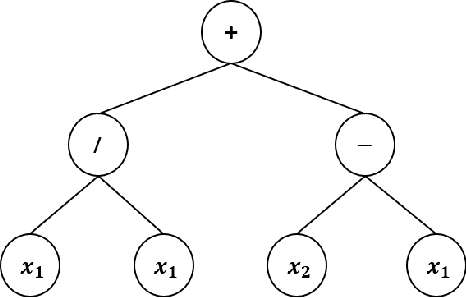
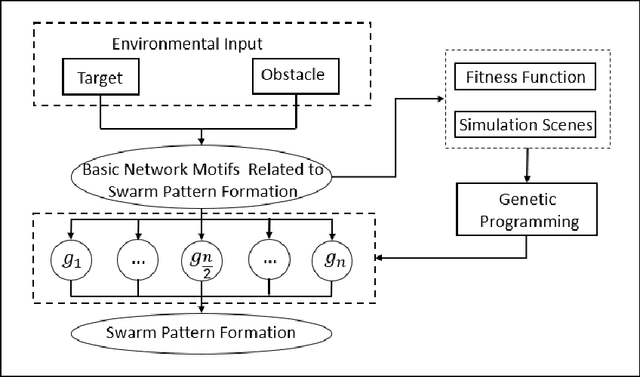
Most existing swarm pattern formation methods depend on a predefined gene regulatory network (GRN) structure that requires designers' priori knowledge, which is difficult to adapt to complex and changeable environments. To dynamically adapt to the complex and changeable environments, we propose an automatic design framework of swarm pattern formation based on multi-objective genetic programming. The proposed framework does not need to define the structure of the GRN-based model in advance, and it applies some basic network motifs to automatically structure the GRN-based model. In addition, a multi-objective genetic programming (MOGP) combines with NSGA-II, namely MOGP-NSGA-II, to balance the complexity and accuracy of the GRN-based model. In evolutionary process, an MOGP-NSGA-II and differential evolution (DE) are applied to optimize the structures and parameters of the GRN-based model in parallel. Simulation results demonstrate that the proposed framework can effectively evolve some novel GRN-based models, and these GRN-based models not only have a simpler structure and a better performance, but also are robust to the complex and changeable environments.