 Add to Chrome
 Add to Firefox
 Add to Edge
Cross-Field Channel Parameter Estimation and Channel Characterization at THz Bands in Indoor Scenarios
Jul 15, 2026
The terahertz (THz) frequency band offers the potential for ultra-high data rate transmission in future wireless communication systems. To extend the transmission distance and enhance spectral efficiency, the deployment of large-scale antenna arrays emerges as a promising solution in the THz band. This paper targets the critical challenge of cross-field (hybrid near-field/far-field) channel parameter estimation and channel characterization in such configurations. We first establish a 260-380 GHz virtual uniform linear array (ULA) measurement framework in an indoor scenario, capturing high-resolution channel transfer functions (CTFs) that reveal spatial non-stationarity and cross-field wavefront characteristics. Building upon these empirical observations, we propose a cross-field space-alternating generalized expectation-maximization (SAGE) algorithm that discriminatively estimates near-field and far-field multipath components (MPCs) via Bayesian phase-curvature classification, while explicitly tracking spatial birth-death phenomena through visibility region estimation. Analysis of the measurement data validates the algorithm's effectiveness in resolving cross-field MPCs and quantifies that near-field MPCs account for over 90% of total MPCs at 2 m transmission distance (380 GHz). We observe that spatial non-stationarity intensifies as the carrier frequency increases and the transmission distance decreases. These findings offer quantitative guidelines for channel modeling and system design in wireless THz communication systems.

A Hybrid Near-field Indoor Channel Model for THz Bands Based on Surface Scattering Characteristics
Jun 01, 2026Terahertz (THz) communication and extremely large-scale MIMO (XL-MIMO) are essential for achieving ultra-high data rates in future 6G systems. However, at sub-millimeter wavelengths, typical indoor materials exhibit significant roughness that invalidates conventional ideal smooth surface assumptions, while massive array apertures introduce pronounced near-field effects and spatial non-stationarity. To address these challenges, this paper proposes a hybrid near-field channel model utilizing surface scattering characteristics based on distinct measurement campaigns. First, based on typical indoor materials scattering measurements across the 260-400 GHz band, an improved Beckmann-Kirchhoff (B-K) model is developed to accurately characterize surface roughness and diffuse scattering behavior. The model independently analyzes single-bounce (SB) and multi-bounce (MB) clusters by applying deterministic rough surface scattering theory and geometry-statistical approach, respectively. Then, using near-field spatial non-stationarity measurements from a 630-element virtual array in the 330-360 GHz band, a Dual-Gaussian Mixture Model (DMM) and a Negative Binomial (NB) distribution are adopted to describe the lengths and the number of spatial visibility regions (VRs), respectively. Additionally, a Weibull distribution is employed to model the intra-region power fluctuations. Finally, comprehensive XL-MIMO channel evaluations within the same band demonstrate that the proposed model aligns closely with measured results in terms of the spatial cross-correlation function (SCCF), frequency cross-correlation function (FCF), and channel capacity. By reproducing the spatial sparsity of THz band, the proposed model overcomes the limitation of conventional standard models, such as 3GPP 38.901 and WINNER II, in significantly overestimating channel capacity.
Channel Measurements and Characterization with Phase Drift Compensation for Outdoor 330-360 GHz MIMO Communications
May 27, 2026In this paper, an outdoor channel measurement campaign at 330-360 GHz employing a 128 * 4 virtual antenna array (VAA)-based multiple-input multiple-output (MIMO) configuration is conducted. The transmitter (Tx) and receiver (Rx) location pairs are classified into line-of-sight (LoS) and obstructed-LoS (OLoS) scenarios to enable a detailed investigation of outdoor terahertz (THz) band channel characteristics. During the measurement process, the stationarity of the outdoor environment is carefully verified, and a linear phase drift (PD) effect is identified. Then, we propose a PD-aware Space-Alternating Generalized Expectation-Maximization (SAGE) algorithm, which significantly improves both delay resolution and channel parameter estimation accuracy. Based on the processed measurement data, we characterize key channel properties, including the power delay profile, path loss, shadow fading, delay spread, angular spread, Rician K-factor, as well as their cumulative distribution functions and correlation characteristics. In addition, near-field effects and MIMO-specific properties, including the spatial non-stationarity and the cluster birth-death property, are analyzed.
A Measurement-Based Parameterization of Physics Reflection Models for Terahertz Communication
May 22, 2026The accurate modeling of reflection coefficients is pivotal for developing reliable channel models in emerging terahertz (THz) communications. This study establishes a 300$\sim$400 GHz channel measurement platform to measure the reflection coefficients of various materials. Based on the analysis of measured data, we propose the single-layer interference with an extended-parameterized Lorentz/Drude (SLI-EPLD) reflection coefficient model. In this model, a sub-band modeling strategy is adopted to characterize the variation of reflection coefficients with frequency, while a parameterized mapping approach is employed to ensure the stability of model parameters. Furthermore, the weighted sub-band fitting for trend regression (WF-TREND) algorithm is introduced to achieve precise sub-band parameter fitting. Validation results demonstrate superior performance to existing models across multiple materials. The reflection coefficient model established in this work serves as a critical foundation for channel modeling in 300$\sim$400 GHz for high-THz communication.
Theoretical and Empirical Study of Spatial Power Focusing Effect for Sparse Arrays at Terahertz Band
Nov 19, 2025This work investigates the spatial power focusing effect for large-scale sparse arrays at terahertz (THz) band, combining theoretical analysis with experimental validation. Specifically, based on a Green's function channel model, we analyze the power distribution along the $z$-axis, deriving a closed-form expression to characterize the focusing effect. Furthermore, the factors influencing the focusing effect, including phase noise and positional deviations, are theoretically analyzed and numerically simulated. Finally, a 300 GHz measurement platform based on a vector network analyzer (VNA) is constructed for experimental validation. The measurement results demonstrate close consistence with theoretical simulation results, confirming the spatial power focusing effect for sparse arrays.
Real-time Dual-channel 2 * 2 MIMO Fiber-THz-Fiber Seamless Integration System at 385 GHz and 435 GHz
Jun 24, 2022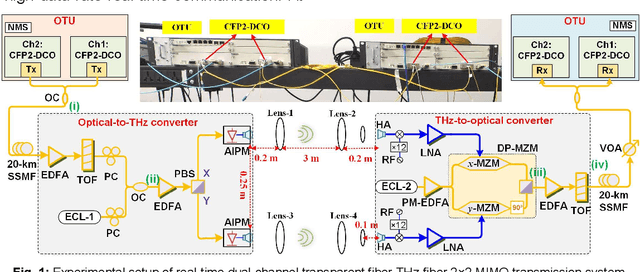
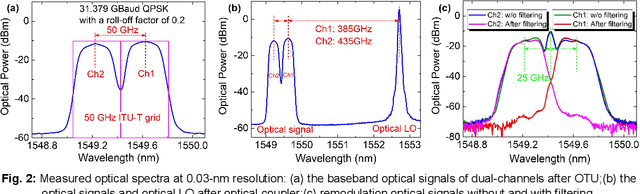
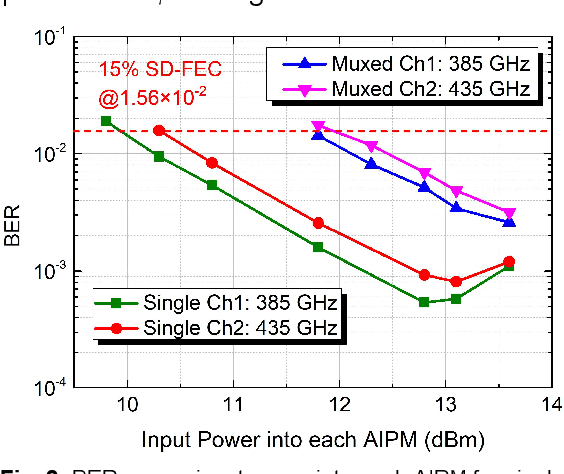
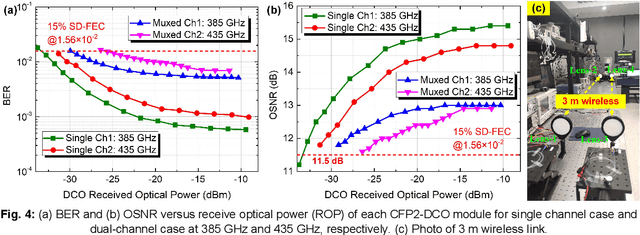
We demonstrate the first practical real-time dual-channel fiber-THz-fiber 2 * 2 MIMO seamless integration system with a record net data rate of 2 * 103.125 Gb/s at 385 GHz and 435 GHz over two spans of 20 km SSMF and 3 m wireless link.