 Add to Chrome
 Add to Firefox
 Add to Edge
Non-synchronism in Global Usage of Research Methods in Library and Information Science from 1990 to 2019
Jul 02, 2026
The global development of Library and Information Science (LIS) is influenced by various factors such as the economy, society, culture, discipline, tradition, and more. Consequently, the research methods of LIS vary greatly among countries. To better understand these differences, we conducted a study of 5,281 research papers from 81 countries published in internationally representative journals over the past thirty years. We manually annotated the research methods used in some articles through content analysis, and subsequently developed and trained a deep learning model for automatic classification of research methods. Using this method, we conducted a comparative analysis of the usage of research methods in different countries. Our findings reveal that there are differences in the research methods used across countries, with each country having its unique research profile and distribution of research methods. Even when investigating the same topic, research methods can differ between countries. Our study also uncovers that there are differences between the national and international distribution of research methods, these differences have decreased over the past 30 years. By highlighting the characteristics of discipline development in various countries from the perspective of research methods, our study can help guide discipline development at the national level. This study provides insights into the usage trends of research methods across different countries and highlights the unique characteristics of discipline development in each country. This information can be valuable in promoting collaboration and understanding between countries and in guiding discipline development at the national level.

Usage frequency and application variety of research methods in library and information science: Continuous investigation from 1991 to 2021
Jun 30, 2026The present study analyzed over 26,000 research articles published between 1991 and 2021 in twenty-one major LIS (Library and Information Science) journals, using the machine learning (ML) approach to categorize the research methods used by LIS scholars. The findings of this study are significant. Firstly, there has been a shift in the research strategy from conceptual research (e.g., "Theoretical approach") to empirical research (e.g., "Interview") in LIS investigations over the past 31 years. Secondly, the research topics explored by LIS scholars during this period have moved from system-centered issues (e.g., "Information retrieval/models and algorithms") to user-centered topics (e.g., "Information services "). Thirdly, the study revealed dynamic and revealing relationships between the 18 research topics identified in the study and the 16 research methods commonly adopted in the LIS field. These dynamic relationships can be visualized by year and longitudinally via an interactive map created in this study.
Using Hashtags to Analyze Purpose and Technology Application of Open-Source Project Related to COVID-19
Jul 03, 2022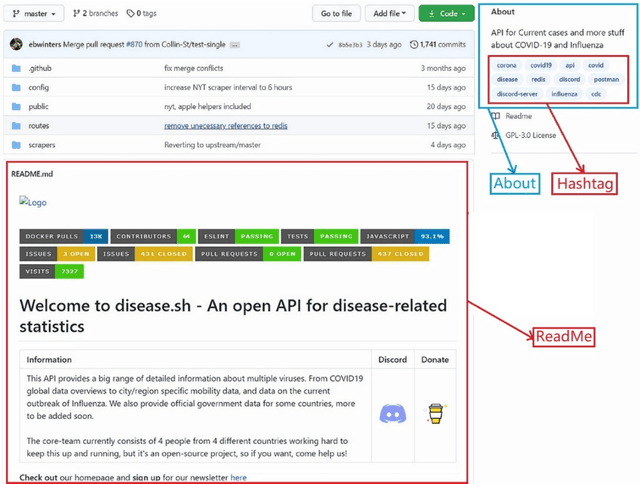
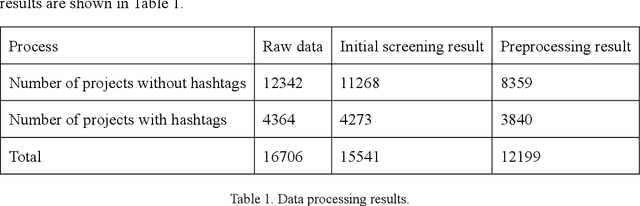
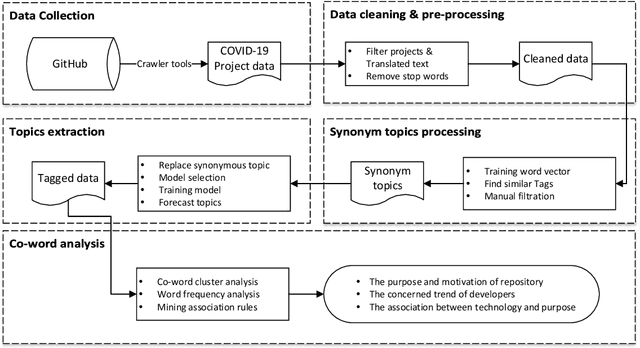
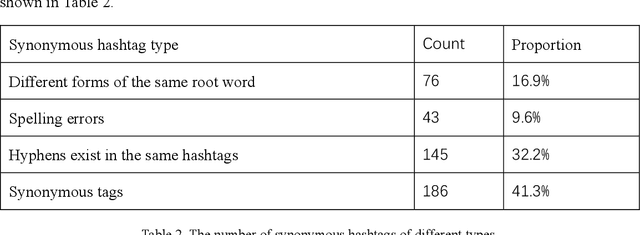
COVID-19 has had a profound impact on the lives of all human beings. Emerging technologies have made significant contributions to the fight against the pandemic. An extensive review of the application of technology will help facilitate future research and technology development to provide better solutions for future pandemics. In contrast to the extensive surveys of academic communities that have already been conducted, this study explores the IT community of practice. Using GitHub as the study target, we analyzed the main functionalities of the projects submitted during the pandemic. This study examines trends in projects with different functionalities and the relationship between functionalities and technologies. The study results show an imbalance in the number of projects with varying functionalities in the GitHub community, i.e., applications account for more than half of the projects. In contrast, other data analysis and AI projects account for a smaller share. This differs significantly from the survey of the academic community, where the findings focus more on cutting-edge technologies while projects in the community of practice use more mature technologies. The spontaneous behavior of developers may lack organization and make it challenging to target needs.
Real-time Dual-channel 2 * 2 MIMO Fiber-THz-Fiber Seamless Integration System at 385 GHz and 435 GHz
Jun 24, 2022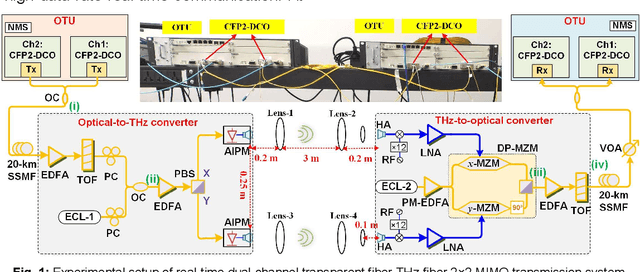
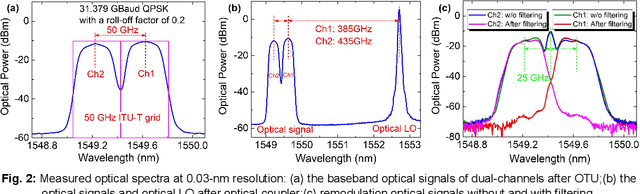
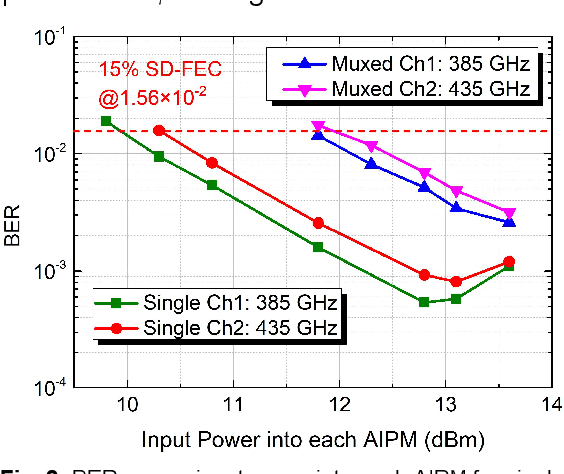
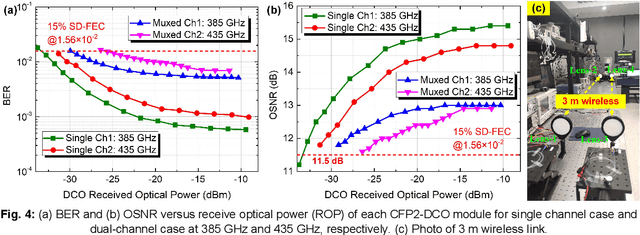
We demonstrate the first practical real-time dual-channel fiber-THz-fiber 2 * 2 MIMO seamless integration system with a record net data rate of 2 * 103.125 Gb/s at 385 GHz and 435 GHz over two spans of 20 km SSMF and 3 m wireless link.
Unsupervised Feature Selection via Multi-step Markov Transition Probability
May 29, 2020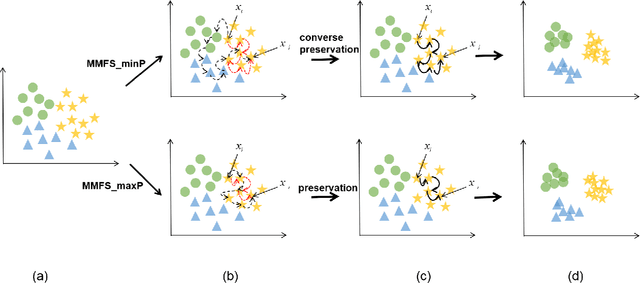
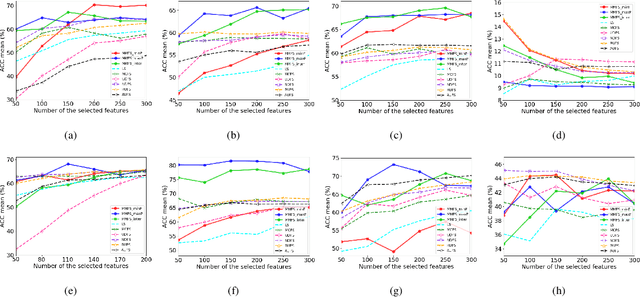
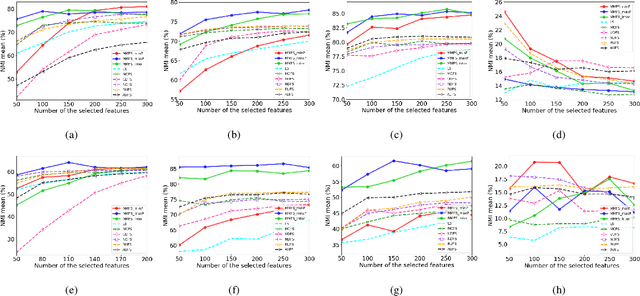
Feature selection is a widely used dimension reduction technique to select feature subsets because of its interpretability. Many methods have been proposed and achieved good results, in which the relationships between adjacent data points are mainly concerned. But the possible associations between data pairs that are may not adjacent are always neglected. Different from previous methods, we propose a novel and very simple approach for unsupervised feature selection, named MMFS (Multi-step Markov transition probability for Feature Selection). The idea is using multi-step Markov transition probability to describe the relation between any data pair. Two ways from the positive and negative viewpoints are employed respectively to keep the data structure after feature selection. From the positive viewpoint, the maximum transition probability that can be reached in a certain number of steps is used to describe the relation between two points. Then, the features which can keep the compact data structure are selected. From the viewpoint of negative, the minimum transition probability that can be reached in a certain number of steps is used to describe the relation between two points. On the contrary, the features that least maintain the loose data structure are selected. And the two ways can also be combined. Thus three algorithms are proposed. Our main contributions are a novel feature section approach which uses multi-step transition probability to characterize the data structure, and three algorithms proposed from the positive and negative aspects for keeping data structure. The performance of our approach is compared with the state-of-the-art methods on eight real-world data sets, and the experimental results show that the proposed MMFS is effective in unsupervised feature selection.