 Add to Chrome
 Add to Firefox
 Add to Edge
A Measurement-Based Parameterization of Physics Reflection Models for Terahertz Communication
May 22, 2026
The accurate modeling of reflection coefficients is pivotal for developing reliable channel models in emerging terahertz (THz) communications. This study establishes a 300$\sim$400 GHz channel measurement platform to measure the reflection coefficients of various materials. Based on the analysis of measured data, we propose the single-layer interference with an extended-parameterized Lorentz/Drude (SLI-EPLD) reflection coefficient model. In this model, a sub-band modeling strategy is adopted to characterize the variation of reflection coefficients with frequency, while a parameterized mapping approach is employed to ensure the stability of model parameters. Furthermore, the weighted sub-band fitting for trend regression (WF-TREND) algorithm is introduced to achieve precise sub-band parameter fitting. Validation results demonstrate superior performance to existing models across multiple materials. The reflection coefficient model established in this work serves as a critical foundation for channel modeling in 300$\sim$400 GHz for high-THz communication.

MEDN: Motion-Emotion Feature Decoupling Network for Micro-Expression Recognition
Apr 20, 2026Unlike macro-expression, micro-expression does not follow a strictly consistent mapping rule between emotions and Action Units (AUs). As a result, some micro-expressions share identical AUs yet represent completely opposite emotional categories, making them highly visually similar. Existing microexpression recognition (MER) methods mostly rely on explicit facial motion cues (e.g., optical flow, frame differences, AU features) while ignoring implicit emotion information. To tackle this issue, this paper presents a Motion Emotion Feature Decoupling Network (MEDN) for MER. We design a dual-branch framework to separately extract motion and emotion features. In the motion branch, an AU-detection task restricts features to the explicit motion domain, and orthogonal loss is adopted to reduce motion emotion feature coupling. For implicit emotion modeling, we propose a Sparse Emotion Vision Transformer (SEVit) that sparsifies spatial tokens to highlight local temporal variations with multi-scale sparsity rates. A Collaborative Fusion Module (CoFM) is further developed to fuse disentangled motion and emotion features adaptively. Extensive experiments on three benchmark datasets validate that MEDN effectively decouples motion and emotion features and achieves superior recognition performance, offering a new perspective for enhancing recognition accuracy and generalization.
Coffee: Controllable Diffusion Fine-tuning
Nov 18, 2025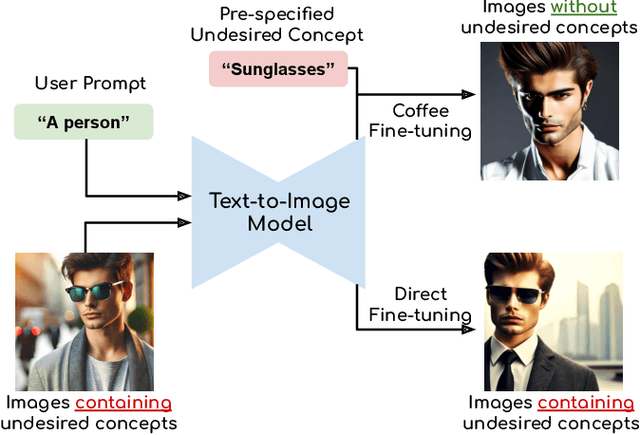
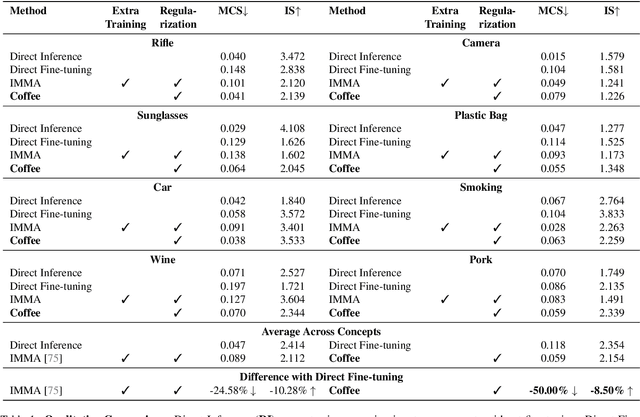
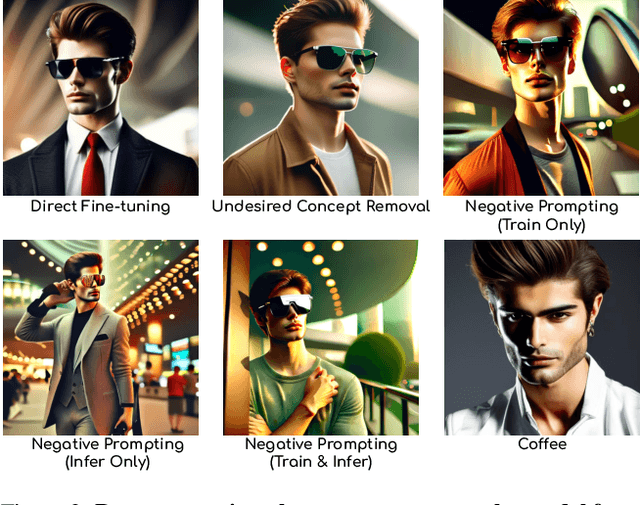
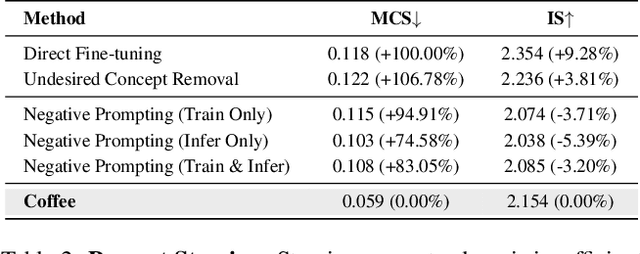
Text-to-image diffusion models can generate diverse content with flexible prompts, which makes them well-suited for customization through fine-tuning with a small amount of user-provided data. However, controllable fine-tuning that prevents models from learning undesired concepts present in the fine-tuning data, and from entangling those concepts with user prompts, remains an open challenge. It is crucial for downstream tasks like bias mitigation, preventing malicious adaptation, attribute disentanglement, and generalizable fine-tuning of diffusion policy. We propose Coffee that allows using language to specify undesired concepts to regularize the adaptation process. The crux of our method lies in keeping the embeddings of the user prompt from aligning with undesired concepts. Crucially, Coffee requires no additional training and enables flexible modification of undesired concepts by modifying textual descriptions. We evaluate Coffee by fine-tuning on images associated with user prompts paired with undesired concepts. Experimental results demonstrate that Coffee can prevent text-to-image models from learning specified undesired concepts during fine-tuning and outperforms existing methods. Code will be released upon acceptance.
Exploration of Class Center for Fine-Grained Visual Classification
Jul 05, 2024Different from large-scale classification tasks, fine-grained visual classification is a challenging task due to two critical problems: 1) evident intra-class variances and subtle inter-class differences, and 2) overfitting owing to fewer training samples in datasets. Most existing methods extract key features to reduce intra-class variances, but pay no attention to subtle inter-class differences in fine-grained visual classification. To address this issue, we propose a loss function named exploration of class center, which consists of a multiple class-center constraint and a class-center label generation. This loss function fully utilizes the information of the class center from the perspective of features and labels. From the feature perspective, the multiple class-center constraint pulls samples closer to the target class center, and pushes samples away from the most similar nontarget class center. Thus, the constraint reduces intra-class variances and enlarges inter-class differences. From the label perspective, the class-center label generation utilizes classcenter distributions to generate soft labels to alleviate overfitting. Our method can be easily integrated with existing fine-grained visual classification approaches as a loss function, to further boost excellent performance with only slight training costs. Extensive experiments are conducted to demonstrate consistent improvements achieved by our method on four widely-used fine-grained visual classification datasets. In particular, our method achieves state-of-the-art performance on the FGVC-Aircraft and CUB-200-2011 datasets.