 Add to Chrome
 Add to Firefox
 Add to Edge
Temporally Decoupled Diffusion Planning for Autonomous Driving
Mar 26, 2026
Motion planning in dynamic urban environments requires balancing immediate safety with long-term goals. While diffusion models effectively capture multi-modal decision-making, existing approaches treat trajectories as monolithic entities, overlooking heterogeneous temporal dependencies where near-term plans are constrained by instantaneous dynamics and far-term plans by navigational goals. To address this, we propose Temporally Decoupled Diffusion Model (TDDM), which reformulates trajectory generation via a noise-as-mask paradigm. By partitioning trajectories into segments with independent noise levels, we implicitly treat high noise as information voids and weak noise as contextual cues. This compels the model to reconstruct corrupted near-term states by leveraging internal correlations with better-preserved temporal contexts. Architecturally, we introduce a Temporally Decoupled Adaptive Layer Normalization (TD-AdaLN) to inject segment-specific timesteps. During inference, our Asymmetric Temporal Classifier-Free Guidance utilizes weakly noised far-term priors to guide immediate path generation. Evaluations on the nuPlan benchmark show TDDM approaches or exceeds state-of-the-art baselines, particularly excelling in the challenging Test14-hard subset.

Interpretable Motion Planner for Urban Driving via Hierarchical Imitation Learning
Mar 24, 2023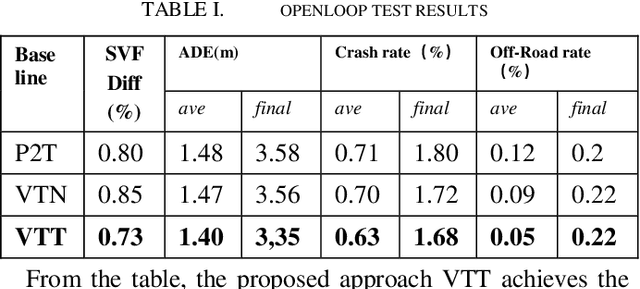
Learning-based approaches have achieved impressive performance for autonomous driving and an increasing number of data-driven works are being studied in the decision-making and planning module. However, the reliability and the stability of the neural network is still full of challenges. In this paper, we introduce a hierarchical imitation method including a high-level grid-based behavior planner and a low-level trajectory planner, which is not only an individual data-driven driving policy and can also be easily embedded into the rule-based architecture. We evaluate our method both in closed-loop simulation and real world driving, and demonstrate the neural network planner has outstanding performance in complex urban autonomous driving scenarios.