 Add to Chrome
 Add to Firefox
 Add to Edge
Extreme Meta-Classification for Large-Scale Zero-Shot Retrieval
Jun 23, 2026
We develop accurate and efficient solutions for large-scale retrieval tasks where novel (zero-shot) items can arrive continuously at a rapid pace. Conventional Siamese-style approaches embed both queries and items through a small encoder and retrieve the items lying closest to the query. While this approach allows efficient addition and retrieval of novel items, the small encoder lacks sufficient capacity for the necessary world knowledge in complex retrieval tasks. The extreme classification approaches have addressed this by learning a separate classifier for each item observed in the training set which significantly increases the representation capacity of the model. Such classifiers outperform Siamese approaches on observed items, but cannot be trained for novel items due to data and latency constraints. To bridge these gaps, this paper develops: (1) A new algorithmic framework, EMMETT, which efficiently synthesizes classifiers on-the-fly for novel items, by relying on the readily available classifiers for observed items; (2) A new algorithm, IRENE, which is a simple and effective instance of EMMETT that is specifically suited for large-scale deployments, and (3) A new theoretical framework for analyzing the generalization performance in large-scale zero-shot retrieval which guides our algorithm and training related design decisions. Comprehensive experiments are conducted on a wide range of retrieval tasks which demonstrate that IRENE improves the zero-shot retrieval accuracy by up to 15% points in Recall@10 when added on top of leading encoders. Additionally, on an online A/B test in a large-scale ad retrieval task in a major search engine, IRENE improved the ad click-through rate by 4.2%. Lastly, we validate our design choices through extensive ablative experiments. The source code for IRENE is available at https://aka.ms/irene.
* Accepted at KDD 2024, 20 pages

Do as I Do: Dexterous Manipulation Data from Everyday Human Videos
Jun 17, 2026How can we scalably generate data for robotic manipulation, especially on human-like platforms such as dexterous multi-fingered hands? Learning from human videos has recently emerged as a likely answer to this question. However, difficulties in estimating hand-object interaction and crossing the human-to-robot embodiment gap have hindered the adoption of abundant monocular RGB-only human videos as the primary source of robot manipulation data. In this work, we present DO AS I DO, an algorithm to reconstruct and retarget monocular RGB human videos to multi-fingered dexterous robotic hands. DO AS I DO reconstructs hand-object interactions from various egocentric and exocentric in-the-wild video sources. The algorithm then retargets these hand-object interaction estimates into a sequence of actions executable in the real world, yielding robot-complete manipulation data from disparate human videos. Overall, DO AS I DO outperforms previous state of the art in estimating hand-object interactions and extracting dexterous manipulation trajectories from RGB videos, as we show in experiments on datasets with ground truths and on a dataset of video clips collected online. Our experiments enable us to propose an efficacy playbook for practitioners collecting human data for manipulation.
CROSS-JEM: Accurate and Efficient Cross-encoders for Short-text Ranking Tasks
Sep 15, 2024Ranking a set of items based on their relevance to a given query is a core problem in search and recommendation. Transformer-based ranking models are the state-of-the-art approaches for such tasks, but they score each query-item independently, ignoring the joint context of other relevant items. This leads to sub-optimal ranking accuracy and high computational costs. In response, we propose Cross-encoders with Joint Efficient Modeling (CROSS-JEM), a novel ranking approach that enables transformer-based models to jointly score multiple items for a query, maximizing parameter utilization. CROSS-JEM leverages (a) redundancies and token overlaps to jointly score multiple items, that are typically short-text phrases arising in search and recommendations, and (b) a novel training objective that models ranking probabilities. CROSS-JEM achieves state-of-the-art accuracy and over 4x lower ranking latency over standard cross-encoders. Our contributions are threefold: (i) we highlight the gap between the ranking application's need for scoring thousands of items per query and the limited capabilities of current cross-encoders; (ii) we introduce CROSS-JEM for joint efficient scoring of multiple items per query; and (iii) we demonstrate state-of-the-art accuracy on standard public datasets and a proprietary dataset. CROSS-JEM opens up new directions for designing tailored early-attention-based ranking models that incorporate strict production constraints such as item multiplicity and latency.
Visual Representations of Physiological Signals for Fake Video Detection
Jul 18, 2022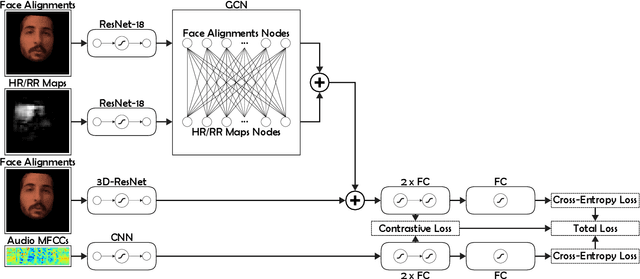
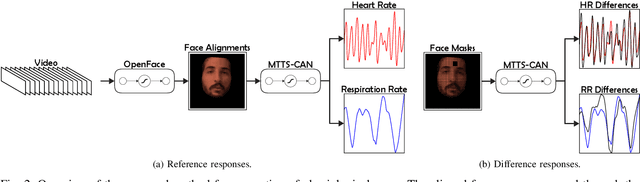
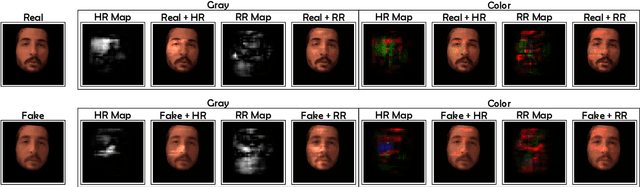
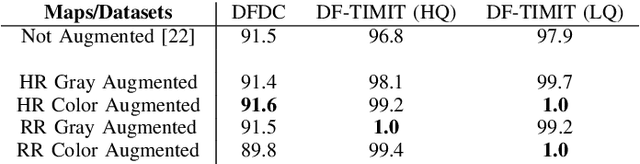
Realistic fake videos are a potential tool for spreading harmful misinformation given our increasing online presence and information intake. This paper presents a multimodal learning-based method for detection of real and fake videos. The method combines information from three modalities - audio, video, and physiology. We investigate two strategies for combining the video and physiology modalities, either by augmenting the video with information from the physiology or by novelly learning the fusion of those two modalities with a proposed Graph Convolutional Network architecture. Both strategies for combining the two modalities rely on a novel method for generation of visual representations of physiological signals. The detection of real and fake videos is then based on the dissimilarity between the audio and modified video modalities. The proposed method is evaluated on two benchmark datasets and the results show significant increase in detection performance compared to previous methods.
NGAME: Negative Mining-aware Mini-batching for Extreme Classification
Jul 10, 2022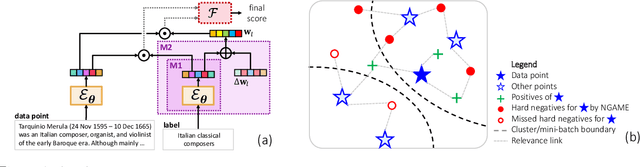
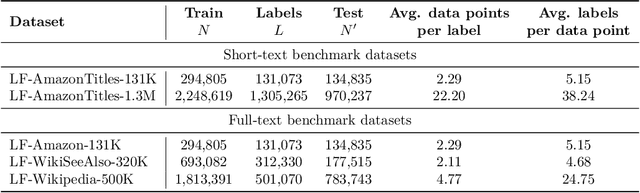
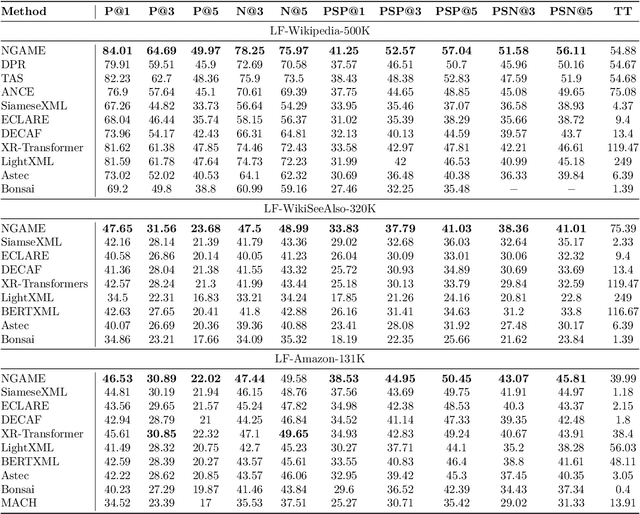
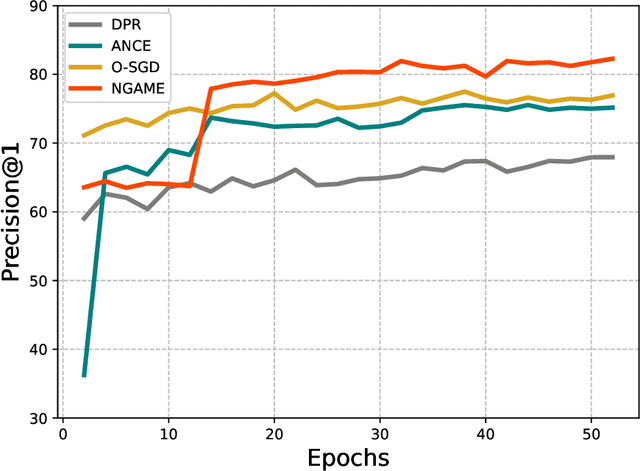
Extreme Classification (XC) seeks to tag data points with the most relevant subset of labels from an extremely large label set. Performing deep XC with dense, learnt representations for data points and labels has attracted much attention due to its superiority over earlier XC methods that used sparse, hand-crafted features. Negative mining techniques have emerged as a critical component of all deep XC methods that allow them to scale to millions of labels. However, despite recent advances, training deep XC models with large encoder architectures such as transformers remains challenging. This paper identifies that memory overheads of popular negative mining techniques often force mini-batch sizes to remain small and slow training down. In response, this paper introduces NGAME, a light-weight mini-batch creation technique that offers provably accurate in-batch negative samples. This allows training with larger mini-batches offering significantly faster convergence and higher accuracies than existing negative sampling techniques. NGAME was found to be up to 16% more accurate than state-of-the-art methods on a wide array of benchmark datasets for extreme classification, as well as 3% more accurate at retrieving search engine queries in response to a user webpage visit to show personalized ads. In live A/B tests on a popular search engine, NGAME yielded up to 23% gains in click-through-rates.